Wheaton Epoxy Flooring has spent more than 20 years on epoxy flooring in Wood Dale and the surrounding DuPage County suburbs, and on this page the conversation starts with paperwork rather than paint chips. A resin floor is a chemical product applied wet on site, and what is in the can decides whether it belongs in a given building as much as how hard it wears.
That matters more than usual when a project is chasing a green-building rating, where the coating has to arrive with its own documentation. It also matters on an ordinary garage or shop floor, because the VOC rules for floor coatings in Illinois bind the person who applies them, not only the company that made the product.
So every proposal we write names the product line, the number of coats and the finished thickness, and the data sheet behind that product is something we are glad to put in front of you. The sections below explain what those documents say and why we read them before anyone talks about color.
A LEED-Bound Data Center Campus in Wood Dale

Large new construction in a city tends to change what people ask about floors, and Wood Dale has a clear example. It shows how a rating system moves the floor-coating decision away from appearance and toward documentation.
CyrusOne’s Two-Building Campus
In May 2025, CyrusOne celebrated the topping out of its newest data center in Wood Dale: two buildings totaling more than 500,000 square feet, with an initial IT capacity of 18 megawatts. The company’s own release describes the campus as intended to be LEED certified, alongside drought-resistant landscaping.
We have no role on that project, and we have not seen its floor finishes, its product list or its credit scorecard. Whether its data halls are coated at all is not something we know. It is useful here only because it puts a familiar question on the map in Wood Dale: what does a rating system ask of a floor coating?
Who Earns LEED, and Who Doesn’t
LEED certification is pursued by a building project and awarded to that project. A coating is not LEED certified, and neither is the crew that applies it; no product or installer carries that label on its own.
What a coating can do is contribute documentation toward a credit the project is trying to earn. For floors, the relevant credit is the one covering low-emitting materials, and it is where a good-looking, hard-wearing floor can still turn out to be the wrong choice for the building.
On a rated project, the flooring submittal normally passes from the installer to the general contractor and on to whoever assembles the credit documentation. We ask early which documents that person wants and in what form, because a product swap late in a job can mean a new emissions report and a new VOC statement. When a manufacturer cannot produce the paperwork for the exact product, we treat that as the answer and move to a system that has it.
Looking for epoxy-flooring closer to Bensenville? See Epoxy-Flooring Services in Bensenville.
Why Bare Concrete Passes and a Coated Floor Needs Paperwork
The low-emitting materials credit treats a plain slab and a coated slab very differently. Understanding that split is the first step in choosing a product for any building that is tracking it.
The Exemption Ends at the First Coat
Under LEED v4, as summarized in a consultant’s guide to the credit, bare concrete counts as inherently non-emitting and is compliant without testing. That holds only while the concrete carries no integral organic-based coating, binder or sealer.
Once an epoxy, urethane or sealer goes down on site, the floor is no longer just concrete. The coating is now an interior wet-applied product, and the credit treats it like a paint applied to a wall, with its own documentation to supply.
The Emissions Test Report
The first document is a third-party emissions evaluation of the product, run to the California Department of Public Health standard method, commonly called the CDPH emissions test. It measures what the cured material gives off in a controlled chamber over a set period.
A manufacturer either has that report for a specific product or it does not. We ask for it by product name, because a report on a sister product in the same family does not cover the one being installed.
The VOC Content Statement
The second document covers VOC content, meaning the grams of volatile organic compounds per liter in the product as applied. The consultant summary says the credit measures this against SCAQMD Rule 1113 or the CARB 2007 Suggested Control Measure, both California rules.
The two documents answer different questions. One describes what the floor releases after it cures; the other describes what is in the can when it is mixed and spread. A product can do well on one and still lack the paperwork for the other, so we check both.
California’s VOC Limits Versus Illinois’ 250 g/L
The gap between the two states’ rules is where most of the surprises happen. A floor coating can be perfectly legal to put down in Wood Dale and still miss the mark the credit is using.
What Illinois Part 223 Sets
Illinois regulates architectural coatings under 35 Ill. Adm. Code Part 223, and the limit it sets for floor coatings is 250 g/L of VOC content. That rule binds the person applying the product, which is why we pick systems inside the Illinois limits for floor and industrial coatings on every job, credit or no credit.
Wood Dale sits in Addison Township in DuPage County, inside the Chicago ozone nonattainment area, and air quality here is overseen by the Illinois EPA. For a homeowner or a shop owner, the practical takeaway is simple: a solvent-heavy product bought online is not automatically legal to apply here.
Why Legal Here Can Still Fail the Credit
The California yardsticks the credit points to are stricter than the Illinois 250 g/L figure. A coating that sits comfortably under the Illinois limit may still land above the California number the credit uses, and it would fail the VOC content requirement even though nobody broke a law by applying it.
We do not quote the California number here, because the exact threshold should come from the current rule and the project’s own credit requirements rather than from a summary. What we do is read the product’s data sheet and VOC statement against whichever yardstick your project names, before the product is ordered.
When Nobody Is Tracking a Credit
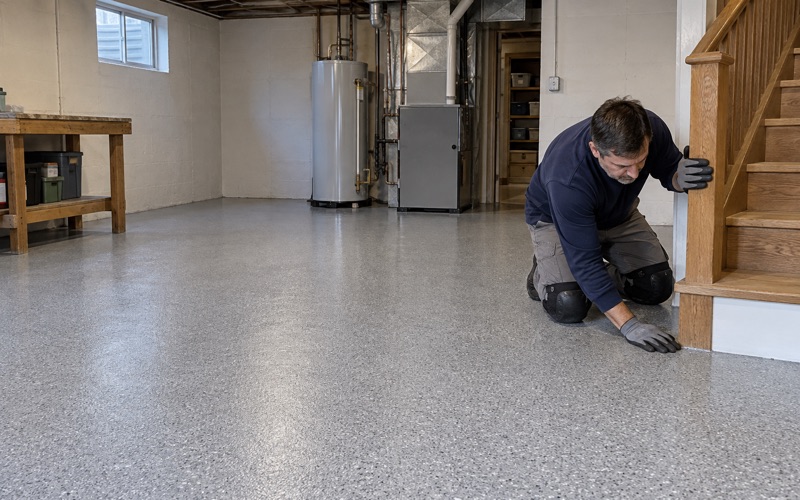
Most Wood Dale floors are not in a rated building at all. For them, the same habit still pays off: a low-VOC or 100% solids epoxy keeps the job inside Illinois rules, and a data sheet that states VOC content plainly is a sign of a manufacturer that documents its products well.
A 100% solids epoxy carries little or no solvent by design, which is part of why it is our default base coat. Polyaspartic and polyurea topcoats vary more from product to product, so their sheets get the closest read.
Choosing a Low-VOC System for a Wood Dale Garage or Shop
Whether the floor sits under a commercial tenant or a two-car garage, the order of decisions is the same. Documentation first, then the slab, then the finish.
Reading the Data Sheet Before the Color Chart
A product data sheet tells us solids content, VOC content as applied, recommended film thickness, recoat windows and chemical resistance. A safety data sheet adds what is in the mix, and the emissions report, where one exists, shows how the cured floor behaves.
We compare those sheets across candidate systems before a color is chosen, and the chosen product is named in the written proposal. That way the finished floor can be checked against the quote, coat by coat and mil by mil.
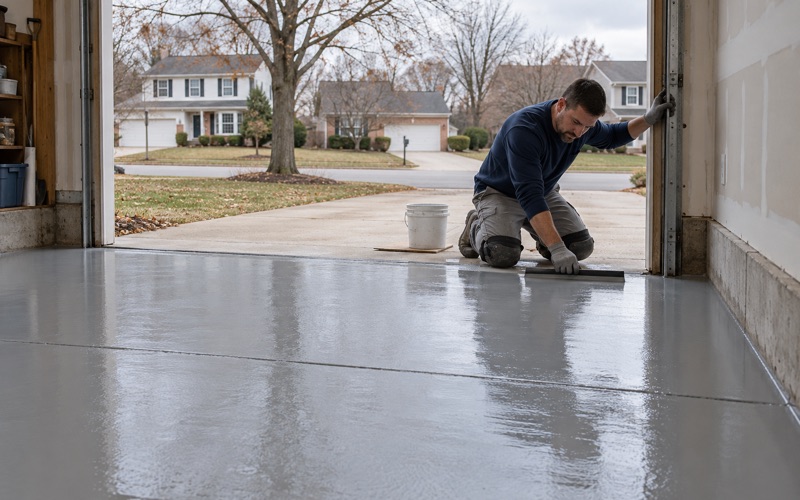
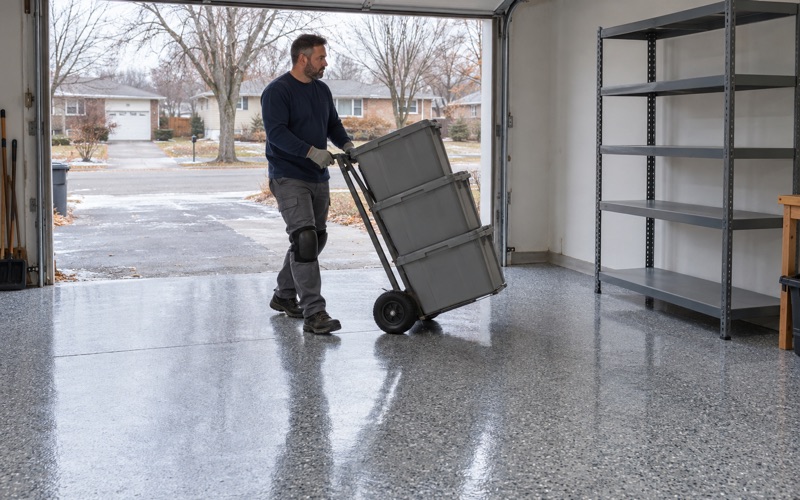
In a garage, the system also has to stand up to the brine and rock salt that ride in on tires all winter, and to hot tire pickup where cars park. A polyaspartic topcoat over a 100% solids epoxy base is a common answer, and its VOC line gets the same read as the base coat. Slip resistance comes from the vinyl flake or quartz aggregate broadcast and the topcoat locked over it, and we name both in the proposal rather than promising a texture in general terms.
Opening and Testing the Slab
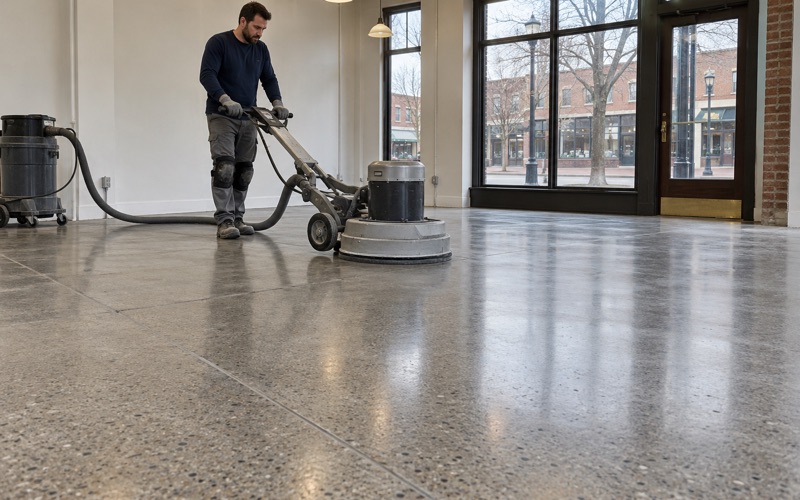
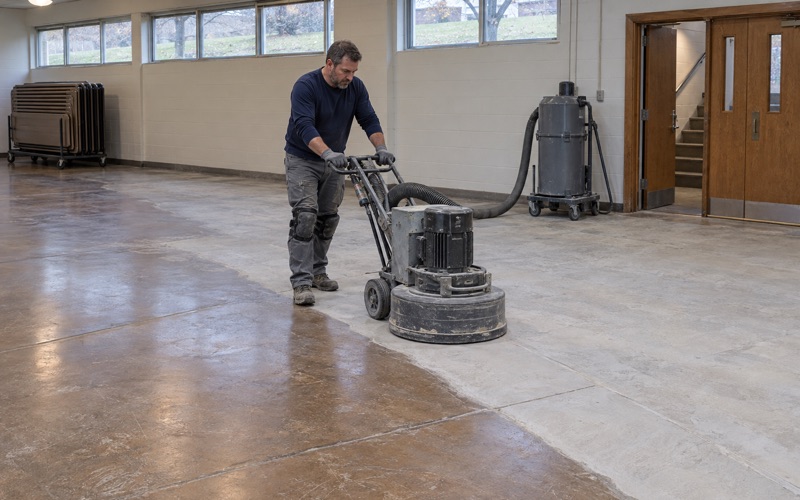
A low-VOC product still needs a sound, open surface to bond. We open every slab with a diamond grinder or a shot blaster, never an acid etch, to reach a concrete surface profile the system calls for, and the grinding dust is captured at the machine by vacuum rather than washed toward a drain.
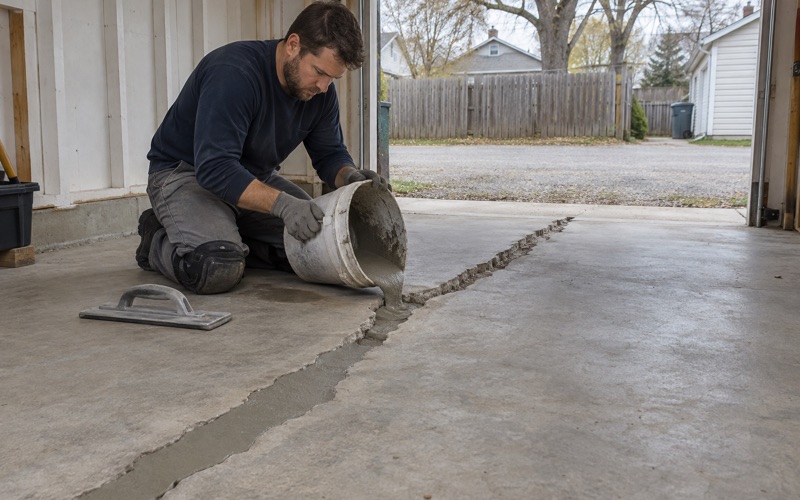
Moisture testing is part of the written scope before the price is final. Depending on the slab, that may be an ASTM F2170 in-situ relative humidity probe or ASTM F1869 calcium chloride testing, and a high reading can mean a moisture-mitigation primer, which has its own data sheet to read. Cracks, spalls and failed old coatings are mapped first, and if a slab needs repair before it should be coated, we say so.
Registration, Permits and the Contract
The City of Wood Dale requires contractors to register with its Community Development Department before a permit is issued, with a certificate of insurance carrying $2,000,000 in public liability coverage naming the city as certificate holder. We check registration and any permit question before a job is put on the schedule.
On home jobs over the state threshold, you receive a written contract and the Illinois Home Repair: Know Your Consumer Rights pamphlet before any grinding starts. We also explain what a coating warranty leaves out before the job is sold, and moisture vapor transmission is the first exclusion we name.
- 20+ Years in Business
- Moisture Tested Before Pricing
- Free Written Estimates