Wheaton Epoxy Flooring brings more than 20 years of epoxy flooring in Winfield to rooms where the floor has a job beyond looking clean. Some floors only ever see tires and boots. Others catch a solvent spill one week and a drip of hot wax the next, and those floors have to be planned around what lands on them.
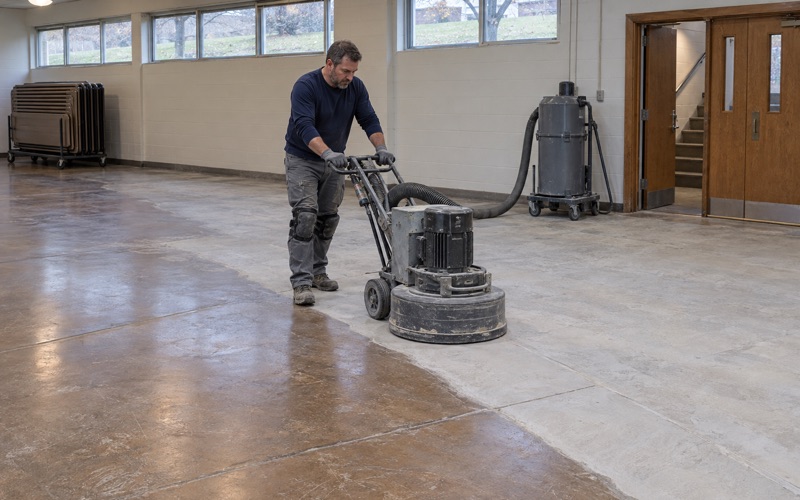
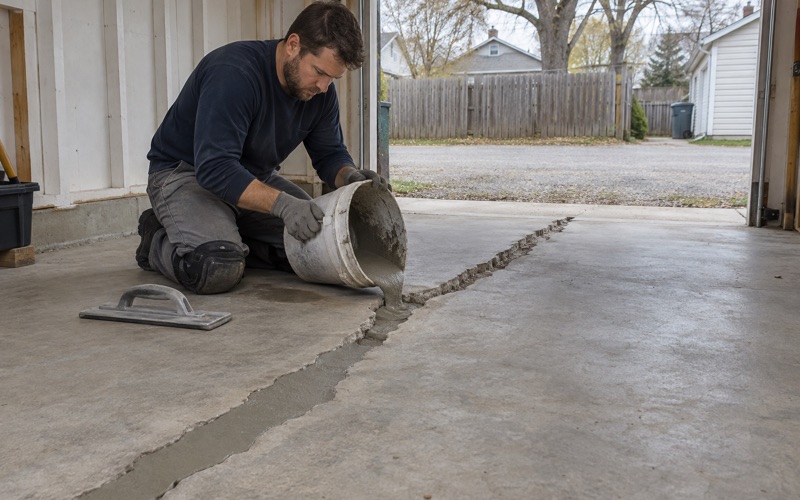
That planning starts with the slab itself. We open every floor with a diamond grinder or a shot blaster, never an acid etch, and we map cracks, spalls and old coatings before a price is set. A moisture test is written into the scope, and the proposal names the product line, the number of coats and the finished thickness, so the floor that goes down can be checked against the paper you signed.
This page walks through one demanding kind of room in detail: a laboratory floor where chemicals and melted wax are part of the routine. The same reasoning carries down to a home workshop or a garage corner where solvents get poured and wax gets melted, and that is where we finish.
A histology lab and the spill it has to plan for
Central DuPage Hospital sits inside the village, and its mapped coordinate falls in Winfield Township. Northwestern Medicine has posted histologist and histotechnician roles located in Winfield, including a full-time night shift running Sunday through Thursday, 10:30 p.m. to 7:00 a.m. Those postings describe the work as being “responsible for tissue processing and various slide preparations for anatomic pathology department.”
What a histology floor is asked to take
Histology is the bench work that turns a tissue sample into a stained slide a pathologist can read. A histology supplier’s spill-response guide lists the chemicals involved as running “from formalin and xylene to different stain reagents.” Formalin is a formaldehyde solution used to fix tissue, and xylene is a solvent, so a histology room handles both a regulated chemical and a volatile one.
We have no relationship with the hospital and have not been inside that lab, and nothing here describes its rooms or its floors. What we can describe is the job a floor does in a room like that. The same supplier tells labs to keep the correct neutralizing agents or absorbents on hand for each chemical in use, and every spill plan built around a bench and a cabinet ends at the floor when a container tips.
What OSHA’s formaldehyde rule says, and what it leaves out
The federal formaldehyde standard, 29 CFR 1910.1048, has a housekeeping section that applies to operations involving formaldehyde liquids. Paragraph (j)(2) says that in work areas where spillage may occur, the employer shall “make provisions to contain the spill,” decontaminate the area and dispose of the waste. Spills are to be cleaned promptly by trained employees in suitable protective equipment, and contaminated waste and debris go into sealed containers.
The rule never mentions floors, and it does not call for a coating of any kind. The connection to flooring is our own reasoning: a spill is easier to contain on a surface it cannot soak into, and easier to decontaminate where there are no seams for it to hide in. That is why we treat a lab floor as part of the containment rather than as the thing being protected.
Looking for epoxy-flooring closer to Warrenville? See Epoxy-Flooring Services in Warrenville.
Paraffin drips: let it cool, then scoop it off
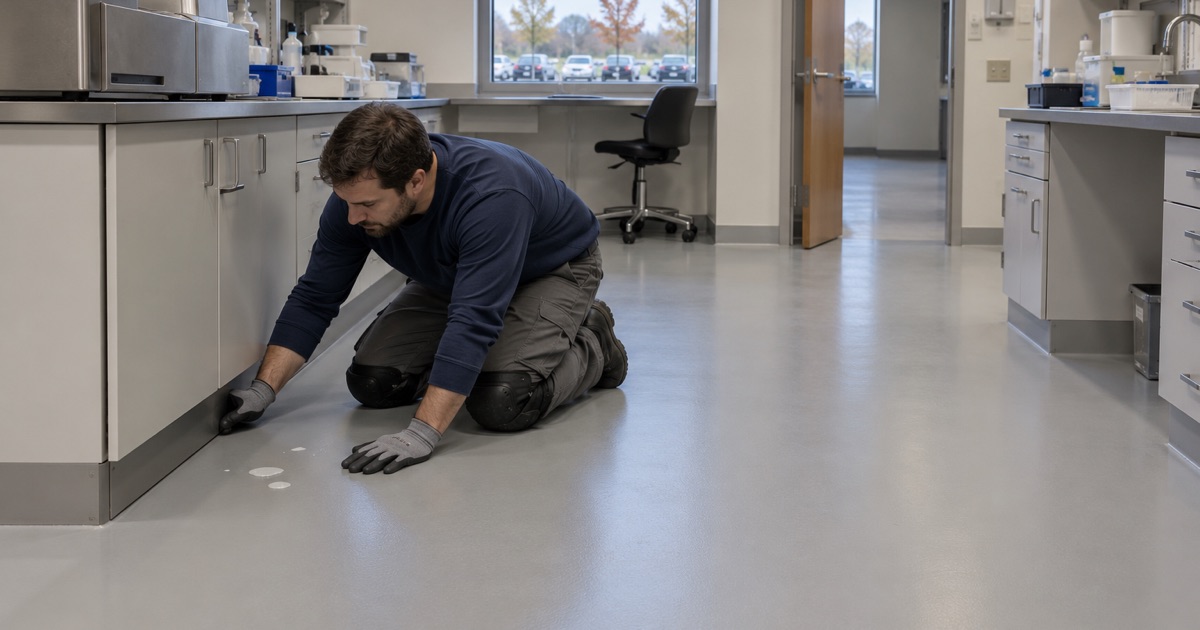
Paraffin is the other thing a histology floor collects. Tissue is embedded in molten paraffin wax at an embedding station, and molten wax drips. The Safety Data Sheet for Paraplast Tissue Embedding Medium, a paraffin product made for tissue embedding in a laboratory setting, gives the cleanup in plain words: “If wax is hot, let cool before initiating clean up.” It then says the wax may be collected “by carefully scooping into a pan, paper towel or other absorbent material.”
Why the topcoat has to take a scraper
That instruction puts an edge against the floor. Cooled wax gets lifted with a scraper or the lip of a pan, again and again, usually in the same few spots around the same station. A soft finish scuffs under that routine, and wax then packs into the scratches where the next scrape cannot reach it.
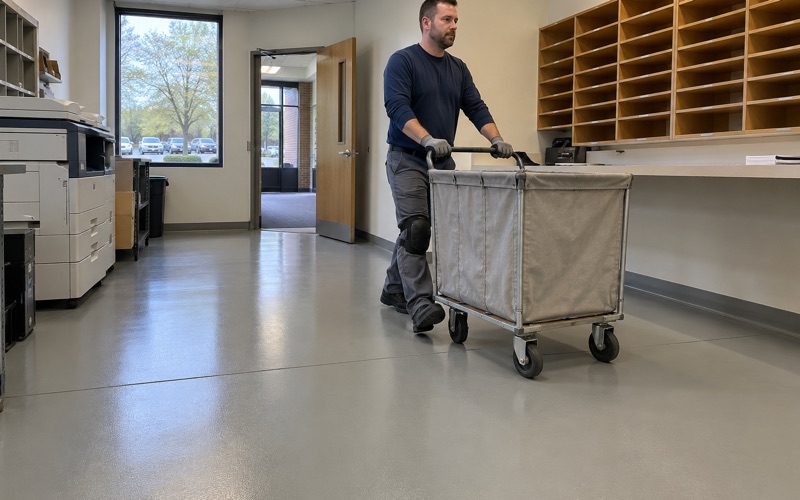
So the top layer of a lab floor is chosen for hardness. Over a 100% solids epoxy body coat, a polyaspartic or polyurea topcoat gives the scraper a hard, nonporous surface to ride on instead of cutting into. Our proposal states which topcoat goes down and at what thickness, so the facility can hold the finished floor to that specification.
Footing where wax lands
Wax on a floor is a slip hazard before it is a cleaning job. We specify slip resistance by the broadcast and topcoat actually used, usually a fine quartz aggregate locked under the final coat, rather than promising grip as a slogan.
There is a real trade-off to talk through. More texture means better footing and harder scraping, because cooled wax settles into the profile. Around an embedding station the answer is often a finer texture than a corridor or a loading area would get, and we set that zone by zone on the drawing.
Seamless, coved floors with nowhere for a spill to soak in
A spill plan usually fails at the edges. Tile grout, sheet vinyl seams and the gap where a floor meets the wall are where formalin or xylene can travel under a surface and stay there, out of reach of any decontamination. A resin floor is poured and troweled as one continuous surface, which removes most of those paths before anything spills.
The integral cove at the wall
The last path is the wall line, and we close it with an integral cove. The coating turns up the wall in a formed radius made from the same resin system as the floor, so floor and base are one piece with no joint between them. A spill pools against the cove instead of wicking behind a rubber base, and it is wiped from the same surface it landed on.
Cove work is handwork, troweled along every wall, casework base and column. We price it as its own line by linear footage, apart from the floor area, so the scope shows exactly how much of the room is being turned up and to what height.
Choosing a system for solvent exposure
A floor in a room that handles xylene and stain reagents has to stay intact under them, so we confirm the system against the chemicals the facility actually names before we quote it. Resistance alone is not the argument, though. A floor can resist a solvent and still let it seep through a crack, which is why mapping and repairing the slab comes before any product choice.
The slab underneath matters as much as the resin on top. We test moisture by ASTM F2170 in-situ relative humidity probes or ASTM F1869 calcium chloride testing, because vapor pushing up from below lifts a coating no matter how well it handles what falls from above. When the readings call for it, a moisture-mitigation primer goes into the scope, and we say so before the price is final.
Working around a lab that never fully closes
A department with a posted overnight shift is not a room that can empty out for a week. We phase clinic and laboratory floors around operating hours, with overnight and weekend windows when a space cannot close, and grinding dust is captured at the machine by vacuum rather than drifting into an occupied building. Cure schedules follow slab temperature and the dew point spread at the slab surface, not the calendar.
Permit questions go to the Village of Winfield building department at 27W465 Jewell Road. Fire code questions go to the Winfield Fire Protection District, which is a separate special district rather than a village department, so we check with both before a schedule is fixed.
Wax, solvents and spills on Winfield garage and basement floors
Most floors we coat in Winfield are not in a hospital. They are garages and basements where somebody refinishes furniture, waxes skis, makes candles or keeps a can of mineral spirits under the bench. The lab’s two rules scale down neatly: contain the spill, then let the wax cool and scrape it off a surface that can take it.
Clean before you coat
A workbench corner with years of drips is the hardest part of a home slab to coat. Trade guidance is blunt that putting a coating over concrete contaminated with grease, oil, paint or wax guarantees a failure, and that oil-stained areas must be degreased and the surface profiled before an epoxy will bond.
So we degrease that corner, grind it to a fresh profile and look again before anything is mixed. If the stain has gone deep enough that grinding will not reach clean concrete, we say so and talk through repair options rather than coating over it and hoping.
A home floor that cleans like a lab floor
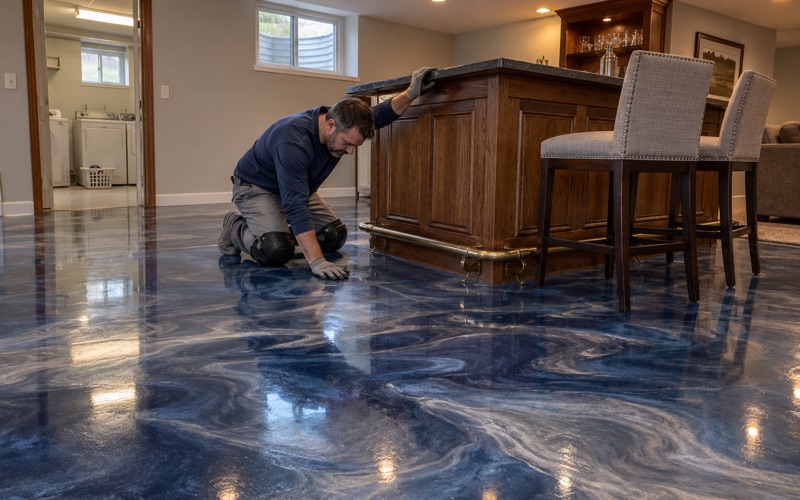
Once the slab is clean, the same choices work at home. A hard polyaspartic topcoat over a vinyl flake broadcast lets cooled wax pop off with a plastic scraper, and a short cove behind a workbench keeps spilled solvent from creeping under the base trim. Wipe solvent spills promptly with the garage door open, and let any hot wax set before touching it.
Garage systems here also have to hold up to the brine and rock salt that ride in on tires all winter, and our products stay inside the Illinois VOC limits for floor coatings. Basements get read for past water first. The DuPage River runs through the village, and a coating does not stop seepage or sewer backup, so we tell you before the job is sold when moisture is the first thing a warranty leaves out.
- 20+ Years in Business
- Moisture Tested Before Pricing
- Free Written Estimates