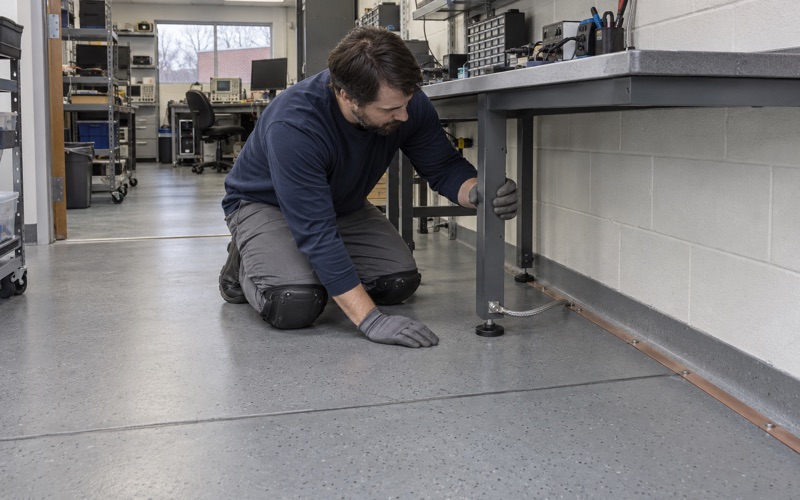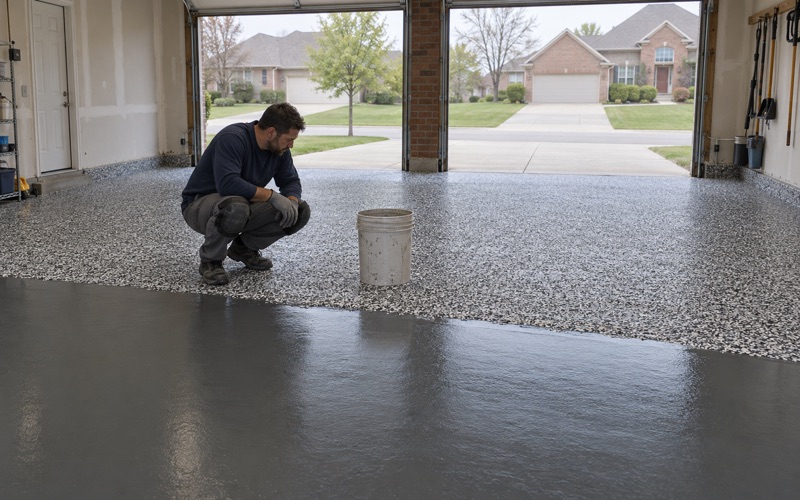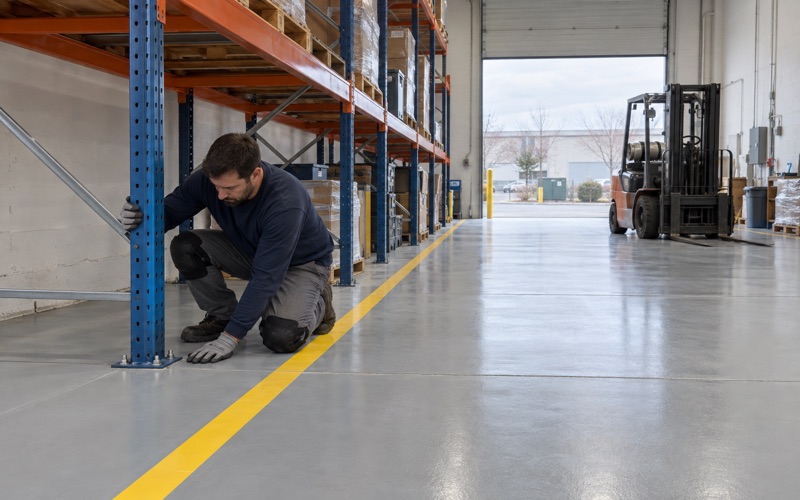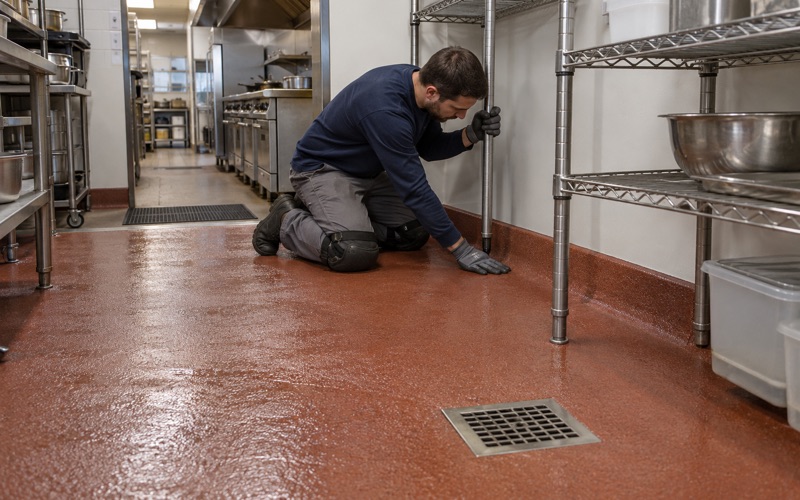
Wheaton Epoxy Flooring has spent more than 20 years on epoxy flooring in Warrenville and the rest of DuPage County, and the jobs that teach us the most are rarely the empty ones. A bare slab is the easy case. The harder floor is the one with something fastened to it: rows of seating, a bolted bench, a run of steel shelving, a workbench lagged into the concrete.
That is where a coating project quietly turns into a furniture project. Whatever is anchored has to come up, the slab has to be ground and coated around the holes it leaves, and the fixture has to go back down without cracking the surface we just built. If nobody decides how that happens before the first coat, someone decides it on the day, usually with a drill.
So our walk-through counts fasteners before it counts square feet. We map cracks, spalls and old coatings, take a moisture reading that goes into the written scope, and list every fixed item with a plan for how it leaves the room and how it returns.
A Flooring Job That Grew Into a Church Renovation
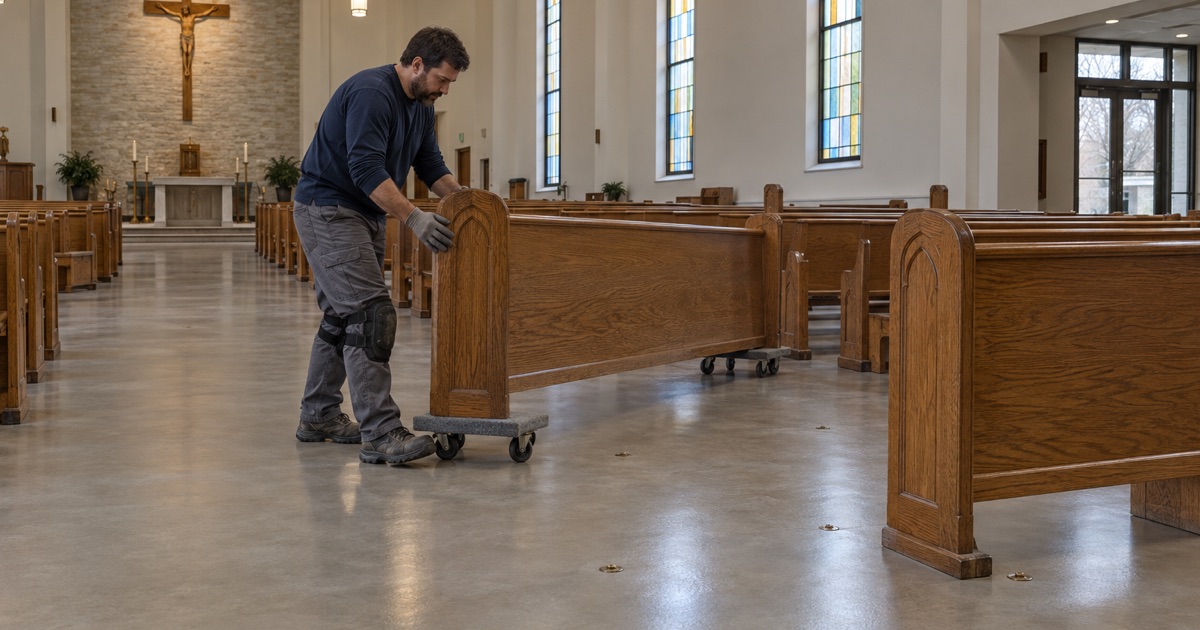
St. Irene on Warrenville Road
In January 2026 the Daily Herald reported that St. Irene Catholic Church, at 28W441 Warrenville Road, would close its church from January 12 to March 28 for renovation work. Daily and weekend Mass moved to the parish’s former church on the same campus, a building from the early 1930s that now serves as its multipurpose space. The stated aim was to reopen in time for Holy Week.
The work is part of a $540,000 campaign called Christ at Our Center, and it covers new flooring, restored pews with kneelers, a sound system and a new crucifix. The pastor, Rev. Gregory Rothfuchs, described it as something that began as a flooring job and grew into a broader update aligned with Diocese of Joliet guidelines. We had no part in that project, and we have not seen what floor went down or how the pews were set back.
Why the Floor Became Pew Work
What the reporting shows is how a floor in a room full of fixed seating behaves as a project. You cannot lay a new surface under a pew that is still standing on the old one. The seating has to be lifted, stored and brought back, and once it is off the floor, the condition of each pew and kneeler is suddenly on the table too.
That is a pattern we see well beyond churches. Any room built around rows that are fastened down, whether a chapel, a lecture space or a meeting hall, carries the same chain of decisions. The floor sets the schedule, but the seating sets the scope.
Looking for epoxy-flooring closer to Hinsdale? See Hinsdale Epoxy-Flooring.
Fixed Seating Turns a Floor Into a Furniture Job
Label, Loosen, Lift
Artech Church Interiors, a contractor that works on church interiors, writes that pews need to be moved three times during a hardwood floor installation. It also warns that general installers may lack the knowledge to label, loosen and move pews without damage. That is one firm describing wood floors in its own marketing, not a code or an industry standard, but the sequence carries straight over to a resin floor.
For a coating, labeling means every row gets a position before it moves, so it returns to the same spot and the same fastener locations. Loosening means freeing the anchors without tearing them out of the concrete. Lifting means the rows travel to a space where they will not be bumped, stacked badly or set on a surface that is still curing.
Anchors: Concealed Fasteners Versus L-Brackets
The same contractor notes that some pews use a concealed anchor system rather than L-brackets, and that installers who swap in exposed L-brackets leave holes in the new floor that did not need to be there. On a resin system that matters more than it sounds. Every fresh hole is a break in a membrane that was meant to be continuous, and each one is a spot where water, cleaning solution or salt can reach the slab underneath.
Our practice is to settle the anchor plan before we grind. If the existing fasteners will be reused, we mark and protect those locations so the coating builds up around them cleanly. If anchors are changing, we would rather set the new positions first and coat to them than drill through a finished surface afterward.
What the Proposal Names
Our proposal lists the product line, the number of coats and the finished thickness, so the floor can be checked against the quote once the seating is back. When fixed items are involved, it also names which anchors are being reused, which are being abandoned and filled, and who handles the lifting. A proposal that leaves those lines blank is how a room ends up with surprise holes.
Setting Rows Back Down on a Floor That Is Never Level
Why a Reset Row Wobbles
Artech puts the problem plainly: no floor is perfectly level, and a pew reinstalled in the wrong place can wobble and crack a new floor. A row of seating has feet at fixed spacing. Set it back over a different patch of concrete and one foot can sit a fraction high, so the whole row rocks on a single point every time someone kneels or stands.
On a coated slab that rocking concentrates load on a small area of a thin surface. A hard coating can chip at the edge of a foot, and the chip becomes a starting point for peeling. That is a strong argument for returning every row to the exact spot it came from, which is why labeling matters so much.
Reading the Slab Before It Is Coated
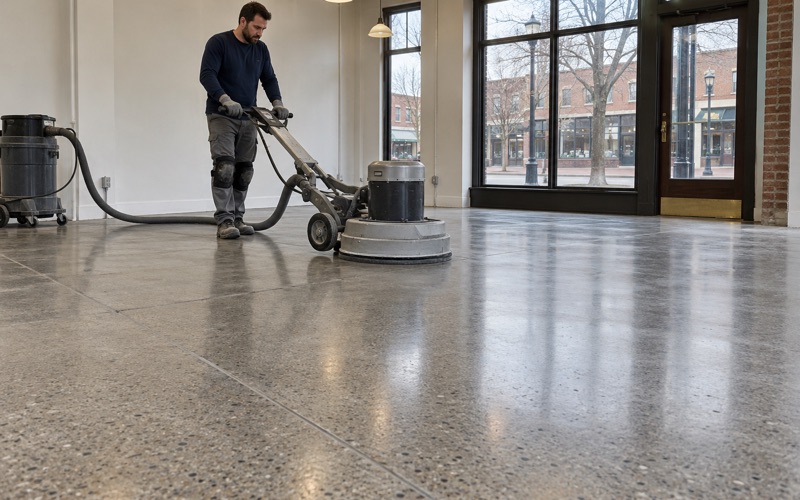
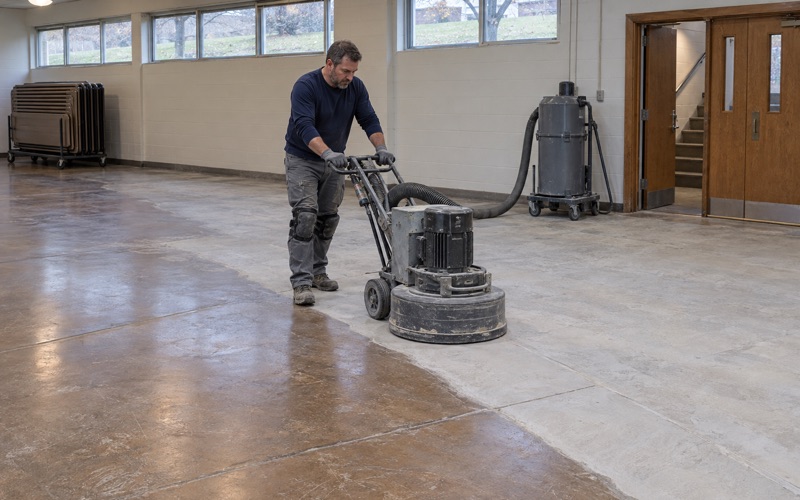
The slab itself is the other half of the problem. We open every floor with a diamond grinder or shot blaster, never an acid etch, which gives the coating a real profile on the ICRI CSP scale and lets us see high spots, low spots and old patches clearly. Where a slab dips under a row, we fill and level it before the first coat rather than shimming the furniture later.
We also test for moisture before the price is final, using methods such as ASTM F2170 relative humidity probes or ASTM F1869 calcium chloride tests. Moisture is the first exclusion we name on any coating warranty, and a basement or slab with a history of water is read before anything is quoted.
Timing the Return
A floor that can be walked on is not yet a floor that can carry a pew pressed down at a few points. We schedule the reinstall against cure, and cure follows slab temperature and dew point rather than a date on a calendar. For a space that has to keep running, we phase work around services and opening hours, with overnight and weekend windows where a room cannot close.
In Warrenville the city’s permit page lists flooring among work that does not need a building permit, but commercial and institutional buildings still answer to the Warrenville Fire Protection District for building and occupancy permits. Moving fixed seating in an assembly room is worth raising with that office before the schedule is set.
Bolted Benches, Shelving and Workbenches at Home
The Garage Version of the Same Problem
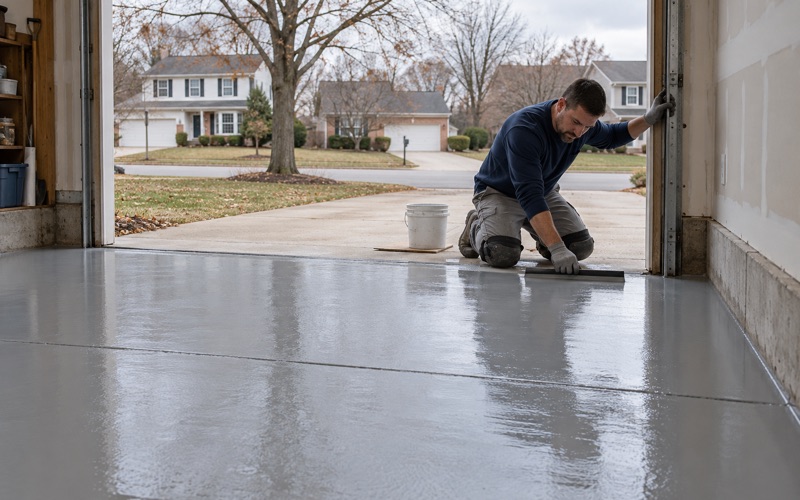
Most Warrenville owners will never move a pew, but plenty have a workbench lagged into the garage slab, a storage system screwed to the floor or a heavy bench bolted near the door. The question is identical: does it come up before the coating, or does the coating stop at its edge? Coating around a fixture leaves a raw strip of concrete underneath that collects salt, oil and moisture, and that seam is often where peeling starts.
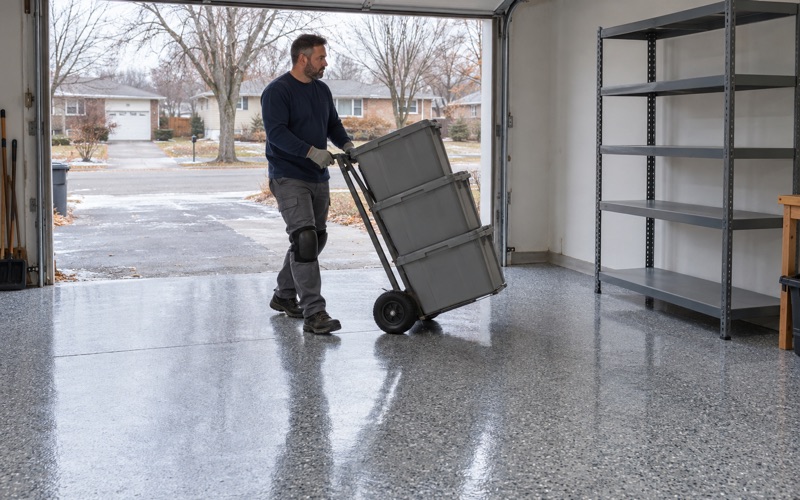
We would rather lift the item, grind and coat the full slab, and then reset it with fresh fasteners into sound concrete. Where an item truly cannot move, we say so in writing and detail the edge so it is sealed rather than feathered out to nothing. Garage systems here are chosen to stand up to the brine and rock salt that ride in on tires all winter, and that edge is where the salt goes first.
Townhome Garages and Shared Slabs
Warrenville has a lot of attached housing, with 1,612 single-family attached units making up 26.8 percent of the stock. A garage in that stock often shares a wall, and sometimes a slab edge, with the neighbor. Before we drill out an old anchor or set a new one, it is worth knowing where the shared edge runs and whether an association has rules about contractors, hours or the exterior.
Basements, Shelving and Sump Areas
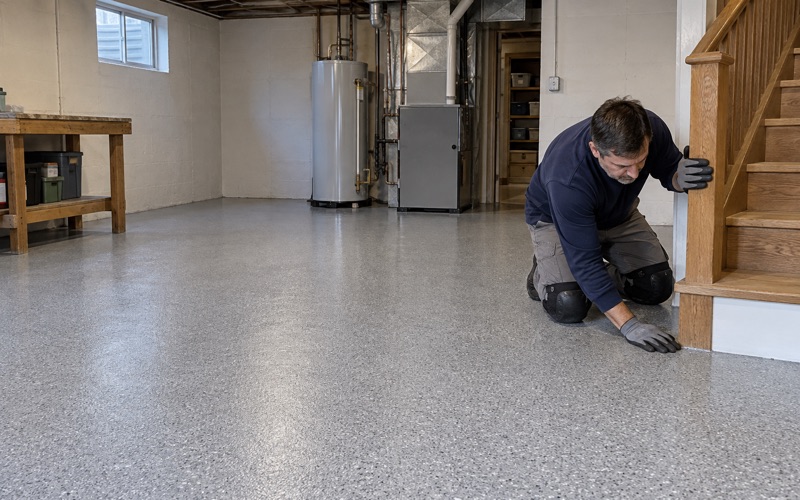
Basement shelving bolted to the floor raises a second issue, because a basement slab is the one most likely to carry water history. A coating does not stop sewer backup or seepage, so we look for past water before we decide what gets anchored where. Grinding dust is captured at the machine with a vacuum rather than washed toward a floor drain.
When the floor is ready, anchors go into cured coating with clean, sealed holes, and anything heavy is set back where it was mapped. It is the same discipline a church floor needs, applied to a workshop: plan the fasteners first, and the new surface does not have to be drilled through to finish the job.
- 20+ Years in Business
- Moisture Tested Before Pricing
- Free Written Estimates