Wheaton Epoxy Flooring has more than 20 years behind it, and the epoxy flooring in Summit we plan most carefully is the kind that has to hold still. A garage that keeps a motorcycle parked on its side stand from fall to spring asks something different of a coating than a floor that sees a car roll in and out twice a day.
Our work starts with the slab rather than the color chart. Every floor is opened with a diamond grinder or a shot blaster instead of an acid etch, and a moisture test is written into the scope before we settle on a price.
From there the question is what the floor will carry and for how long. Below we walk through why a season of parked bikes changes the coating plan, what belongs under a kickstand, and how one bike stored in a home garage follows the same rules.
Seven Months of Parked Motorcycles on Harlem Avenue
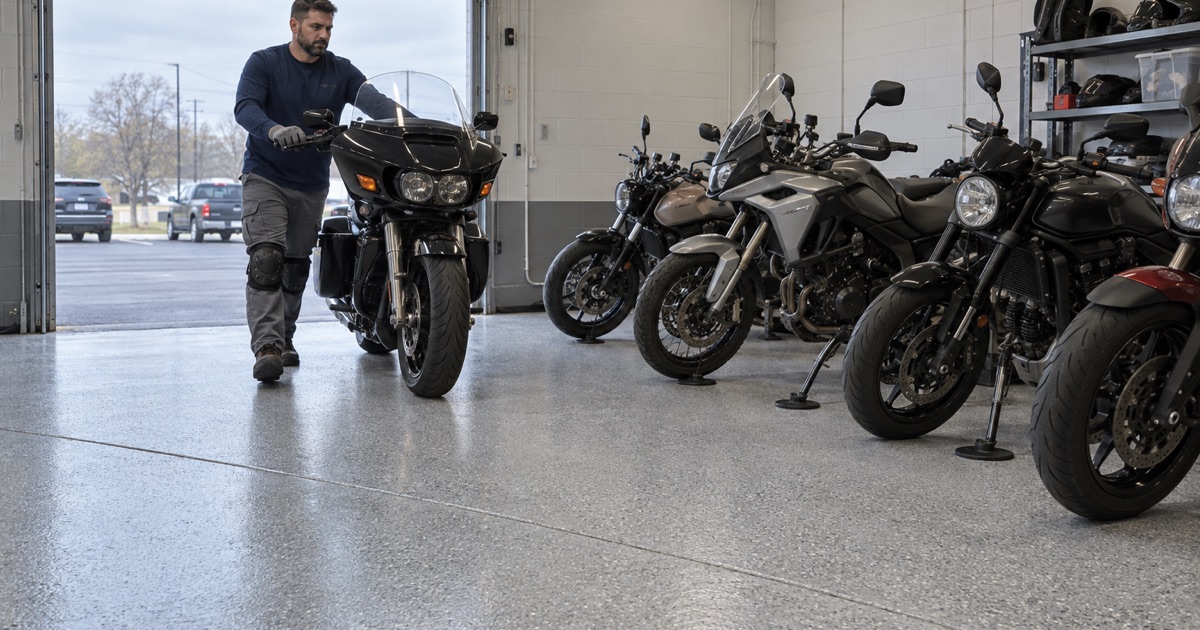
A Heated Winter Storage Room
Cycle Tech, a motorcycle repair shop at 5824 South Harlem Avenue that has served riders since 1989, offers winter storage from October 1 to May 1, longer if needed. Its storage page describes a heated, secured facility, with Stabil added to each fuel system and a test ride performed before a bike goes home. Standard-size motorcycles are listed at $305 for the season and touring-size bikes at $350.
We have no connection to the shop, and we have not seen how it parks bikes or what its floor is. We mention it because it puts plain dates on a kind of floor use that many Summit garages share on a smaller scale: a vehicle that arrives in the fall and does not move until spring.
Why a Still Load Is Different
A car floor sees traffic, hot tires and the occasional scuff, but the load keeps moving. A stored motorcycle sits in one place, and the parts of it that touch the floor press on the same few square inches every day for seven months. A room full of stored bikes multiplies those spots, each one a small, fixed load that never shifts until the season ends.
That is the pattern a coating has to be planned around, in a storage room and in a home garage alike. The real question is not whether a floor can handle a weekend of parking but whether the topcoat under a small steel foot is still smooth when the bike rolls out in May.
The Permit Desk in Lyons Township
The shop’s address geocodes inside the Village of Summit, in Lyons Township, Cook County. Floor work in the village answers to Summit’s own Building and Public Works department at the municipal center on West 59th Street.
We check registration and permit questions for each job before it goes on the calendar, not after the grinder is unloaded. That way the schedule we hand an owner is one the village has no reason to interrupt. It also means the cure window we plan around the bike’s parking date is not cut short by a stop-work notice halfway through the job.
Looking for epoxy-flooring closer to Justice? See Epoxy-Flooring Services in Justice.
A Kickstand’s Small Steel Foot, and the Wrong Pad
Part of the Weight on a Few Square Inches
A side stand, the kickstand most riders rely on, carries a portion of the motorcycle’s weight on a foot only a few square inches across. A patent for a kickstand accessory, granted in 2010, notes in its background that a deployed stand can leave an imprint in asphalt on a warm day. Concrete does not soften that way, but a coating sitting on concrete is a thinner and softer layer than the slab beneath it.
Motorcycle owners on garage forums report side stands scratching or marking epoxy floors, and one described a coating pushed aside under a parked bike with no dragging at all. These are owner accounts rather than tests, and others answer that the tires carry most of the weight and that poor prep or an uncured topcoat explains most failures. We read both sides as pointing at the same place: the topcoat and its cure.
Why a Metal Pad Is the Wrong Pad
The same patent states that existing kickstand pads are typically made from metal and easily mar finished surfaces. A metal plate spreads the load, but it sets a hard edge against a gloss topcoat, and any grit trapped beneath it turns into an abrasive each time the bike shifts.
A non-metal pad or puck does the spreading job without that edge. One forum owner warns that some pucks can be slippery on a glossy epoxy floor, so we suggest a kickstand pad with some grip on its underside, or a cut piece of mat material, over a bare plastic disc. Whatever the pad is, it should be wiped clean and set on a clean floor, because grit under a soft pad still scratches.
What a Coating Cannot Promise
No floor coating is immune to a kickstand, and we do not sell one as though it were. What a properly prepared, fully cured system does is resist marking under ordinary parking, while a pad under the stand handles the rest.
That is also why we explain what a coating warranty leaves out before a job is sold. Moisture is the first exclusion we name, and we talk through how the product’s terms treat a concentrated load such as a stand foot so nobody learns it in the spring.
Full Cure, Stand Pads, Chocks and Walking Bikes In
Full Cure Before the Season’s Load
A topcoat that feels dry underfoot may still be days from its full hardness. Polyaspartic and polyurea topcoats and 100% solids epoxy each follow their own cure schedule, and parking a bike on its stand before that schedule is met is the shortcut owners on those forums most often blame for a marked coating.
We set cure times by slab temperature and the dew point spread at the slab surface, not by the calendar. When a floor is being coated ahead of an October parking season, we schedule backward from full cure rather than from the day the bike needs to go in, and an unheated garage that has already turned cold is told to wait.
Chocks, Center Stands and Pads
Where a bike has a center stand, or the owner uses a wheel chock, the load rests on the tires and a broader base rather than one small foot. Where the side stand is the only option, a non-metal pad goes under it every time the bike is parked, not only over the winter.
Wheel chocks are often heavy steel themselves, so we suggest a rubber mat under the base of one as well. The aim is that nothing metal sits directly on the topcoat for months at a time. If the floor carries a broadcast texture for slip resistance, we specify it by the flake or quartz broadcast and the topcoat over it, so a pad still sits flat and the surface stays easy to sweep around a parked bike.
Walk It In on Its Tires
Owners on garage forums describe stands digging in when a parked bike is rolled backward or rocked on a deployed stand. A stand dragged across a coating is a different load from one that is set straight down, and it can mark a floor that never showed a problem from parking alone.
The habit is simple: walk the bike into position on its tires, then lower the stand onto its pad. Bringing it out in spring is the same in reverse, with the stand up first and the bike rolled second. A quick look at the pad and the floor beneath it in May tells an owner whether the spot needs anything before next fall.
One Touring Bike in a Summit Garage, October to May
The Home Garage Version
Most Summit riders are not renting space in a storage room; they are clearing a corner of their own garage. Owner-occupied single-family detached homes account for 1,795 of the village’s units, and a bike wintered in one of those garages faces the same seven-month question at the scale of a single stand foot.
A touring bike is the heavy case, which is why seasonal storage pricing separates touring models from standard ones. On a home floor we plan as if the heaviest bike in the household will sit on its side stand all winter, and we agree on its parking spot and its pad before the coating goes down. Knowing where the stand will land lets us give that part of the floor extra attention during prep instead of guessing afterward.
Grinding, Not Etching
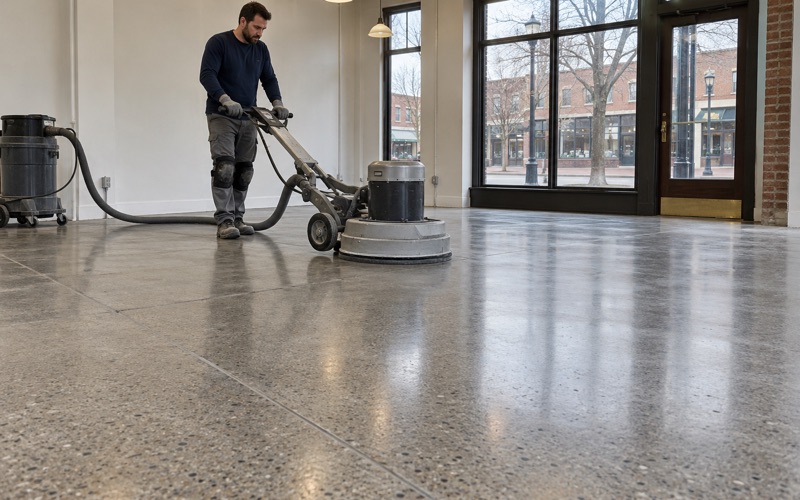
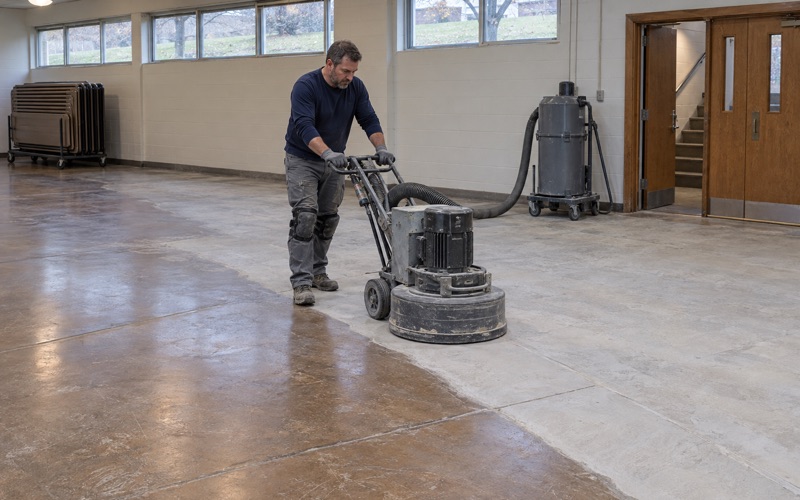
A coating that lifts under a stand often never gripped the slab well to begin with. We open every floor with diamond grinding or shot blasting to a measured profile on the ICRI CSP scale, and the dust is captured at the machine by a vacuum instead of being rinsed toward a drain.
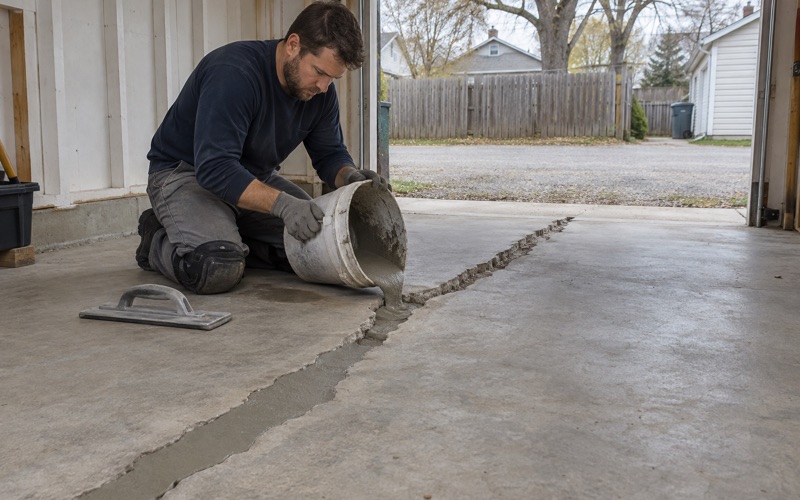
Cracks, spalls and old coatings are mapped before any of that starts. If the slab under the bike’s spot needs repair, or the whole floor should be replaced before it is coated, the proposal says so plainly. A patched spall directly under a stand foot is the last place a weak repair should hide.
Moisture and an Older Slab
Summit’s housing stock largely stopped growing after the 1970s, so nearly every garage floor we see here is an existing slab rather than a new pour. Moisture testing, such as ASTM F2170 relative humidity probes or an ASTM F1869 calcium chloride test, is part of the written scope before the price is final. A slab pushing vapor from below can soften the bond under a coating, and a stand foot pressing on that same spot all winter is where it tends to show first.
The proposal then names the product line, the number of coats and the finished thickness. That lets an owner hold the floor that went in against the floor that was quoted, right down to the topcoat that will sit under a stand pad from October to May.
- 20+ Years in Business
- Moisture Tested Before Pricing
- Free Written Estimates