Wheaton Epoxy Flooring has spent more than 20 years on epoxy flooring in River Grove and the surrounding suburbs, and the jobs that teach the most start on concrete that already carried another floor. When tile comes up, the slab underneath is rarely bare. It holds whatever the removal left behind, and that leftover layer decides whether a resin coating bonds for years or lets go in patches.
Our first visit is a reading of the slab, not a sales pitch. We map cracks, spalls, patches and any old coating or adhesive, run a moisture test that is written into the scope before the price is final, and tell you plainly when the concrete needs repair, testing or replacement before it should be coated. Some of those answers end the job for us, and we would rather say so than coat over a problem.
This page is about one question that comes up whenever an old floor is removed: what is still on the concrete, and will a coating manufacturer stand behind a system laid over it. The answer shapes everything from surface preparation to the warranty, so we settle it before anyone looks at color charts or flake blends.
A Whole-School Floor Project on Thatcher Avenue
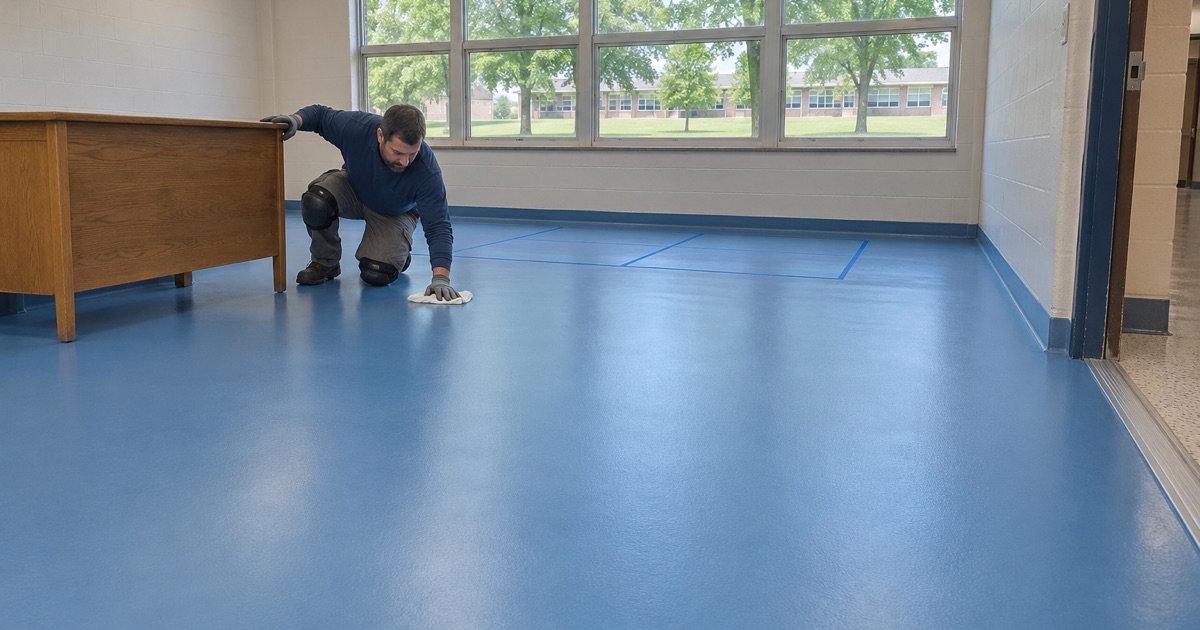
One School, One Summer
River Grove is a village in Leyden Township, Cook County, with 10,612 residents at the 2020 census. River Grove School District 85.5 runs a single K-8 school, River Grove School on Thatcher Avenue, so when that building changes its floors, the whole district’s floors change at once.
The superintendent’s message for the 2025-26 school year described a summer project of asbestos abatement followed by new flooring in almost the entire school. The gym floor and part of the library were left out. Abatement began May 27, affected areas stayed closed until removal was finished, classrooms were packed out and offices were relocated, with new floors expected when school resumed in August.
What the District Reported Afterward
The district’s message for the following year said that over the summer almost the entire school enjoyed a flooring refresh, with brighter and more colorful flooring in the hallways, classrooms, offices and larger spaces. An earlier message had reported the second phase of an interior project, which brought new ceilings and LED lights throughout the building.
We had no part in that work, and the district’s messages do not say which old materials were removed or what the new floors are made of. What the project does show is the order a careful owner follows. Abatement comes first, done by the people licensed to do it, and only then does a new floor go down over the slab that remains.
Why a School Project Matters to a Coating Buyer
A school is a large version of the question every building owner faces when an old floor comes out. The finished surface everyone admires in August depends on the condition of concrete nobody sees after May.
For a resin floor the stakes are higher than for most coverings, because epoxy and polyaspartic systems bond directly to the slab rather than resting on a fresh adhesive bed. Whatever is left on the concrete becomes part of the bond line, for better or worse, and no topcoat can fix a weak layer underneath it.
Looking for epoxy-flooring closer to Forest Park? See Epoxy-Flooring in Forest Park.
After Abatement: What Is Still on the Concrete
Old Cutback Adhesive Is Presumed to Contain Asbestos
Armstrong flooring guidance, published through the AHF FloorExpert knowledge base, notes that some previously manufactured asphaltic cutback adhesives contained asbestos. Its instruction is to presume existing adhesive is asbestos-containing unless testing confirms otherwise, and never to dry-scrape it or use similar methods.
That presumption changes who takes the first step. We are not an asbestos abatement contractor, so a black adhesive layer of unknown makeup is not something we grind, blast or scrape. Testing, and removal where it is needed, belong to licensed professionals before our equipment touches the floor.
A Thin, Smooth Film Is the Expected Result
The same guidance says adhesive should be left so that no ridges or puddles are evident and what remains is a thin, smooth film. It points readers to the Resilient Floor Covering Institute’s recommended work practices for removing resilient floor coverings.
In other words, a properly finished removal does not necessarily produce bare, open concrete. It produces a slab with a controlled residue on it, which suits a new resilient floor set in fresh adhesive and raises a separate question for a coating that has to grip the concrete itself.
Why That Film Matters More to a Coating
The guidance was written for new resilient flooring, not resin. A coating over an adhesive residue is a compatibility question for the coating manufacturer, and we put that question to them in writing before we commit to a system.
Some product lines accept certain residues with a specific primer, and some require the film to be gone entirely before any primer goes down. If the maker will not accept what is on the slab, we tell you so, and the floor either gets a different system or waits until the slab is ready for one.
Solvent Removers and the Residue That Bleeds Through
What the Guidance Warns About
The FloorExpert article adds a second warning: many adhesive removal products contain solvents that leave a residue within the subfloor. That residue can negatively affect the new adhesive and bleed through the new floor covering.
For a coating, that kind of contamination can show up as poor bond, soft spots or discoloration that telegraphs through a clear or light topcoat. A residue soaked into the concrete is harder to find than a film sitting on top, which is why we ask how the old floor came off before we price the new one.
Questions We Ask Before Quoting
We ask for the abatement contractor’s closeout paperwork and any test results, what removal method was used, and whether a solvent remover went down. We also ask what the slab looked like when the crew left, since a gray, dull surface and a dark, tacky one point to very different next steps.
Those answers go to the coating manufacturer along with our own readings of the slab. Where a slab is cleared for preparation, the proposal names the product line, the number of coats and the finished thickness, so you can check the installed floor against the quote.
Preparing a Slab That Has Been Cleared
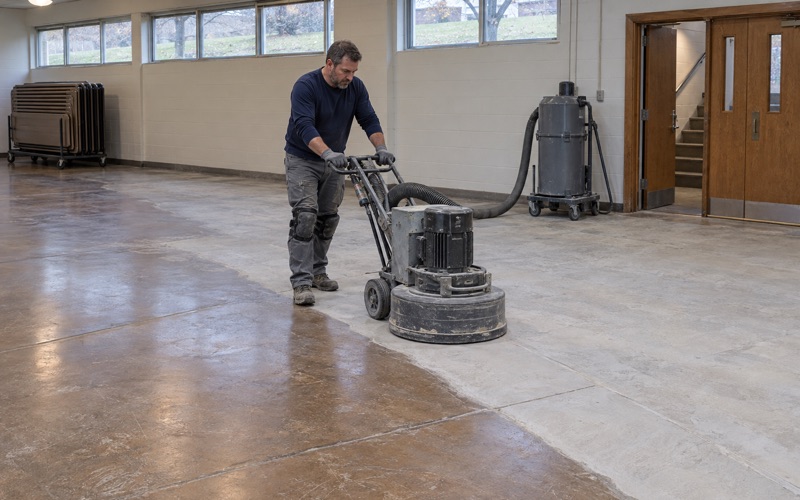
Once test results or abatement records show the residue is not asbestos-containing and the coating maker accepts the slab, we open it with a diamond grinder or a shot blaster, never an acid etch. The goal is a real concrete surface profile the primer can grip, and grinding dust is captured at the machine with a vacuum instead of being washed toward a drain.
Moisture testing comes next, using ASTM F2170 in-situ relative humidity probes or ASTM F1869 calcium chloride testing, depending on the slab. A floor that carried tile for decades can hold moisture the old covering hid, and a moisture-mitigation primer may be the difference between a lasting coating and one that lifts in its first year.
Old Black Adhesive Under Tile in a River Grove Basement
The Same Question at Home Scale
Plenty of River Grove houses have had a basement floor covered and re-covered over the years. Census figures count 2,332 owner-occupied homes among 4,196 occupied units, and 1,579 of those owners live in single-family detached houses, so a great many basement floors here are the owner’s own decision.
When old square tiles come up and a black adhesive stays behind, treat it the way the guidance treats it: presume it may contain asbestos until a test says otherwise. Do not dry-scrape it, sand it or pour a solvent remover on it to get the floor ready for us, because either step can create the very problem the testing is meant to rule out.
What We Do and What We Leave to Others
Our part begins after the adhesive question is answered. If testing shows no asbestos and the coating maker accepts the slab, we prepare it mechanically and coat it, and if the answer is unclear, we wait. A coating is never a substitute for testing or abatement, and we do not present it as one.
We also read a basement for past water before we price it, because a coating does not stop seepage, and moisture is the first warranty exclusion we name. Cure times follow slab temperature and the dew point at the surface rather than the calendar, which matters in a cool basement where a rushed coat can blush or stay soft.
Permits and Paperwork in the Village
River Grove requires a building permit for any remodeling valued over $100, including concrete work, and the Building Department sits at 2621 N Thatcher Avenue. Contractor licenses here run on the calendar year, January 1 to December 31, regardless of when they are issued, with a $10,000 trade-specific bond and a certificate of liability insurance naming the village.
We check those requirements before a job is scheduled rather than after. Home jobs over the state threshold also get a written contract and the Illinois Home Repair: Know Your Consumer Rights pamphlet before any grinding starts, so you know your rights before the first pass of the machine.
- 20+ Years in Business
- Moisture Tested Before Pricing
- Free Written Estimates