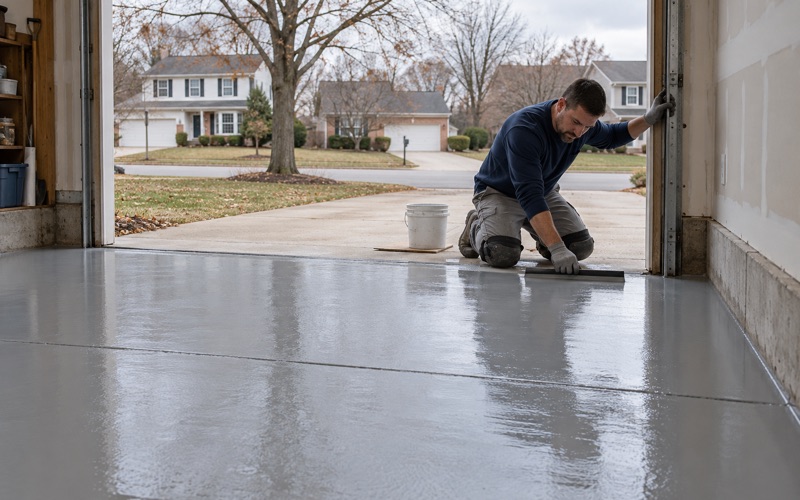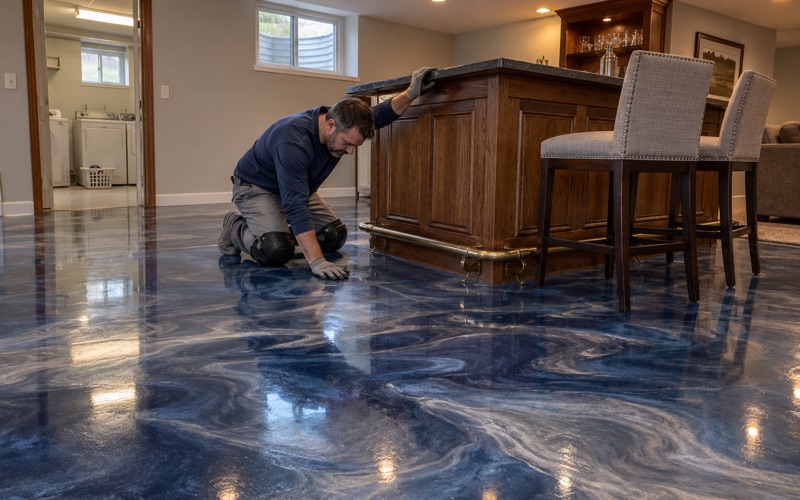
Wheaton Epoxy Flooring has spent more than 20 years installing epoxy flooring in River Forest and the surrounding western suburbs, and the floors we think hardest about are the ones where a strong chemical lands by accident. A clinical treatment room and a home garage both collect spills that bare concrete cannot shrug off. Our job is to put a sealed, seamless resin between that spill and the slab.
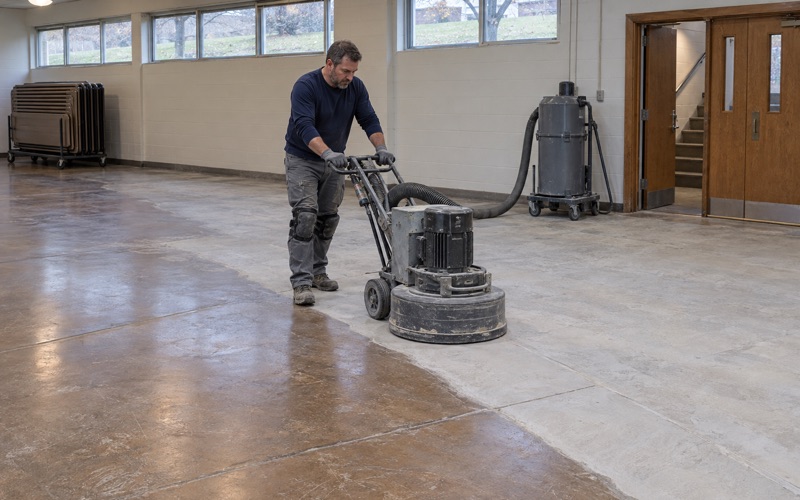
Every system we install starts with a slab opened by a diamond grinder or a shot blaster, never an acid etch, so the primer grips a real profile instead of a chemically roughened skin. Before a price is final, a moisture test is written into the scope, and the proposal names the product line, the number of coats and the finished thickness. That gives an office manager or a homeowner something specific to check the finished floor against.
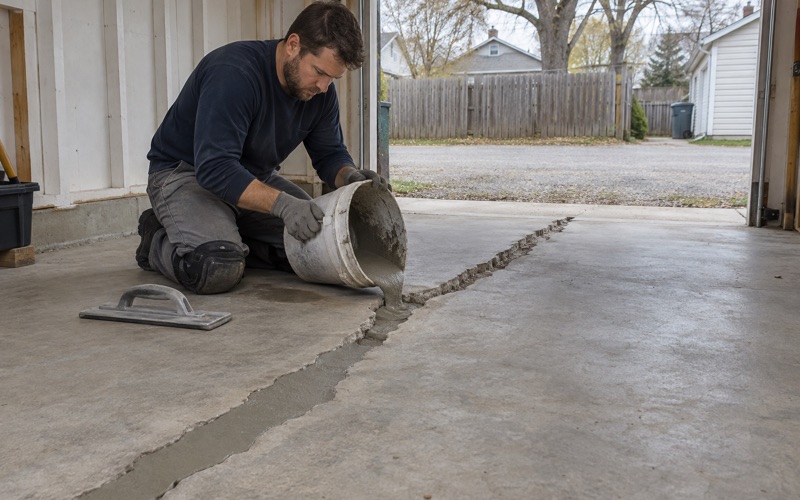
Cracks, spalls and failing old coatings are mapped before anything is sold, and we say plainly when a slab needs repair or replacement first. We also explain what a coating warranty leaves out, and moisture is the first exclusion we name. No resin floor shrugs off strong acid forever, so the honest pitch is a surface that buys time to wipe a spill away.
A Bonding Chair on North Avenue and the Etch That Comes With It
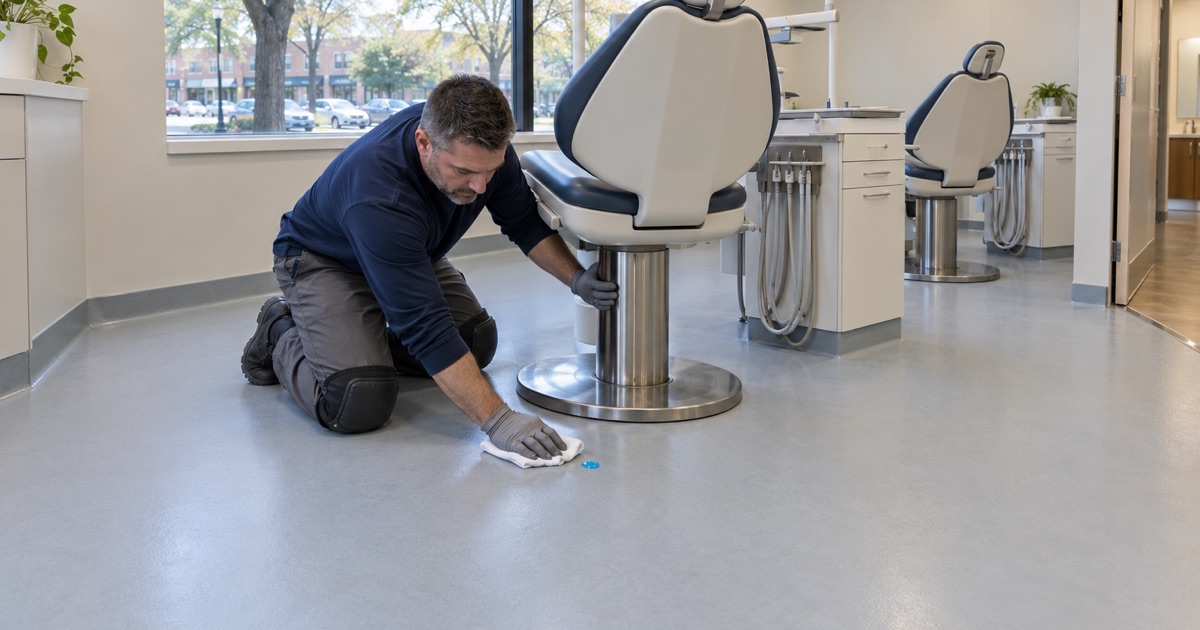
An orthodontic office at the village’s northern edge
Novick Orthodontics sits at 7351 West North Avenue, on the south side of North Avenue, which forms River Forest’s northern edge. The address geocodes inside the village and River Forest Township in Cook County. The practice offers braces for children, teens and adults, and its own site references i-CAT Cone Beam 3D imaging.
We have no relationship with the practice, we have not seen its floors, and we do not know which etch product it uses. We name the office because it is a real example of a room type River Forest has: a clinical chair where a strong acid is part of the daily routine.
What conventional bracket bonding asks of the tooth
Conventional bracket bonding starts with an acid etch: a gel is applied to the enamel, then rinsed away so the adhesive has a roughened surface to hold. One product in that class, TP Orthodontics’ Blue Etchant Gel, is described on its safety data sheet as 37 percent phosphoric acid intended for orthodontic treatment, with a pH of 0 to 1.
The same sheet carries the signal word Danger and a hazard statement that the gel causes severe skin burns and eye damage. It also lists the gel as water soluble, and that single property shapes everything we would recommend for the floor beneath the chair.
Where the drips land
A tip dropped during a swap, a smear on a glove that brushes the chair base, a blot wiped off an instrument tray: none of it is dramatic, and all of it ends up on the floor within an arm’s reach of the patient. Over a working week those small events repeat in the same few square feet.
The methylene blue dye in a gel like this one can also mark a porous surface. On bare cement that stain is one more reason to seal the surface rather than rely on scrubbing. The bigger concern is what an acid of that strength does to whatever cement it touches.
Looking for epoxy-flooring closer to Lyons? See Lyons Epoxy-Flooring.
What Strong Acid Does to Cement Paste and Grout
The chemistry in plain terms
Concrete is sand and stone held together by hardened cement paste, and that paste is alkaline. A strong acid reacts with it, dissolving the binder and leaving loose aggregate behind, which is why a bare slab splashed with acid turns sandy and pitted where the drip sat.
The American Concrete Institute’s repair guide, ACI 546R-04, lists phosphoric acid among the acids that disintegrate unprotected concrete slowly. Slowly is the operative word: one drop is not a failure, but the same spot hit again and again over months is.
Grout lines are the weak point in a tile floor
Many clinical rooms are finished in ceramic or porcelain tile, and the tile face usually tolerates a splash far better than its joints do. Cement grout is the same alkaline paste as concrete, sitting slightly below the tile face where a drip pools and dries. Epoxy grouts hold up better, but they still leave a line of joints running across the room.
Once the grout surface is eaten back, the joint holds dirt and moisture and becomes harder to clean, which matters in a room that has to look clinical. Regrouting around a treatment chair also means taking that chair out of service for days.
Diamond grinding instead of acid etching
The same chemistry explains why acid etching is a poor way to prepare a slab for coating. Acid etching leaves residue and an uneven profile, and it is the very reaction the finished floor is meant to keep away from the concrete.
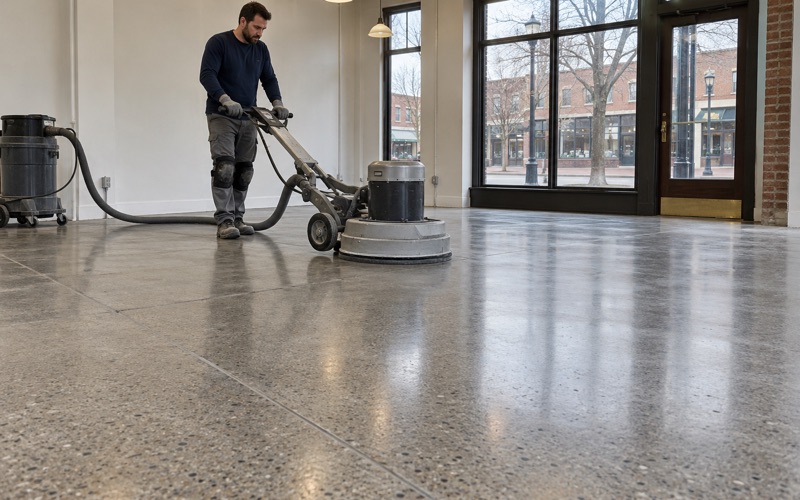
Diamond grinding or shot blasting produces a measurable concrete surface profile on the ICRI CSP scale, with nothing left in the pores to interfere with the primer. The coating then bonds to sound concrete rather than to a weakened skin. On a clinic floor that profile is usually lighter than a thick garage system needs, and the proposal states which one we are aiming for.
A Sealed, Seamless Floor With a Chemical-Tolerant Topcoat
Seamless matters more than any one product
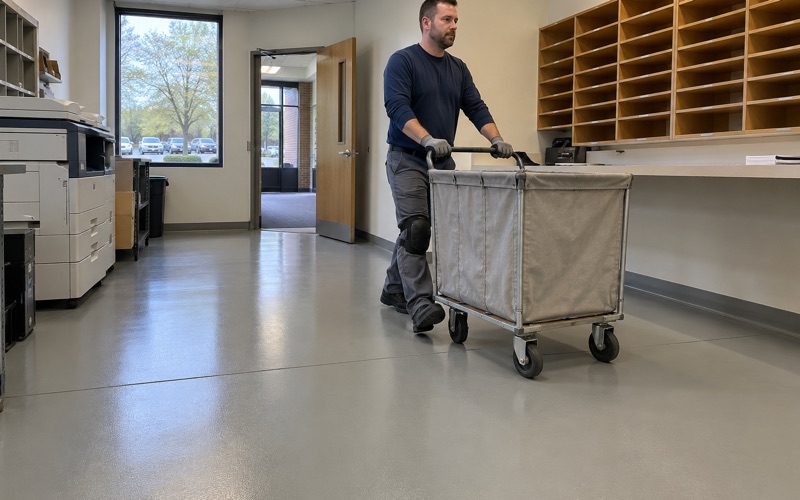
The first job of a resin floor in an operatory is to remove the joints. A 100% solids epoxy body coat, coved up the wall base where the room allows it, leaves no grout line, seam or gap for a drip to run into and sit. At the wall, the cove turns the floor up into the base so a mop or a wipe has no corner to push liquid into.
Over that we specify a chemical-tolerant topcoat, usually an aliphatic polyurethane or a polyaspartic, chosen for the chemicals the room actually handles. We ask for the safety data sheets on the etchants, disinfectants and floor cleaners in use before choosing, because resistance differs by product, concentration and temperature.
Splash, wipe and rinse
Coating makers generally separate short-term exposure, meaning a splash rinsed off the same day, from long-term exposure of the same spot. A strong acid a topcoat tolerates as a quick splash can still dull or discolor it if left to sit, so the realistic promise is a floor that holds the acid on the surface while someone deals with it.
Because a gel like this is water soluble, the right response to a drip is a damp wipe followed by a clean-water rinse of the spot, not a dry scrub that spreads it around. On a sealed floor that takes seconds; on bare concrete or grout, the acid has already started working by the time anyone notices. We leave a short written cleanup note with every finished clinical floor so new staff learn the routine.
Working around a patient schedule
A practice with a full chair schedule rarely closes for a week, so an office can often be done one operatory at a time while the other rooms keep seeing patients. We phase operatory floors around opening hours, using overnight and weekend windows, and the cure schedule follows slab temperature and dew point rather than the calendar.
Products are selected inside the Illinois VOC limits for floor coatings, which matters in an occupied building where odor travels down a hallway. Grinding dust is captured at the machine with a vacuum rather than swept or rinsed toward a floor drain.
Acid Cleaners and Battery Acid on River Forest Garage Floors
The same chemistry at home
The acids that reach a home garage floor are less specialized and often arrive in larger amounts. Muriatic acid concrete cleaners, sold to brighten a stained slab, and the sulfuric acid in a leaking lead-acid battery attack cement paste in the same way an etch gel does.
A cracked battery case left on a shelf, or a cleaner poured straight onto an old slab, can leave a pale, sandy patch that never comes back. A sealed resin floor gives the owner time to neutralize and rinse a spill before it reaches the concrete underneath. Storing batteries and acid cleaners on a shelf over a drip tray, rather than directly on the slab, helps as well.
Old slabs are the expected case here
River Forest’s housing is old: 42.2 percent of it predates 1940 and 68.8 percent predates 1960, so a prewar garage or basement slab is the norm rather than the exception. A slab of that age may have been acid washed, patched or painted over the decades, and each of those histories changes the prep. With 87.7 percent of occupied homes owner-occupied, most garage floors here are chosen by the person who will park on them for years.
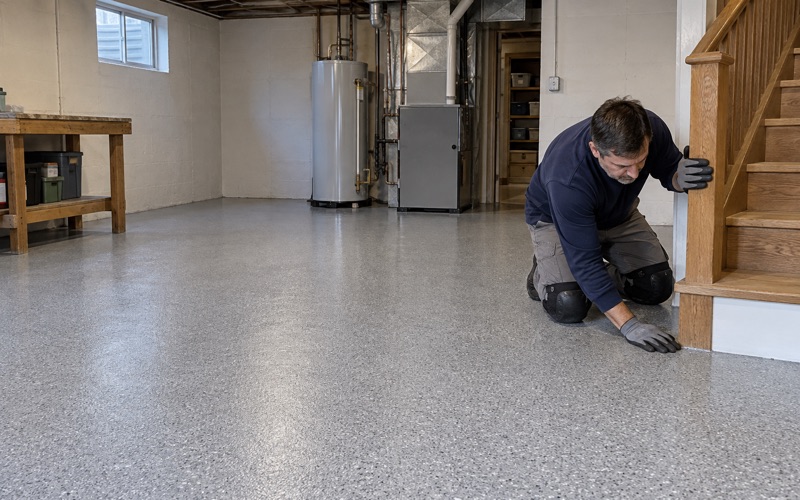
We grind through old paint and sealers to sound concrete, map cracks and spalls, and run an ASTM F2170 in-situ relative humidity probe or an ASTM F1869 calcium chloride test before the price is set. Basement floors are read for signs of past water first, because a coating does not stop seepage or sewer backup.
Winter salt and a written contract
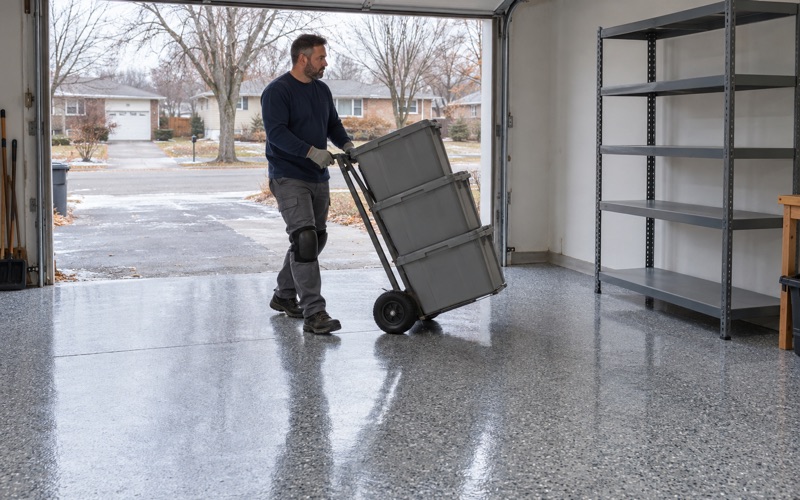
Garage systems we put down here are built to take the brine and rock salt that ride in on tires all winter, typically a vinyl flake or quartz broadcast locked under a polyaspartic or polyurethane topcoat. In an unheated garage in deep winter we tell the owner to wait, because a coating laid without enough dew point spread at the slab surface can blush or fail to cure properly. The topcoat also has to resist hot tire pickup, which is where cheap one-part garage paints tend to fail first.
Home jobs over the state threshold get a written contract and the Illinois consumer-rights pamphlet before any grinding starts. We also never sell a floor coating as radon reduction, since in Illinois that is mitigation work regulated by IEMA and a coating is not a substitute for it.
- 20+ Years in Business
- Moisture Tested Before Pricing
- Free Written Estimates