
Wheaton Epoxy Flooring has spent more than 20 years grinding and finishing concrete, and polished concrete floors are the purest form of that work in Wheaton, IL, serving surrounding cities including Winfield, Warrenville, Hinsdale, Wood Dale and Bensenville. Instead of covering the slab, we refine it, so the concrete itself becomes the finished floor.
A polished floor is ground flat with metal-bond diamonds, hardened with a lithium silicate densifier and brought up through finer resin-bond diamonds to the sheen you pick. There is no coating to peel, no film to scuff through in traffic lanes and no topcoat to recoat every few years.
Because the result depends on the slab, every project starts with a test area and a written scope that names each grinding stage, the densifier and the final sheen. If your concrete is too soft, damaged or patched to polish well, we tell you that before you commit and suggest a coating that will serve you better.
How Polished Concrete Is Made
Grinding Stages and Flattening
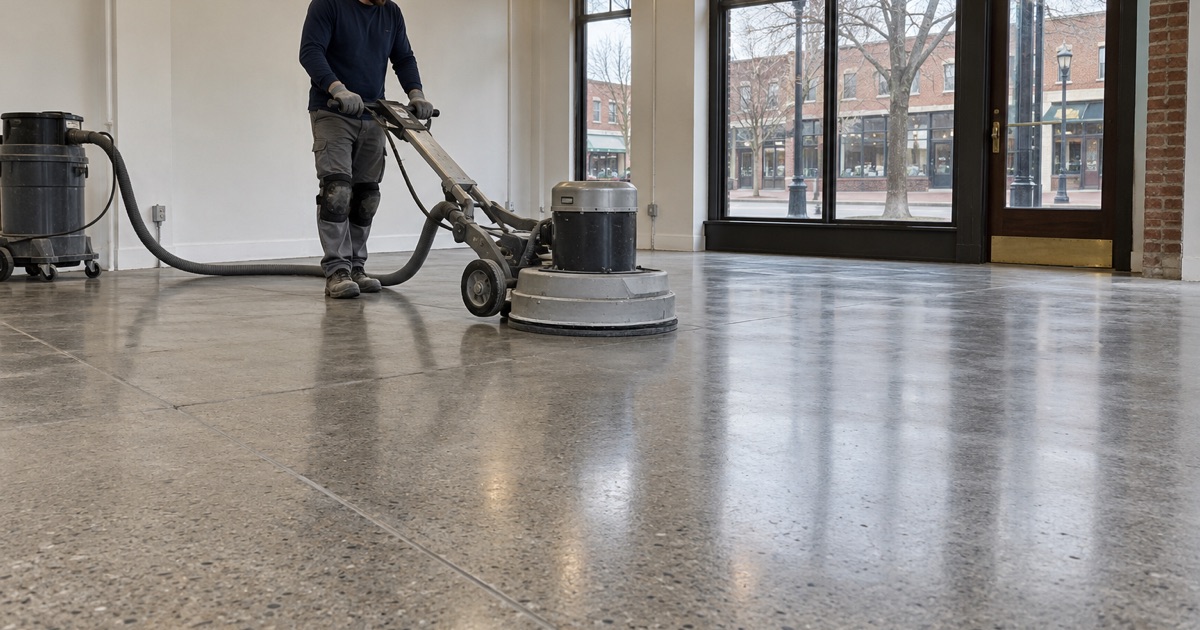
The first passes use coarse metal-bond diamonds to remove surface laitance, old sealers and minor high spots. Each later pass uses a finer grit to erase the scratches of the one before it. Skipping steps leaves swirl marks that show up under store lighting, so the number of passes is written into the scope rather than left to the crew’s mood.
All grinding runs with a vacuum attached to the machine. The fine concrete dust is captured at the head, which keeps occupied homes and businesses cleaner and keeps slurry from being washed toward a floor drain.
Lithium Silicate Densifier
Partway through the process, a lithium silicate densifier is applied to the open concrete. It reacts with the slab to harden the surface, which lets the later diamonds create a tighter, brighter polish and makes the floor more resistant to wear and dusting. The densifier is part of the concrete once it reacts, not a coating sitting on top.
Polishing Grits and Stain Guard
After densifying, resin-bond diamonds take the floor up through the grits to the final sheen. A penetrating stain guard is usually applied at the end to help resist spills, then burnished in. The result is a floor that reflects light evenly and cleans with a dust mop and a neutral cleaner.
Choosing the Look of Your Floor
Cream, Salt-and-Pepper or Full Aggregate
A light grind keeps the smooth cream layer at the top of the slab with little stone visible. A medium grind exposes fine aggregate for a salt-and-pepper look. A deeper grind cuts into the slab to reveal larger stone, which looks striking but also shows every variation in how the concrete was placed.
Aggregate never sits at a perfectly even depth across a slab, so we grind a test patch before quoting the full look. What appears there is what you can expect across the rest of the floor.
Sheen Levels From Matte to High Gloss
Polished concrete can stop at a low satin sheen or continue to a high gloss that reflects overhead lights. Higher sheens look dramatic in showrooms and lobbies, while lower sheens hide scuffs and suit homes, offices and workshops. The final grit you choose is named in the proposal.
Sheen is also about upkeep. A high-gloss floor shows dust, footprints and the grit tracked in from salted sidewalks sooner than a satin one, so a busy entry or a family kitchen often looks better week to week at a middle sheen than at the highest one the slab can reach.
Dyes, Saw Cuts and Borders
Penetrating dyes can add color during polishing, and saw cuts can create borders, grid lines or patterns that follow the room. These details are laid out on the slab before work starts so they line up with walls, columns and doorways. Dyes do fade in strong sunlight, so we discuss placement near windows.
Residential Polished Concrete
Basements With a Sound Slab
Polished concrete can turn a basement slab into a finished floor without adding a layer that moisture can push off. That makes it attractive for family rooms and home offices on an existing floor. We still read the basement for past water first, because no floor finish stops seepage or a sewer backup.
Old paint, carpet glue and tile adhesive have to be ground away completely, and where the slab has been patched heavily the repaired areas will polish differently from the original concrete. We show you that on a test area before committing to a full basement.
Main Floors and Additions
New additions and homes with slab-on-grade floors can be polished, often after drywall is up and before trim goes in. On a new slab, the curing time and the way the concrete was finished both affect the final look, so we coordinate timing with your builder and check the surface before grinding begins.
Protecting the slab during construction matters as much as the polish itself. Drywall mud, paint drips, plumbing work and dragged equipment all mark fresh concrete, and some of those marks go deeper than the final grind will reach, so we agree with your builder on how the floor will be covered until we arrive.
Garages and Workshops
A polished floor can suit a heated workshop or a lightly used garage, but salt, brine and oil are tough on concrete that stays slightly porous. For a garage that sees daily winter driving, we usually recommend a ground and coated system instead, and we explain why in the proposal rather than selling a finish that will not suit the space.
Commercial Polished Concrete
Retail, Office and Lobby Floors
Retail spaces, offices and lobbies use polished concrete for its low upkeep and bright finish under store lighting. It takes cart and foot traffic without a coating to wear through, and it is maintained with an auto-scrubber and neutral cleaner rather than stripping and waxing.
When a business has to stay open, we work in sections overnight or across weekends. Because polishing has no long cure time, finished sections can go back into use the next morning.
Warehouses, Shops and Back-of-House Areas
Warehouses, maintenance shops and storage rooms get the durability of densified concrete with less dusting and easier cleaning than bare concrete. A lower sheen suits these spaces, and the grind can be kept shallow to control cost. Floors that see heavy oil or chemical exposure may still be better served by a coating.
Forklift and pallet-jack lanes are worth looking at closely before polishing. Joints that have spalled under hard wheels need to be repaired and filled first, because a polished surface makes broken joint edges more visible, and the wheels keep chipping them until the edges are rebuilt.
Maintaining a Commercial Polished Floor
Polished floors stay bright with daily dust mopping and regular cleaning with a neutral cleaner. Acidic or harsh cleaners can etch the surface, and grit tracked in from salted sidewalks wears it like sandpaper. Entry mats and a simple cleaning plan go a long way, and we leave written care instructions with every job.
Over time, a high-traffic polished floor can dull in its busiest lanes. Rather than recoating, it is usually brought back by burnishing or by a light repolish with fine resin diamonds, which restores the sheen without the downtime of stripping a coating. That long-term upkeep is part of why polished concrete appeals to facility managers.
- 20+ Years in Business
- Moisture Tested Before Pricing
- Free Written Estimates