Wheaton Epoxy Flooring handles epoxy flooring in Palos Hills with more than 20 years in the trade, and many of the rooms we get asked about here are ones where the floor is cleaned hard and often. Some of the toughest are not garages at all but treatment and exercise spaces, where oil and lotion settle on the floor a little at a time. We build those floors around how they will be cleaned, not just how they look the day the coating cures.
Every slab we coat is opened with a diamond grinder or a shot blaster rather than an acid etch, which gives the resin a real profile to hold. Before the price is final, a moisture test goes into the written scope, along with the product line, the number of coats and the finished thickness. That way a homeowner or a building manager can check the finished floor against the quote line by line.
This page follows one kind of problem: a thin film of body oil and lotion that ordinary mopping cannot shift. It starts with a campus clinic in town, works through why that film behaves the way it does, and ends in the home gyms and basement rooms where the same film shows up.
A Student Massage Clinic in Moraine Valley’s Building B
What the clinic does
Moraine Valley Community College, whose campus sits in Palos Hills in Palos Township, runs a Student Massage Clinic where interns give Swedish-style massage. A college news release from 2019 placed the clinic in Building B, Room B161, on the main campus at 9000 West College Parkway. We have no connection to the college and have never seen that floor, so what follows is about the conditions a room like it creates, not about the clinic’s own finish.
The clinic’s Fall 2025 policy sheet sets out the visit plainly. Each one-hour appointment is a 50-minute hands-on massage, with five minutes for intake and five to redress, at $30 or $20 with a student ID. Clients must be 18 or older and pay by cash or check.
Grapeseed oil and basic lotions on every client
The same policy sheet names the products in one line: ‘We use pure grapeseed oil and basic lotions.’ It asks clients to raise any allergies with the therapist, which is why the products are named at all. For a floor, though, that line matters for a different reason.
Fifty minutes of oil work on one client means oil on skin, on linens and on the therapist’s hands and forearms. Some of it leaves the room on the client, and some of it drops, transfers or gets wiped toward the floor around the table. Repeat that across a full schedule of sessions and the floor collects a film nobody spilled on purpose.
Where the film gathers around a table
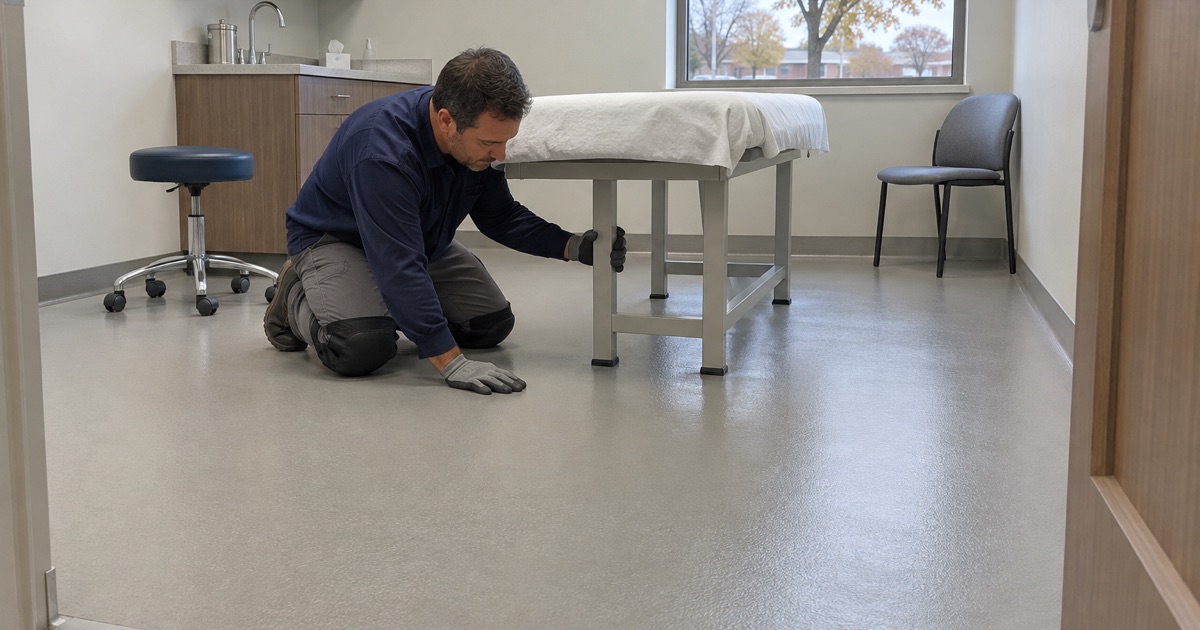
The film does not spread evenly across a treatment room. It builds where the therapist stands and shifts weight, along the sides and head of the table, and at the spot where clients step down and walk out. Those are also the places where footing matters most.
A floor in a room like that is chosen around the film rather than in spite of it. The finish has to survive a daily degreasing routine, and the texture has to keep working on the days the cleaning has not happened yet.
Looking for epoxy-flooring closer to Prospect Heights? See Epoxy-Flooring Services in Prospect Heights.
The Hazy Sheen of an Oil Film, and Why Water Spreads It
Reading a satin, hazy sheen
The most useful description we have seen of this film comes from a floor supplier writing about dance floors, a different room with the same problem. It names perspiration and body lotion residue as the primary source of oil on a floor. It also gives the tell: a floor carrying an oil build-up takes on a satin, hazy sheen.
That sheen is easy to mistake for a worn topcoat or a cleaner that left residue behind. On a resin floor the coating underneath is usually sound, and the haze sits on top of it. Seeing it as a film rather than wear changes what the fix is.
Water does not dissolve oil
The same supplier puts the cleaning problem in four words: water does not dissolve oil. A mop and a bucket of plain water push an oil film around, thin it out and lay it back down across a wider area. The floor looks clean while it is wet, then dries back to the same haze.
In a massage room that matters more than in a garage, because the film keeps arriving with every session. A routine that only moves the oil around lets it build week after week, until the whole floor carries it rather than the patch beside the table.
A detergent degreaser as the daily step
The answer the supplier gives is a detergent degreaser, used as part of normal cleaning rather than as an occasional deep clean. A degreaser breaks the oil up so it lifts into the mop water and leaves with it. A clean-water pass afterward keeps the cleaner itself from becoming a second film.
For us that sets the order of decisions. We ask what the cleaning routine will be before we pick a topcoat, because a coating that dulls, softens or stains under a daily degreaser is the wrong coating for that room, however it looks on day one.
Degreaser-Tolerant Topcoats and Fine Texture Under a Film
A topcoat matched to the cleaner
A coated floor for an oil-and-lotion room usually starts with a 100% solids epoxy body coat for build and adhesion. The decision that matters most is the topcoat, because that is the layer the degreaser meets every day. Polyaspartic and polyurea topcoats, and urethane cement where service is harder, are the families we weigh, and the proposal names the exact product line.
We read each maker’s data for the cleaners it allows and match that against the products the room will actually use. If a facility already has a preferred degreaser, we want its name before the order goes in. A topcoat chosen that way is not guessing about the chemical it will meet most often.
Fine texture specified by the broadcast
Texture on a resin floor comes from what is broadcast into it and how the topcoat is rolled over that broadcast. For a treatment room we lean toward a fine quartz aggregate locked under the topcoat, which leaves a tooth that still reads through a thin film of oil. A coarse texture would bite harder but would also hold oil and fight the mop.
We specify that texture by the aggregate and the topcoat used, and we write both into the scope. We do not promise that an oily floor will behave like a dry one, and we have not measured a slip value for any of these rooms. What we can do is choose a surface that gives footing a better chance while the film is there.
A matte finish that shows the film
High gloss hides an oil haze until it is thick. A matte or satin topcoat lets the hazy sheen show up early, as a visible cue that the floor is due for its degreaser. In a room that sees oil every session, a finish that tells staff when to clean is doing part of the work.
Clinic and office floors are also phased around opening hours, with overnight and weekend windows when a room cannot close. Cure schedules follow slab temperature and dew point rather than the calendar, so the room reopens when the topcoat is ready for its first degreaser, not before.
Lotion, Oil and Sweat on Palos Hills Home Gym and Basement Floors
Home exercise and spa rooms
The same film turns up at home. A basement gym collects sweat, a home massage or spa room collects oil and lotion, and both get mopped with whatever is under the sink. The fix is the same as in a clinic: a topcoat that takes a detergent degreaser, a fine texture in the walking paths, and a finish that shows the haze.
Most building in Palos Hills took place from the late 1970s through the early 1990s. An owner turning a lower level from that era into a gym or a quiet room is coating a slab that has had decades to show what water does to it, and that history is worth reading before any color is picked.
Reading the basement for past water first
Parts of the city have a documented water problem. The city reports that Roberts Road north of 103rd Street and adjacent streets flood, with overflow running down side streets from 99th to 103rd Street, and that the area from 103rd Street north to 99th Street, between 78th Avenue and the Lucas Ditch, is a FEMA floodplain with repetitive flooding. A coating does not stop sewer backup or seepage, and we say that before a basement job is sold.
So we read the slab for past water first, looking for efflorescence, tide lines and old patching, and we map cracks, spalls and old coatings at the same visit. Moisture is the first exclusion we name in any coating warranty, and where the readings call for it, a moisture-mitigation primer goes into the written scope. Grinding dust is captured at the machine with a vacuum rather than washed toward a floor drain.
Townhomes, associations and city registration
Palos Hills counts 945 owner-occupied attached homes, and more owner households than renter households in buildings of three or more units. In that kind of housing a garage, storage room or shared floor is often an association’s decision rather than one owner’s, and a townhome slab can meet a neighbor’s wall line. We like to know who signs off before we schedule anything.
Commercial work in the city calls for a registered contractor, and the City of Palos Hills Building Department registers general contractors for $50 for two years with a $25,000 surety bond and a certificate of liability insurance. Homeowners who do their own work sign a hold-harmless agreement instead. On home jobs above the state threshold, we provide a written contract and the Illinois consumer-rights pamphlet before any grinding starts.
- 20+ Years in Business
- Moisture Tested Before Pricing
- Free Written Estimates