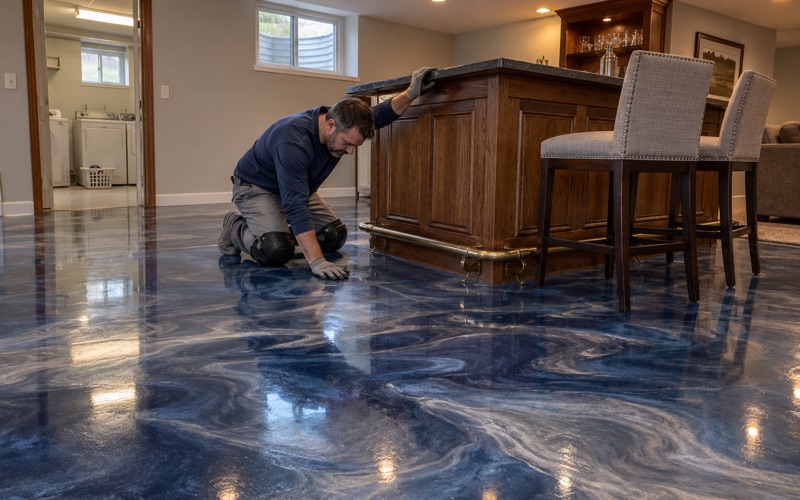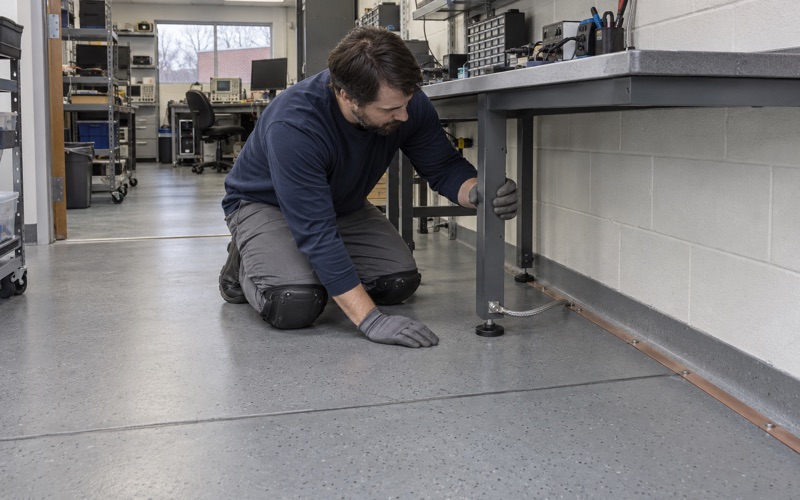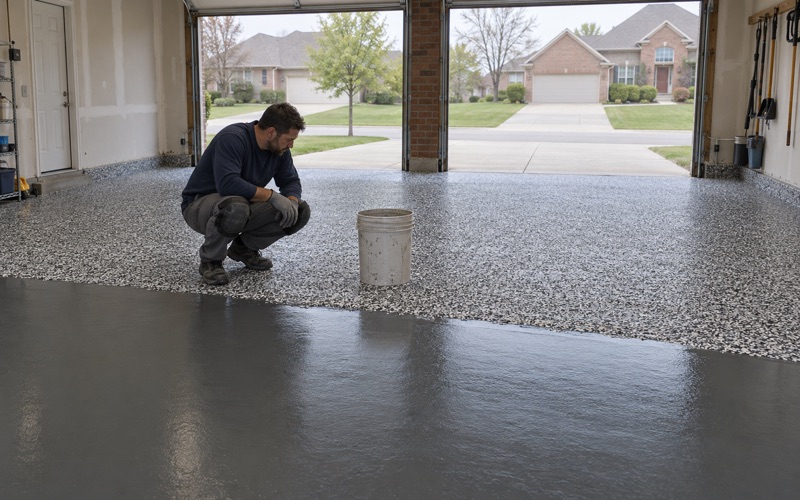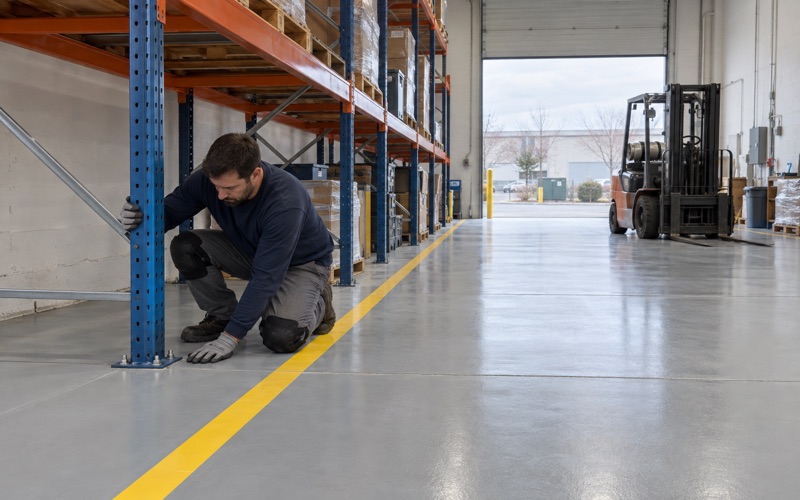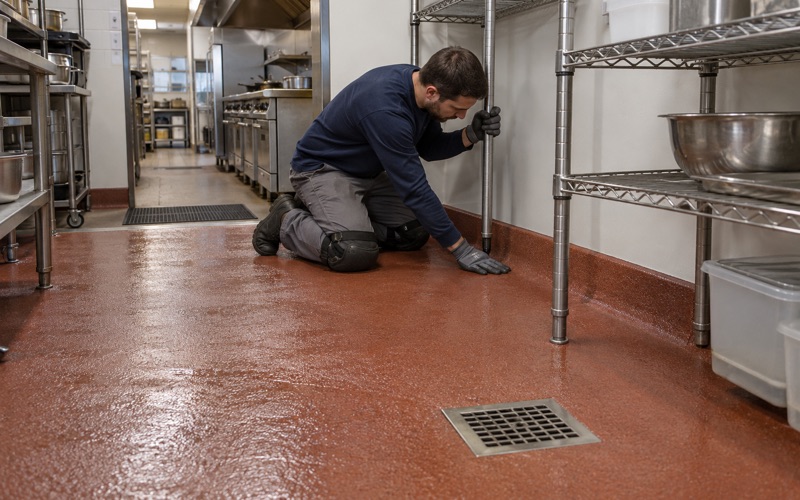
Wheaton Epoxy Flooring has spent more than 20 years installing epoxy flooring in Northlake plants, warehouses and homes, and the industrial slabs we think hardest about are the ones where the coating does a job beyond looking clean. On some floors, the seal on the concrete is what keeps a moving system working at all. This page is about that kind of floor.
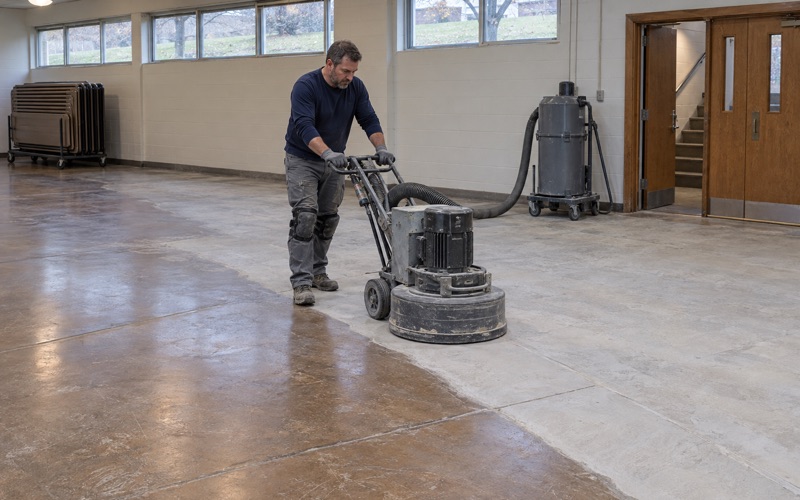
Our preparation never changes with the size of the job. A diamond grinder or a shot blaster opens every slab, never an acid etch, so the coating has a real profile to grip. Before anything is priced, cracks, spalls and old coatings are mapped, and when a slab needs repair or replacement before it should be coated, we put that in writing.
The proposal you get names the product line, the number of coats and the finished thickness, so a plant engineer can hold the installed floor up against the quote. A moisture test sits inside that written scope before the price is final.
A Container Canyon on Northwest Avenue

What the 2009 Design Called For
In July 2009, Microsoft opened its Chicago data center at 601 Northwest Avenue in Northlake, a building of about 700,000 square feet and the company’s first container data center. As trade press described it at the opening, server-filled shipping containers backed in on trailers, were unloaded with winches and were stacked two-high onto air skates that float on compressed air.
As few as four employees could then move the 60-ton stack into place in the lower-floor container canyon, which had diagonal parking spaces for 40-foot container stacks. We have no connection to that building, and its current layout, its use of air skates and its floor finishes are not something we have seen. We describe the design only as it was reported when it opened.
How an Air Skate Carries a Load
An air skate or air caster lifts a load on a thin film of compressed air escaping between a flexible bladder and the floor. With friction nearly gone, a few people can push what a forklift could not carry. The floor stops being something the move merely happens on and becomes half of the bearing.
AeroGo’s floor specification for these systems says the air pressure inside a caster, in some cases up to 50 pounds per square inch, is pushing down on the floor surface. The film it rides on is only 3 to 5 thousandths of an inch thick, which is why small details of the concrete decide whether a move goes smoothly or stalls.
Surface Texture Matters More Than Levelness
The same specification accepts normal floor undulation, because the casters follow it; levelness matters mainly because a floating load drifts downhill. What it ranks first is porosity and smoothness at the surface itself. Rough concrete peaks of 15 to 20 thousandths of an inch stand well above that air film, and the document warns that they abrade the caster.
Looking for epoxy-flooring closer to Westchester? See Epoxy-Flooring in Westchester.
Why Porous Concrete Lets the Air Out
Where the Air Goes
Bare concrete is full of capillary pores and open surface voids. On a porous floor, AeroGo notes, the air can escape through the surface and be wasted. The caster loses part of its film, the load settles and drags, and the compressor works harder just to keep the stack floating.
The fix the specification names is plain: concrete floors are easily sealed and made non-porous with commercial sealants, and its sketch shows a surface coating filling the valleys in the concrete. On a floor like that, sealing is part of the equipment rather than a finish chosen for looks.
Choosing What Closes the Surface
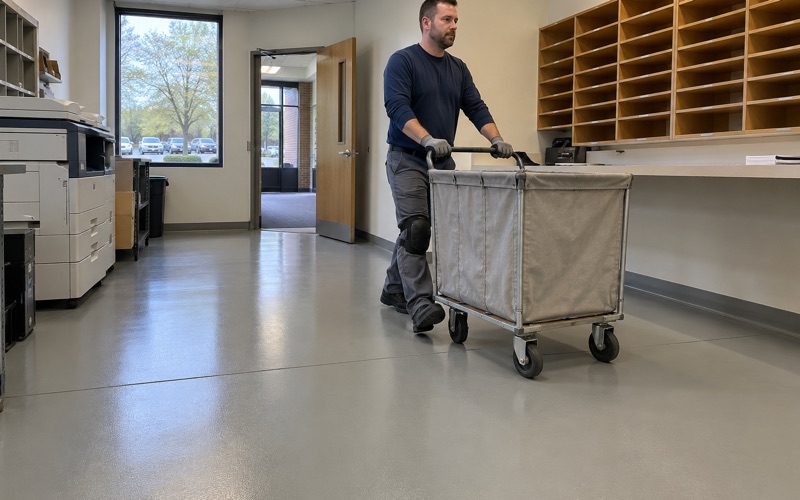
For an air path, we grind to a concrete surface profile the chosen product is made to bond to, then close the surface with a film rather than relying on penetration alone. A densifier hardens concrete but does not reliably leave it non-porous, so on a travel path we usually look at a 100% solids epoxy, sometimes under a polyaspartic or polyurea topcoat, that covers the peaks and fills the valleys.
The texture choices that make sense on a garage floor work against an air film. A vinyl flake broadcast or a heavy quartz aggregate broadcast puts the roughness right back, so the path itself stays smooth. Where people walk beside it, slip resistance is specified by the broadcast and topcoat we name in the proposal, not promised as a slogan.
Testing Moisture Before the Slab Is Sealed Shut
A sealed surface traps whatever vapor is moving up through the slab. If that vapor is high, a film coating can blister, and a blister is a raised edge that a pressurized caster will find. That is why moisture testing comes before the price, using ASTM F2170 in-situ relative humidity probes or ASTM F1869 calcium chloride testing, with a moisture-mitigation primer specified when the numbers call for one.
Cure follows the slab, not the calendar. We watch slab temperature and the dew point spread at the surface, because a coat laid down too close to the dew point can develop amine blush that has to be removed before the next coat bonds. Moisture is also the first exclusion we explain in any coating warranty, before the work is sold.
Cracks and Joints Filled Flush and Bonded
Continuity Is the Specification
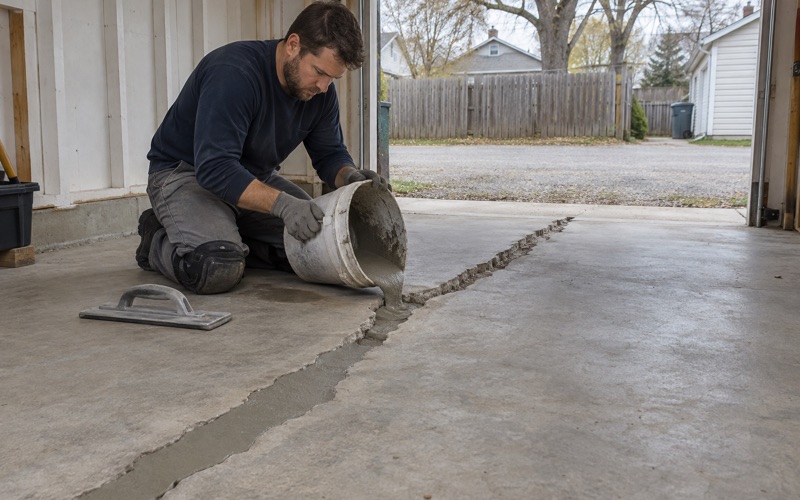
AeroGo’s guidance asks for a floor that is continuous, without cracks, steps or other interruptions through which air can be lost. Cracks are cleaned out and epoxy filled smooth and flush. Saw-cut and construction joints are filled smooth and flush over backer rod, so the caster never meets an open gap.
An unfilled joint is a leak path under a load that depends on trapped air. As a caster crosses it, part of the film vents into the cut, the load dips, and the leading edge of the skate can catch. Repeated over many moves, that is how a joint edge starts to chip.
Pressure From Both Directions
The specification says the filler must be applied securely so that it resists both down or up air forces. Pushing down is the obvious load. The less obvious one is air finding its way under a poorly bonded fill and lifting it from below, which turns a repair into a loose flap in the middle of the path.
So each crack is routed to sound concrete, vacuumed clean and filled with a bonded semi-rigid epoxy, then ground flush with the surrounding floor before the coating goes down. Joints that still move get a filler chosen for that movement, and we explain where a joint may need refilling later rather than pretending any fill is permanent.
When a Fill Is Not Enough
Mapping comes first for a reason. A crack that is still opening, an edge with a step across it, or a spalled section that has lost its bond will not hold a fill, and coating over it only hides the problem until the next move. When we find that, we say the slab needs concrete repair before it should be coated.
We are also direct about what a coating cannot do. It seals and smooths the surface, but it does not add structural capacity, and the slab under the path has to carry the load on its own. Floor capacity is a question for the building’s engineer, not for the floor coater.
Sealed, Smooth Travel Paths for Air-Caster and Rigging Moves
An Edge the Air Cannot Lift
The AeroGo document states that coatings shall be securely bonded to the concrete. On an air path, the weak point is any edge: a feathered border, a patch boundary or a thin spot where the coating rests on dust instead of profiled concrete. Air under pressure works into a loose edge and peels it.
We carry the full grind right to the edge of every coated area and keep the boundary out of the caster track wherever the layout allows. Grinding dust is captured at the machine with a vacuum rather than washed toward a floor drain or storm inlet, which also leaves a clean surface for the bond.
Planning a Path for Rigging and Machinery Moves
Northlake’s industrial land keeps being reformatted rather than simply added to, and that means heavy equipment gets moved in, rearranged and moved out. For a rigging or machinery move on air casters, we plan the path from the door where the load enters to the spot where it lands, including thresholds and transitions between old and new concrete.
Plants rarely close for floor work, so the path is phased around production, with overnight and weekend windows when an area cannot shut down. Products are chosen inside the Illinois VOC limits for floor and industrial coatings, which bind whoever applies them, and that matters in an occupied building.
Registration and Sign-Off in Northlake
The City of Northlake requires every contractor and subcontractor to register before working in town: a $100 license good for one year from issuance, a $10,000 bond and a certificate of insurance naming the city. Building questions go to the City of Northlake Building Department, and we check them before the job is scheduled.
Fire protection here is a separate body, the Northlake Fire Protection District, rather than a city department. When a commercial floor raises a fire-code question, that is the office we contact, so the answer comes from the authority that actually signs off on it.
- 20+ Years in Business
- Moisture Tested Before Pricing
- Free Written Estimates