Wheaton Epoxy Flooring brings more than 20 years of resinous floor work to epoxy flooring in Norridge, and the jobs that test a crew hardest are the ones where the doors cannot close for a week. A business that sells food from early morning until late evening has one usable window each day, and the whole job has to fit inside it. We plan that kind of floor by the hour before we plan it by the square foot.
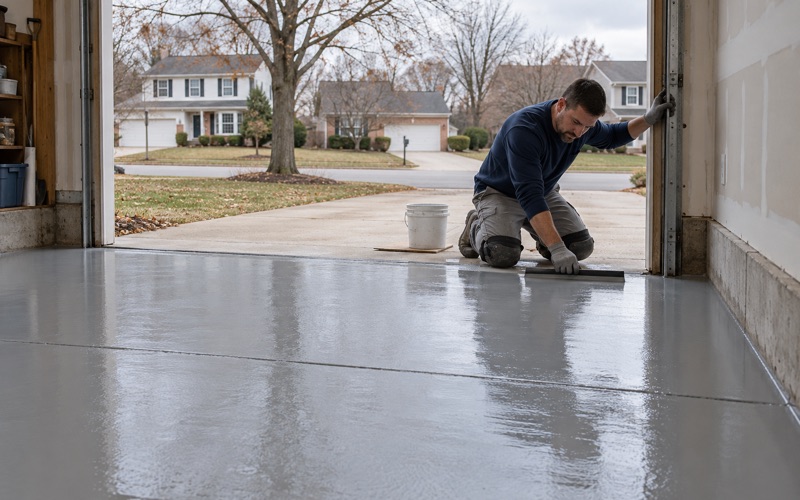
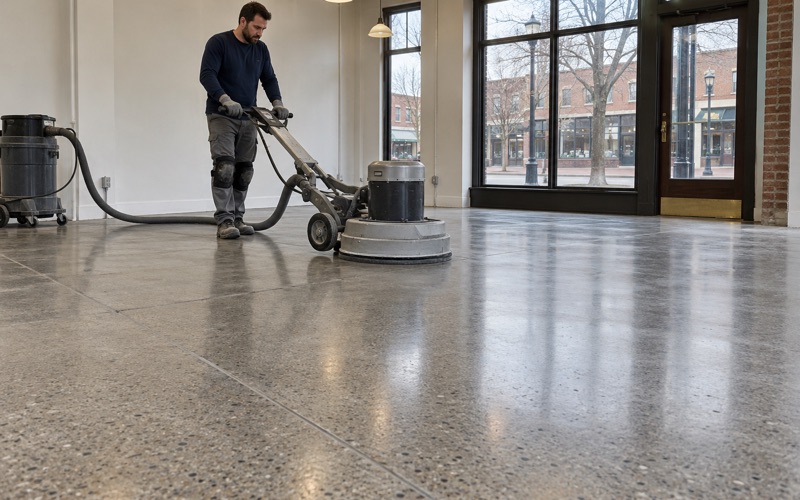
Every floor we take on starts with the same groundwork. The slab is opened with a diamond grinder or a shot blaster rather than an acid etch, a moisture test is written into the scope before the price is final, and the proposal names the product line, the number of coats and the finished thickness so the result can be checked against the paper.
That method holds whether the floor is a two-car garage on a quiet residential block or a sales floor that reopens to carts at dawn. What changes is the schedule, the dust control and how much of the floor we can touch in one visit, and those decisions are what this page walks through.
A Grocery That Sells Exposed Food From Open to Close
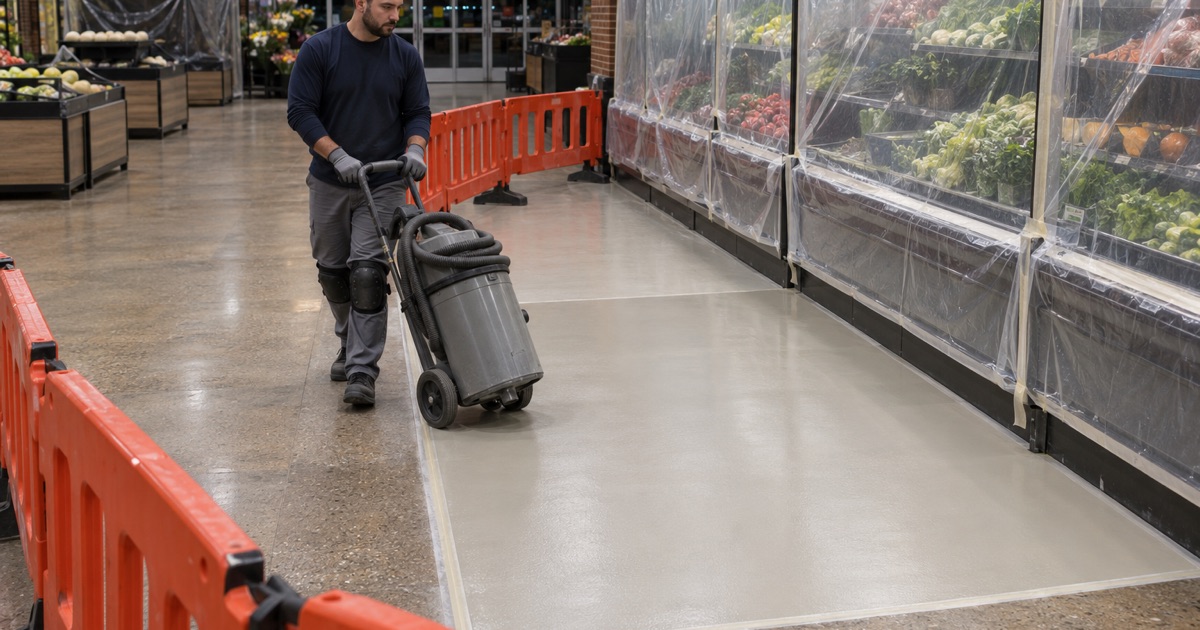
Caputo’s at Harlem and Montrose
Angelo Caputo’s Fresh Markets opened its 10th store at the northwest corner of Harlem and Montrose in August 2023, a 40,000-square-foot market at 4410 North Harlem Avenue inside the village. Trade coverage of the opening listed from-scratch bakery items, hot foods such as pizza and soups, sushi and sandwiches, and Cafe Angelo selling coffee and gelato inside the store.
The store locator lists hours of 6:00 a.m. to 9:30 p.m. We have no connection to the store and have not seen how it cares for its floors, but it is the clearest example in Norridge of a floor that never sees an empty daytime hour.
What open food counters mean for floor work
A grocery like that is not a warehouse with a few shelves of sealed boxes. Bread cools on racks, hot food sits in open wells, and gelato is scooped across a counter, so any dust or overspray that drifts across the sales floor lands somewhere a customer will eat from.
That is the core difference between a retail floor and a food floor. The question is never only which coating suits the traffic, but when the work can happen without putting grinding dust or wet resin anywhere near product that is out in the open.
Where wear collects in a busy market
In a store of that size, wear tends to gather at the entrances, along the checkout lanes and in front of service counters, where carts turn and shoppers stop. Those are the spots where a coating chips first and where a worn floor is noticed first.
They are also the zones a store can least afford to rope off. We usually plan them as their own small sections instead of folding them into a larger area, so a single night can finish them completely.
Looking for epoxy-flooring closer to Hickory Hills? See Epoxy-Flooring in Hickory Hills.
The Food Code’s After-Closing Logic
What the cleaning-frequency rule actually says
Norridge moved to the 2022 FDA Food Code as adopted by the State of Illinois on January 1, 2025. The model code’s cleaning-frequency rule, section 6-501.12, was read here through Virginia’s verbatim adoption, and it says that apart from a spill or other accident, cleaning shall be done during periods when the least amount of food is exposed, such as after closing.
That rule governs cleaning, not resurfacing, and it does not order anyone to coat a floor at night. We borrow its reasoning because it is sound: if mopping belongs to the hours when food is put away, grinding and coating belong there even more.
Carrying that reasoning into repairs
Floor repair inside a food sales area follows the same pattern for practical reasons. A grinder throws fine concrete dust, a fresh coat needs still air and an undisturbed surface, and a crew moving equipment across the aisles cannot share that space with shoppers.
The rule itself leaves room for spills and accidents, and small repairs can work the same way. A chipped patch of coating near a hot-food counter can sometimes be filled in a small, coned-off area, but a full recoat waits for the closed hours.
Planning with the store before the first night
Before any section is scheduled, we walk the floor with the manager and agree on an order that keeps the busiest departments open longest. Freezer cases, bakery racks and display tables that cannot move are marked on the plan so nobody discovers them at midnight.
That walk is also where cracks, spalls and failing patches are mapped. If part of the slab needs repair before it should be coated, we say so in writing and put that repair into its own night rather than squeezing it into a coating night.
Fitting Floor Work Into an Eight-and-a-Half-Hour Night
Sizing each section to the window
Between a 9:30 closing and a 6:00 opening there are eight and a half hours, and not all of them belong to the coating. Setup, covering product, grinding, vacuuming, priming, the coats themselves and the time the surface needs before carts roll across it all come out of the same night.
So a large sales floor is divided into sections that can each be ground, coated and returned to foot and cart traffic inside one closed night. We size those sections from the cure data of the chosen system and the slab conditions we measure, not from a target square footage, and the section map is part of the written proposal.
Matching return-to-service time to the closing window
The coating system is chosen backward from the window. A thick 100% solids epoxy build may suit a back room that can stay closed over a weekend, while an aisle that must reopen at dawn usually points toward a faster-curing polyaspartic topcoat or a different system altogether.
Return-to-service figures on a data sheet assume a slab temperature and humidity that a store at night may not match. We read slab temperature and the dew point spread at the surface before each section, and if a night’s readings would push the cure past opening, that section waits rather than reopening soft. We do not promise a reopening hour before those readings exist.
Covered food and dust caught at the grinder
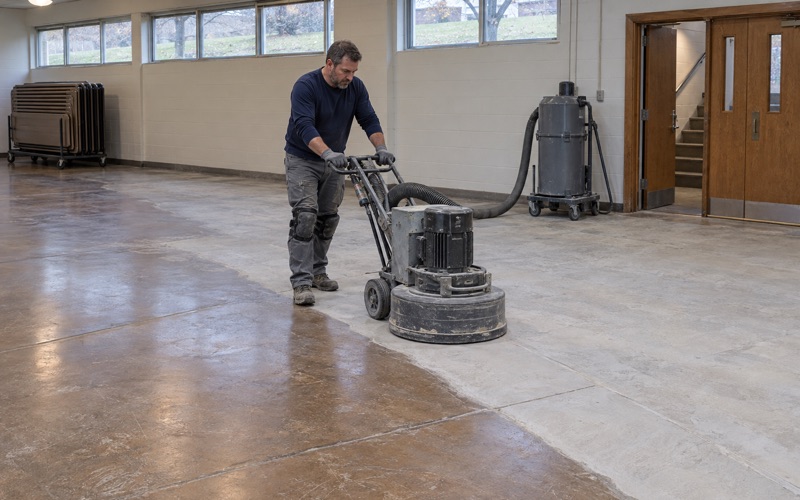
Grinding near a bakery case or a hot-food counter is only acceptable with the dust caught at the machine. Our grinders run tied to a vacuum, and the work zone is closed off with plastic sheeting so nothing travels down an aisle toward open shelving.
Exposed product near a section is covered or moved before the first pass, and that step is agreed with the store’s own staff, who know what can be moved and what cannot. Collected dust is bagged and carried out, never rinsed toward a floor drain.
Texture and section edges in a sales aisle
A grocery floor sees melted ice, produce water and dropped dairy, so traction matters. We specify slip resistance by the broadcast and topcoat used, such as a fine quartz aggregate locked under the final coat, rather than by a word on a brochure.
The boundary between one night and the next needs care too. Each edge is ground and feathered so the next section bonds to it cleanly, and slab joints that move get a flexible treatment instead of being bridged rigidly for a seamless look.
Norridge Garages and Basements
Mid-century slabs under 1950s and 1960s houses
Away from Harlem Avenue, Norridge is a village of owner-occupied houses. Census figures put 82.4 percent of occupied units in owner hands, with 3,971 owner-occupied detached houses, and the largest share of the housing stock was built in the 1950s and 1960s.
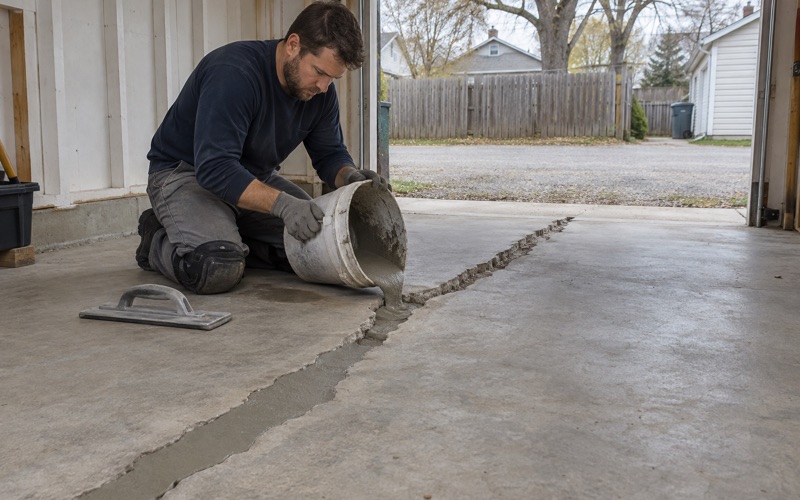
A garage slab that old has usually seen decades of salt, oil and patching. We map cracks, spalls and any old coating first, and we tell an owner plainly when a pad needs repair or replacement before it is worth coating.
Salt, tires and the garage system
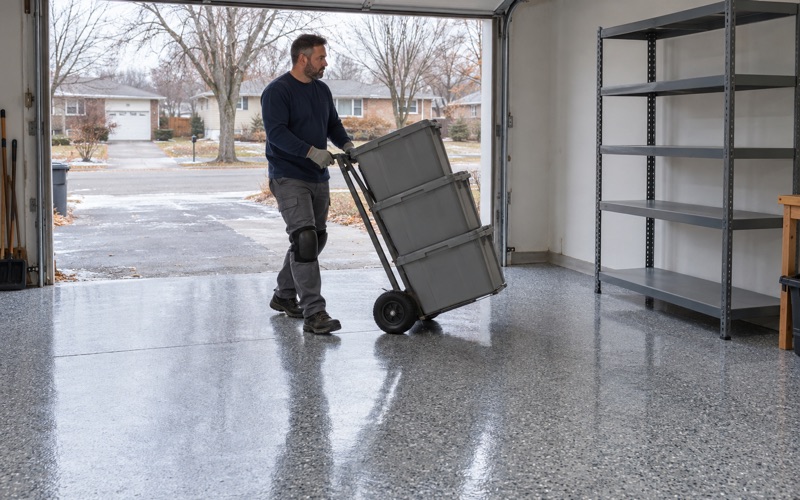
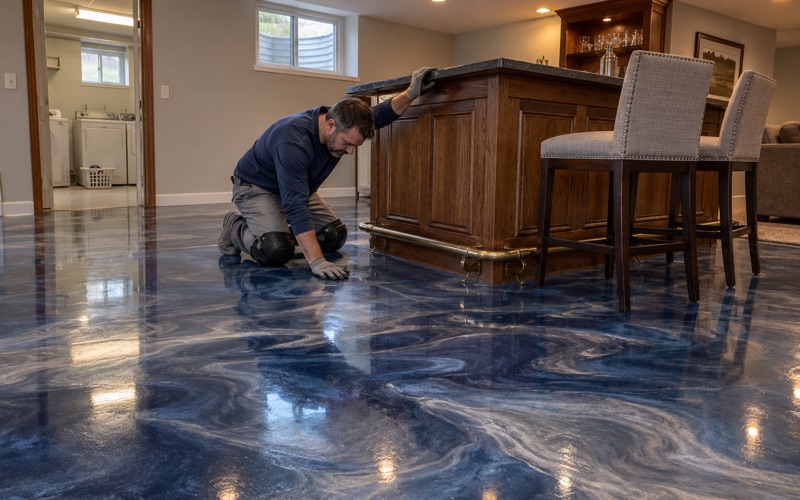
Brine and rock salt ride in on tires every winter, and a garage floor here has to shrug them off. We build garage systems for that exposure, usually a ground slab, an epoxy base with a vinyl flake broadcast, and a topcoat chosen to resist hot tire pickup and salt staining.
Timing follows the slab, not the calendar. Cure schedules are set by slab temperature and dew point, and an unheated garage in the depth of winter is told to wait for warmer weather rather than coated cold.
Basements and the old ‘Swamp’ nickname
Before a local improvement association incorporated it as a village in 1948, heading off an effort by Chicago to annex it, the area was nicknamed ‘Swamp’ for its lack of streets and swamp-like conditions. Nobody has measured whether that history shows in present-day slabs, so we treat it as a reason to test rather than an assumption.
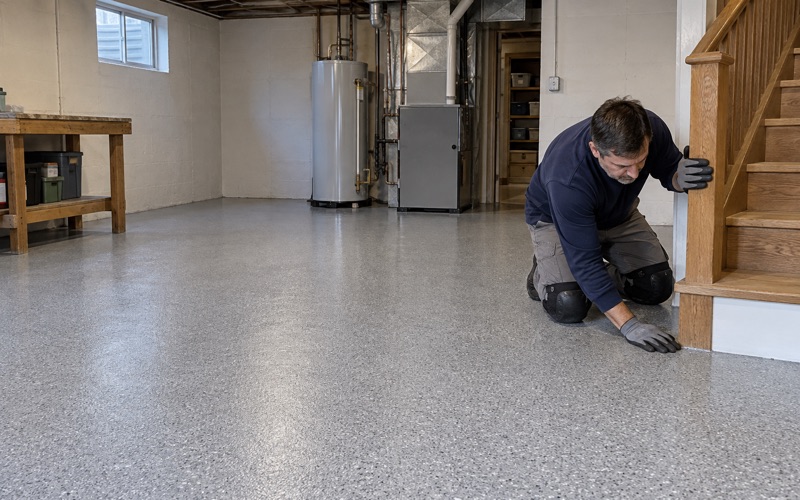
Every basement job starts by reading the floor for past water, including staining, efflorescence and the history of any sump pit. A moisture test, such as an ASTM F2170 relative humidity probe or an ASTM F1869 calcium chloride test, is written into the scope, and moisture is the first exclusion we name in any warranty, because a coating does not stop seepage or sewer backup.
- 20+ Years in Business
- Moisture Tested Before Pricing
- Free Written Estimates