Wheaton Epoxy Flooring has spent more than 20 years on epoxy flooring in Lyons and across the western suburbs, and a good share of that work starts with one question: should this slab be coated again, or should it come out? The answer shapes the price, the schedule and how much mess the job leaves behind. We would rather settle it on the floor itself than on a guess.
Most of the floors we see here already carry something, whether an old garage paint, a worn epoxy or a sealer that has gone cloudy and loose. That history matters twice. It decides how we prepare the surface for a new system, and it changes what happens to the concrete if the slab is broken out instead.
This page walks through that second part, which most coating quotes skip. Removing coated concrete is not the same as removing bare concrete, and the difference shows up in paperwork, testing and disposal. Knowing that before you decide is part of making the coat-or-replace call honestly.
A Clean-Fill Yard on First Avenue
When a slab in Lyons is broken out, the rubble has to go somewhere, and part of the answer sits inside the village. That makes the disposal side of a tear-out less abstract here than in most towns we serve.
Reliable Materials and its Lyons yard
Reliable Materials, part of the Bluff City Materials group, lists a Lyons yard at 4401 South First Avenue, with an office on Lawndale Avenue. The yard geocodes inside the Village of Lyons, in Lyons Township, Cook County. It operates as a clean construction or demolition debris fill site, the kind of facility Illinois regulates under its own set of rules.
The company’s own pages describe clean fill as stone, broken concrete, broken asphalt and dirt, and its incoming-fill application lists concrete without protruding metal as a material category. We have no relationship with the yard or with any hauler, and we have not confirmed what it takes or charges today. What its paperwork shows is the shape of the question a coated slab runs into.
What Illinois counts as clean construction or demolition debris
The Illinois Environmental Protection Agency defines this material as uncontaminated broken concrete without protruding metal bars, bricks, rock, stone or reclaimed asphalt pavement generated from construction or demolition. The short name is CCDD. Bare concrete with the rebar cut flush is the easy case under that definition.
The word doing the work is uncontaminated. Concrete that carries something on its surface is no longer judged only as concrete, and that is where an old garage or shop floor coating enters the picture. A slab that looks like ordinary rubble once it is broken up may still need more than a truck to leave the property.
A rulemaking footnote with a Lyons name on it
Reliable Lyons has appeared in the state’s own fill-rule debate. In an Illinois Attorney General petition in the Supreme Court case over the Pollution Control Board’s fill rules, the brief notes that a fill-site trade association pointed to information from one of its members, Reliable Lyons, about water pumped into the Des Plaines River. That was one association’s claim offered during a rulemaking, not a current environmental finding.
We mention it only because it shows how closely these yards sit inside a regulated system. The rules on what goes into them are written down, argued over and enforced. A homeowner planning a tear-out benefits from knowing that system exists before the jackhammer arrives.
Looking for epoxy-flooring closer to Summit? See Epoxy-Flooring in Summit.
Painted Concrete Needs a Signed Certification
The Illinois EPA treats painted debris as its own case. This section covers what the agency says plainly and where the rule stops short of a coated floor.
The LPC-667 form and who signs it
According to the Illinois EPA, painted CCDD must be certified by a professional engineer or a professional geologist using the LPC-667 form. The agency adds that certification is always necessary for painted CCDD to be used as fill in a CCDD fill operation. There is a narrow exception for roadway debris whose only paint is pavement markings, which does not describe a garage floor.
That means a painted slab headed for a fill site carries a step bare rubble skips. Someone with an engineering or geology license has to review it and sign. That work, and its cost, belongs to the tear-out side of the decision, and it is not something we do or offer.
Sampling the paint is part of the job
The agency also states that sampling and analyzing the paint on the debris is an integral part of the certification process. In practice, the coating itself becomes something to test, not just something to haul. That adds time between demolition and disposal.
For a homeowner, the practical effect is that the schedule for breaking out a coated floor depends partly on people outside the concrete crew. The certifying professional, the lab and the receiving facility each have a say. None of that applies to a slab that stays where it is.
Does a resin coating count as paint?
The Illinois EPA page addresses painted debris and does not name sealed or resin-coated concrete. Whether a pigmented epoxy, a clear sealer or a polyaspartic topcoat is treated as paint is our inference, not an agency ruling. A colored epoxy behaves a lot like a thick paint film on concrete, which is why we raise the question at all.
The honest answer is to ask before anything is broken out. The hauler and the receiving facility are the ones who can say what paperwork a coated load needs. We would rather point you to that question early than have it surface with a loaded truck in the driveway.
Grind It Off, or Keep the Slab and Recoat
Once disposal is part of the comparison, keeping a sound slab often looks better than it did on day one. The deciding factor is still the concrete, so that is where we start.
Reading the slab before anyone picks a hammer
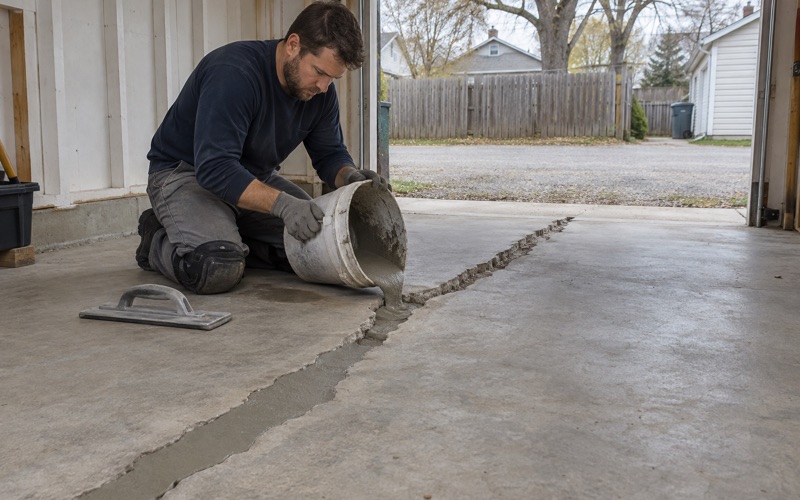
We walk the floor and map cracks, spalls, settled sections and every patch of old coating before quoting anything. When a slab is broken through, heaved or crumbling, we say so plainly, because no coating fixes structural failure. When it is merely ugly, that is a different conversation.
A moisture test is written into the scope before the price is final, using methods such as an ASTM F2170 in-situ relative humidity probe or an ASTM F1869 calcium chloride test. Moisture is the first warranty exclusion we explain, and we explain the rest of them before the job is sold. That way the recoat option is judged on real numbers, not on hope.
Recoating a sound slab
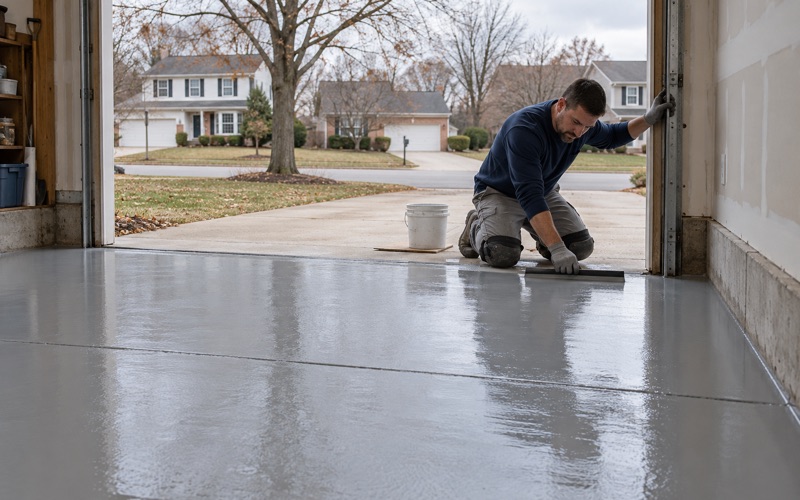
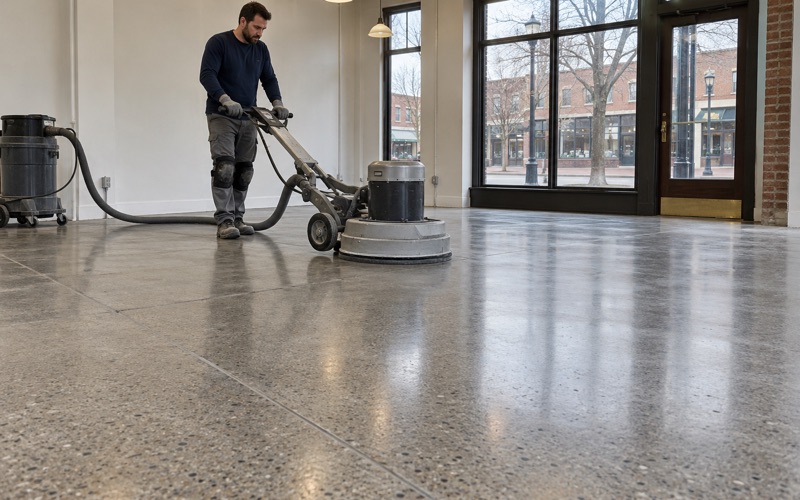
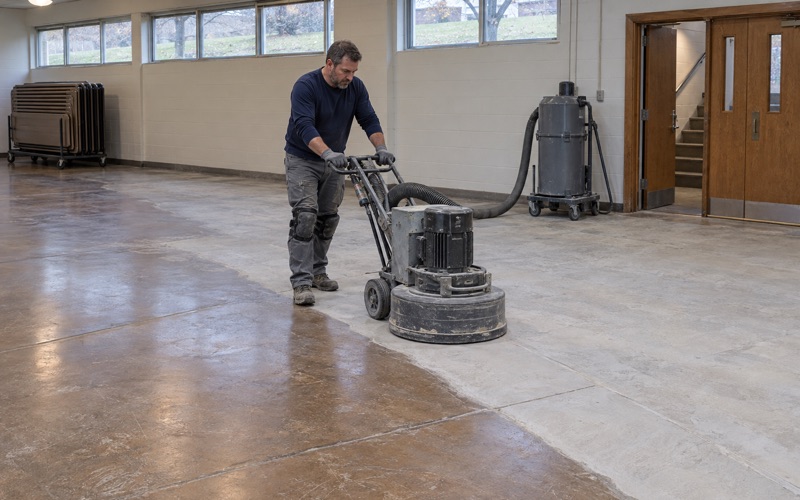
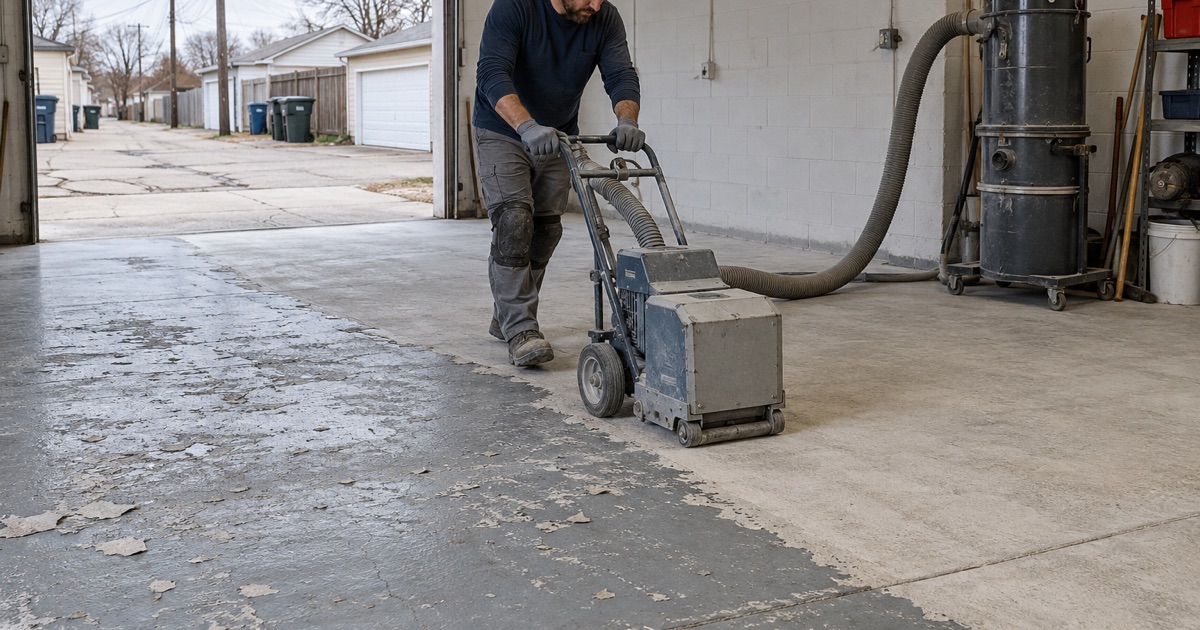
If the concrete is sound, we can usually recoat instead of replace. Every floor is opened with a diamond grinder or a shot blaster, never an acid etch, to reach a concrete surface profile in the ICRI CSP range the chosen system calls for. The old film comes off in that pass, and the new system bonds to clean, profiled concrete.
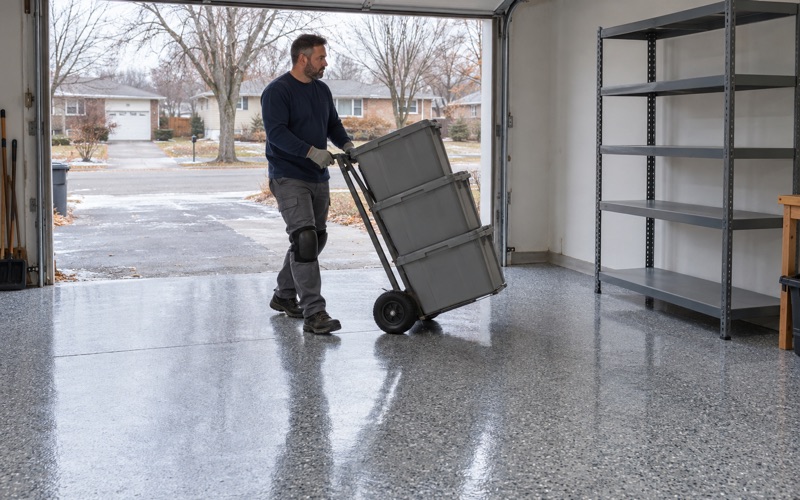
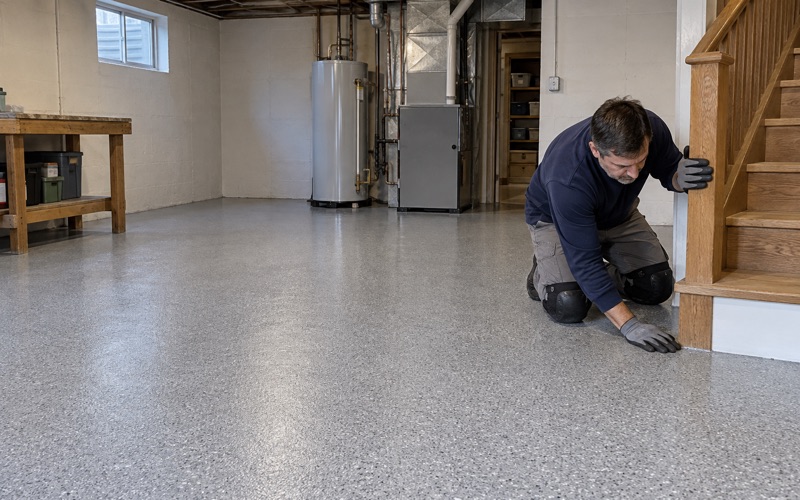
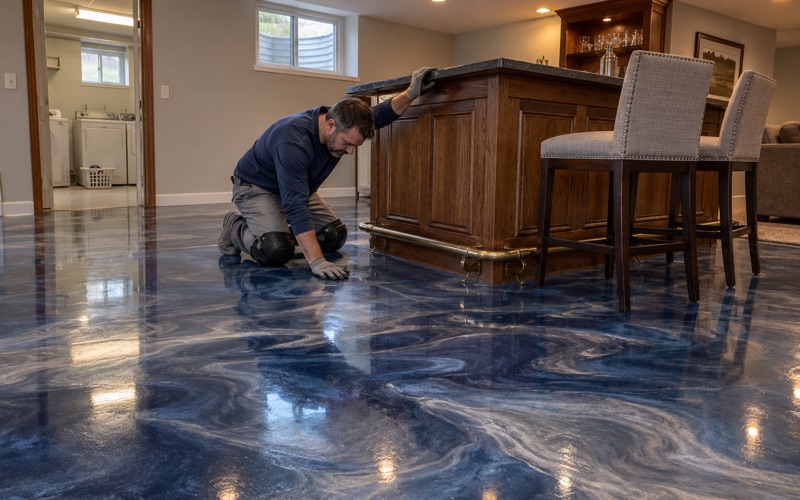
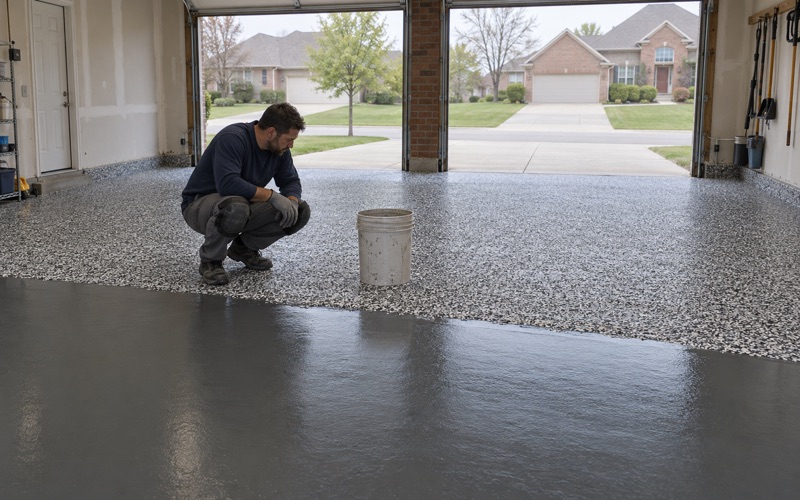
Our proposal names the product line, the number of coats and the finished thickness, so the finished floor can be checked against the quote. For a garage, that often means a 100% solids epoxy base with a vinyl flake broadcast and a polyaspartic topcoat chosen to stand up to brine and rock salt off winter tires. The slab stays put, and nothing leaves the property as debris except bagged dust.
Grinding the old film off before demolition
Sometimes replacement is the right call: a slab that has failed, or a remodel that changes the floor layout. In that case, grinding the old coating off before the slab is broken out is worth discussing with your demolition contractor. Bare concrete is the easy case under the state definition, and a coated slab is not.
Whether that grind pays for itself depends on the size of the floor, the coating and what the receiving facility tells you. Our part is the grinding, done with dust captured at the machine by a vacuum instead of rinsed toward a floor drain or storm inlet. The demolition, hauling and any certification stay with the people licensed to do them.
Replacing a Lyons Garage Slab: Ask Where the Rubble Goes
If you decide a slab has to come out, a few questions up front can save a delay later. They also clarify which parts of the job belong to which trade.
Questions for the hauler and the receiving yard
Ask the demolition contractor where the broken concrete is going and whether that facility needs anything for a coated load. Ask whether metal will be cut flush, since the state definition turns on concrete without protruding metal bars. Ask who arranges any LPC-667 certification if one is needed, and how long it adds.
Those answers come from the hauler and the facility, not from us. We do not demolish, haul, sample or certify anything. What we can do is tell you, in writing, what is on the floor now and how thick it is, which helps whoever handles the rubble.
Where our work begins on a new slab
A freshly poured replacement slab is a separate project with its own timeline. New concrete needs to cure and dry before a resin system goes down, and we test it the same way we test an old floor. Cure schedules follow slab temperature and dew point rather than the calendar, so an unheated garage in deep winter may be told to wait.
On home projects over the state threshold, you receive a written contract and the Illinois Home Repair: Know Your Consumer Rights pamphlet before any grinding starts. Products are chosen inside the Illinois VOC limits for floor coatings, which bind the applicator as well as the maker. Whether the slab stays or goes, the goal is a floor in Lyons that matches what the paperwork says it is.
- 20+ Years in Business
- Moisture Tested Before Pricing
- Free Written Estimates