Wheaton Epoxy Flooring has handled epoxy flooring in Lemont and across the western suburbs for more than 20 years, and some of the floors that teach us the most are the ones where color, not traffic, does the damage. Pigment powders, cooking spice and lamp fuel can mark a floor that has never seen a forklift or a winter tire. This page is about building a floor that holds up to that kind of exposure.
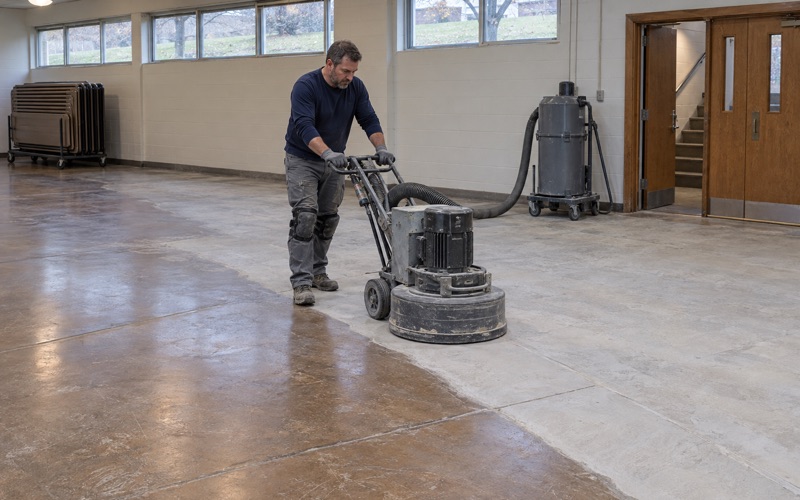
Every job starts the same way. We open the slab with a diamond grinder or a shot blaster rather than an acid etch, we test for moisture as part of the written scope before the price is final, and the proposal names the product line, coat count and finished thickness so you can check the floor against the paper.
What changes from room to room is the top of the system. A kitchen, a prayer corner or a shared hall where powders and oils are handled needs a sealed, nonporous surface and a topcoat chosen for stain resistance, in a color that does not show every spill. We explain the tradeoffs, and the limits, before anything is sold.
Puja Kits, Turmeric and Why It Stains Like a Dye
What the Lemont Road temple sells
The Hindu Temple of Greater Chicago, on Lemont Road in the DuPage County part of the village, publishes samagri lists for its pujas. Its Navagraha Homam sheet offers a $70 package from the temple that includes turmeric powder, kumkum powder, chandan (sandalwood) powder, camphor, wick, havan samagri and a bottle of ghee. Six other puja sheets are linked beside it.
We have no relationship with the temple and have not seen its floors, so nothing here describes them. What the list does is name, precisely, the materials that families carry home and handle on their own floors, and those materials behave very differently from mud or road salt.
Curcumin is a pigment, not a spill
Turmeric gets its color from curcumin. One stain-removal guide puts it plainly: curcumin “behaves more like a dye than a food spill.” A dye does not sit on top of a surface waiting to be wiped; it moves into whatever will accept it.
That same guide, written for hardwood, says turmeric “quickly penetrates the protective wax or polyurethane coating” and that if it sits, “the color deepens and becomes significantly harder to lift from porous surfaces.” It is consumer guidance about wood, not a test of any resin floor, but the mechanism it describes is the one we plan around.
Kumkum and sandalwood in the same tray
Kumkum is a deep red powder and sandalwood powder is fine and pale, and both come in the same kit as the turmeric. Fine powder settles into texture, seams and the pores of bare concrete, and a damp mop can carry it further before it lifts it.
That is why we treat the whole tray of offerings as one exposure rather than three. A floor that resists one pigment but has open texture or a worn spot will still collect the others. On a sealed floor all three usually lift with a dry cloth if they are caught early, while open concrete keeps a shade of each.
Looking for epoxy-flooring closer to River Grove? See River Grove Epoxy-Flooring.
Porous Concrete, Thin Finishes and Color That Deepens Overnight
Bare and lightly sealed slabs
Plain concrete is porous by nature, and a slab with only a thin penetrating sealer or a worn floor paint is not much better. Yellow and red powders that land there can migrate into the surface, and a mark left overnight is usually a harder problem by morning than it was at dinner. That is the same deepening the stain guide describes, playing out on a surface that is open rather than finished.
Before we quote, we look at what is already on the slab. Cracks, spalls and old coatings are mapped first, and if the concrete needs repair or replacement before a coating makes sense, we say so in writing. Grinding dust is captured at the machine with a vacuum, never rinsed toward a floor drain.
Why a thin film is not enough
A worn or thin film has the same weakness the hardwood guide describes: once the pigment reaches through the finish, the stain sits underneath what you can clean. Thin decorative coats also wear first along walking paths, which are often exactly where trays are carried and set down.
A properly built system has enough thickness to stay intact in those paths. We specify 100% solids epoxy or a comparable body coat for build, and the proposal states the finished thickness so you know what you are paying for. Where a room will see daily trays and lamps, we would rather add a coat at installation than leave you recoating a worn lane a few years later.
Moisture comes before color
A coating that blisters or lifts invites stains under its edges, so the moisture reading comes ahead of any talk about colors. Depending on the slab, we use ASTM F2170 in-situ relative humidity probes, ASTM F1869 calcium chloride testing or a quick ASTM D4263 plastic sheet check.
If the readings call for it, a moisture-mitigation primer goes into the scope. We also tell you what a coating warranty excludes before the job is sold, and moisture vapor transmission is the first exclusion we name.
Sealed Floors, Stain-Resistant Topcoats and Forgiving Colors
What the topcoat has to do
The body coat gives a floor its build, but the topcoat is what turmeric and kumkum actually touch. For a room where pigments and oils are handled, we choose a stain-resistant topcoat, often a polyaspartic or a chemical-resistant urethane, because those finishes close the surface more tightly than a plain epoxy top layer.
No coating is stain-proof, and we will not describe one that way. A good topcoat buys you time: a spill that would set into bare concrete can usually be wiped cleanly if it is caught while fresh. Fresh is the word that matters, because the guide’s warning is about color left to sit.
Choosing a color that forgives yellow and red
Color is a practical decision in these rooms. A warm tan, a mid-gray or a blended flake in brown, red and gold hides a faint yellow shadow far better than a bright white or a pale solid gray. Very dark solids carry their own problem, since pale sandalwood powder and everyday dust show on them just as clearly.
A vinyl flake broadcast also breaks up the floor visually, so a small tint along a seam or under a lamp stand does not read as a stain. We bring sample boards so you can judge the choice under your own lighting before anything is installed.
Texture without traps
Slip resistance matters where ghee or lamp oil can reach the floor, but a heavy aggregate gives powder places to hide. We specify texture by the broadcast and the topcoat used, choosing a finer grit where pigments will be handled so the floor keeps its grip without becoming a powder catcher.
That balance is written into the proposal rather than left to the crew on the day. If a room needs more grip than a fine texture can give, we explain the cleaning tradeoff before you choose.
Turmeric, Ghee and Lamp Oil in Lemont Homes
Spice-heavy kitchens
Lemont’s housing is newer than many people expect: about 63 percent of homes were built since 1990, and almost every owner-occupied home is single-family. A household that cooks with turmeric every day handles the same pigment the temple list names, and a lower-level kitchenette or a garage prep area takes the same abuse as the main kitchen.
Those rooms can be built with a sealed body coat and a stain-resistant topcoat. We read a basement for past water first, because a coating does not stop seepage or sewer backup, and we never sell a floor coating as radon reduction. Around the range and prep counter, where spice jars are opened and powder drifts most, we keep the topcoat continuous to the cabinet base rather than stopping short.
Home prayer corners
A prayer corner or a small shrine room collects the same materials the samagri lists name, often in a tight space with lamps, camphor and a tray set low. Powder that falls there is wiped, swept and walked over many times a week, so the topcoat in that corner matters more than in the rest of the room.
We can coat a single room or zone instead of a whole level when that is what the space needs. Ghee and lamp oil are not pigments, but they leave a film that holds powder, so the same fresh-wipe habit covers both.
Cleaning while it is fresh
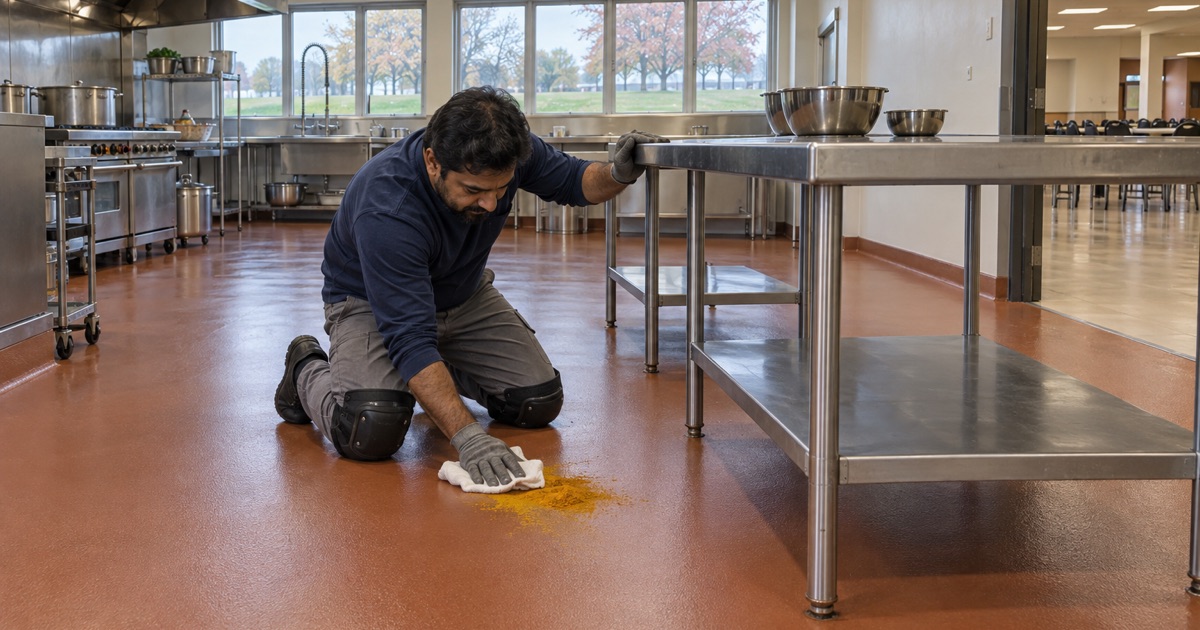
The habit that does the most work is simple: lift pigment powder while it is dry and fresh, then clean the spot with a damp cloth and a mild cleaner. Pushing dry turmeric around with a wet mop turns a small spill into a wide one.
For a mark that has already set, the hardwood guide notes that hydrogen peroxide “chemically alters the structure of the curcumin molecule.” Try anything on a hidden spot of your own coated floor first, since that advice was written for wood and not for a resin system.
Cure schedules follow slab temperature and dew point rather than the calendar, so we plan installation around the days a room is needed, and an unheated garage in deep winter is told to wait. Lemont’s contractor registration terms could not be read from the village website, so we confirm them with the Village of Lemont Building Department before a start date is set.
- 20+ Years in Business
- Moisture Tested Before Pricing
- Free Written Estimates