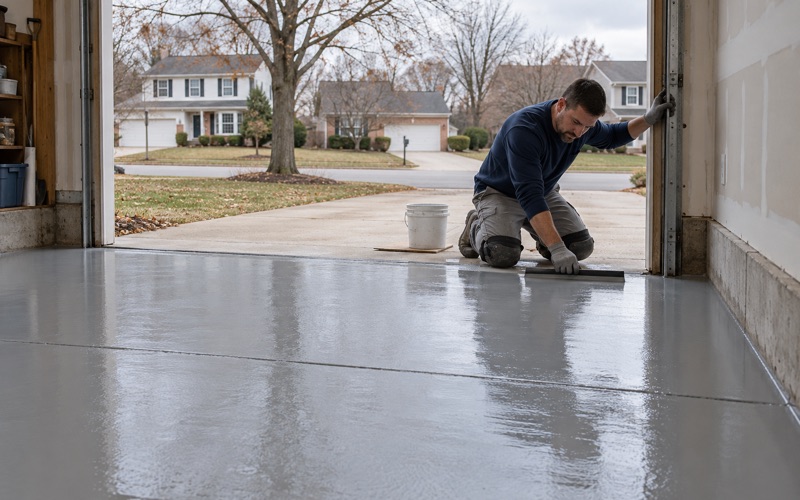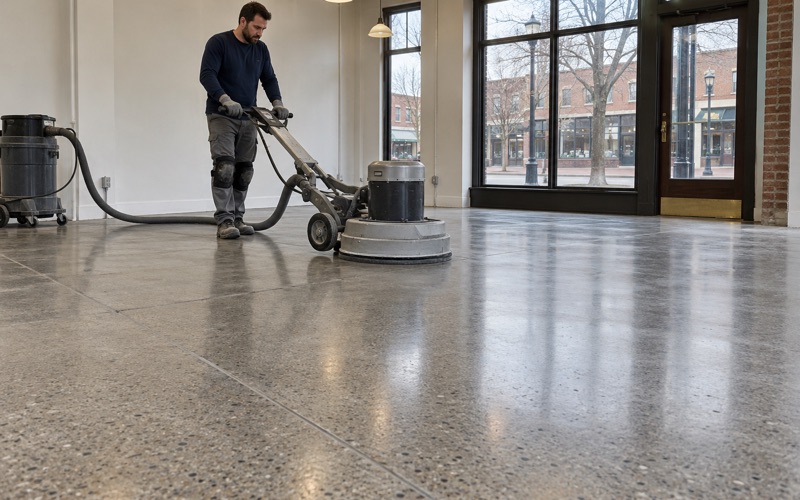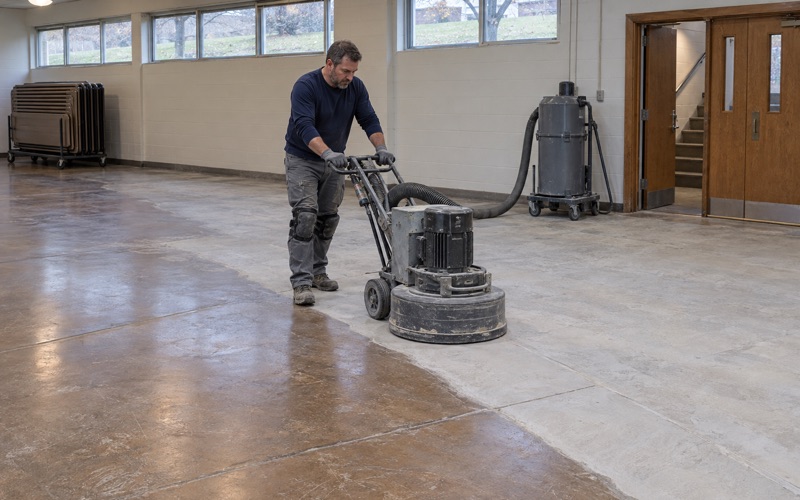
Wheaton Epoxy Flooring has handled epoxy flooring in La Grange Park and across the west suburbs for more than 20 years, and every job starts with the slab rather than the color chart. We open the concrete with a diamond grinder or a shot blaster, never an acid etch, and we map cracks, spalls and old coatings before anyone talks about finishes. A moisture test sits inside the written scope, so the price is not final until we know what the slab is doing.
A commercial kitchen adds a question no grinder can answer. Where a restaurant cooks over wood or charcoal, the floor in front of that appliance belongs to the fire code before it belongs to any flooring contractor. Our plan has to start at that boundary instead of running straight through it.
This page covers where that boundary comes from, how we finish a floor that stops at it, and what changes when the same work moves into a house garage or basement. Each proposal we write names the product line, the number of coats and the finished thickness, so an owner can hold the floor up against the paper.
A Wood-Fired Oven Changes the Floor in Front of It
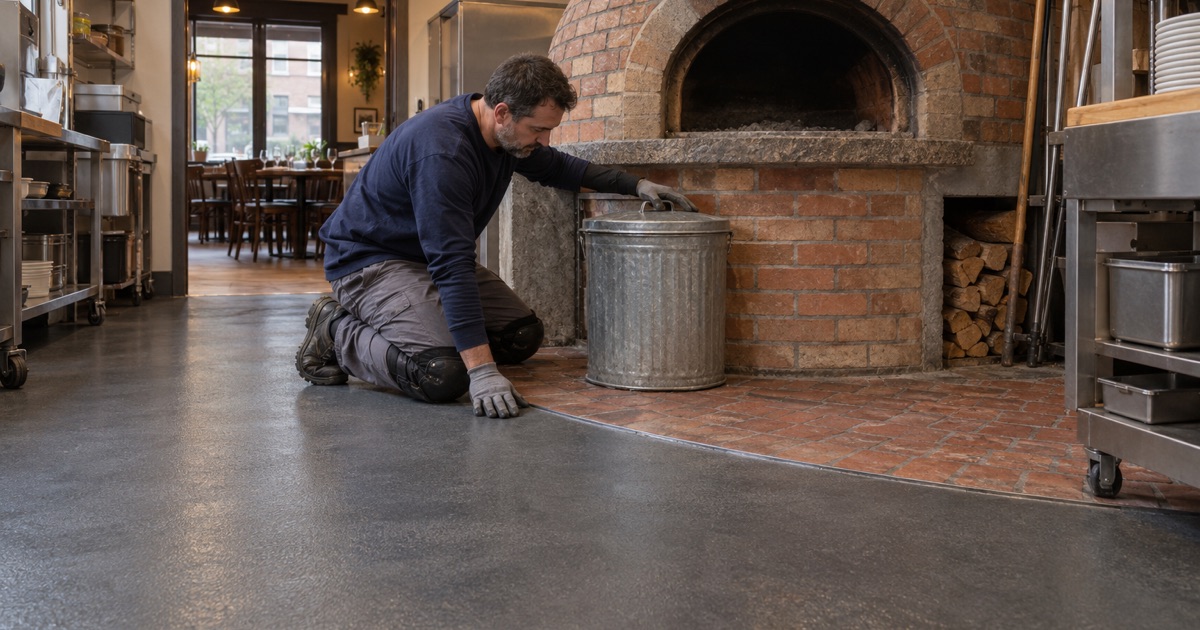
Mattone and the brick oven on 31st Street
Mattone Restaurant and Bar, at 9 East 31st Street, is a wood-fired Italian restaurant with a brick oven centerpiece, and its name means “brick” in Italian. Brothers Franco and Vito Francese took over the family business from their father in 2013 and renamed it from D’s Little Italy. We have no connection to the restaurant and have not seen its oven, its hearth or its floor.
We use it here because it is the clearest local example of a kitchen where the floor question starts with fire. A few doors east, Hop District Brewing serves no food of its own and lets patrons order Mattone dishes to their tables, so one wood-fired brick oven can feed two rooms on the block. A hearth that busy means steady foot traffic, carts and ash handling across the floor right in front of it.
What the fire checklists quote
Local fire-marshal inspection checklists quote NFPA 96, the standard for commercial cooking operations, on solid-fuel appliances. They are to sit on floors of noncombustible construction that extend 3 feet in all directions from the appliance, unless the appliance is listed for a smaller clearance. The checklists cite that as section 14.9.1.
We read that rule through those checklists, not through the standard itself, and section numbers shift from one edition to the next. So we never tell an owner which edition applies or what it permits. The La Grange Park Fire Department, which sits within the village’s Department of Fire and Emergency Management, decides what it enforces and how it reads a particular oven.
The listing comes before the finish
The exception in that rule matters as much as the rule. An oven listed for a smaller clearance changes the size of the ring, which makes the manufacturer’s listing the first document we ask to see. Until that listing and the fire department’s answer are both in hand, there is no honest way to draw the line where a coating may begin.
Looking for epoxy-flooring closer to La Grange? See La Grange Epoxy-Flooring.
Where the Coating Stops, and What Sits Inside the Ring
Resin is a film, not masonry
Epoxy, polyaspartic and urethane cement systems are all resin-bound, and a resin film burns even when it is thin. We never call a coating noncombustible, fire-rated or safe around any oven, because none of those claims is ours to make. What we can do is raise the question early and plan the floor around the answer.
That answer usually takes one of two shapes. Either the fire department and the oven’s listing allow a particular system closer in, or the ring stays tile, brick or bare noncombustible concrete and the resin stops at its edge.
Ending the coating at a hearth or tile apron
A coating that simply feathers out against a hearth will lift at that edge, because carts and mop water catch it there first. We sawcut a clean termination line, key the system into the cut so it ends at full thickness, and keep the edge flush with the apron so a wheel rolls across instead of snagging. Where tile meets resin, the joint between them is detailed so cleaning water does not pool in it.
The floor outside the ring gets the same preparation as any other: grinding or blasting to an ICRI concrete surface profile the primer can actually grip. On a cook line we usually look at urethane cement, because steam, hot water and oven heat punish a standard epoxy, and a quartz aggregate broadcast gives a wet kitchen floor its texture.
Who signs off on what
We hold no license or certification that would let us approve anything, and we give no fire-code approval. The fire department rules on the ring, the Cook County Department of Public Health inspects food-service surfaces, and building questions go to the village’s Department of Building and Inspectional Services, whose code reviews are handled by an outside consultant. We ask what a coating scope requires before we quote a schedule, not after the floor is down.
Embers, Ash Cans and the Edge of the Finish
Where embers land
A wood-fired oven drops embers when it is fed and again when it is cleaned out. Most of them land nearest the oven mouth, which is exactly the floor the 3-foot ring exists to protect. We set the coating edge where embers land least, and that is often a little beyond the minimum ring rather than right on it.
The finished floor outside the ring still sees the odd stray ember carried on a peel or a boot. A textured broadcast floor hides small scorch marks far better than a glossy smooth one, and a urethane cement shrugs off heat that would mark a thin epoxy film.
The route to the ash can
One mobile-unit checklist, citing the 2017 edition, has ash removed from the firebox at least daily into a closed metal container kept at least 3 feet from any cooking appliance. That can has to travel, and its route across the kitchen is a wear lane we can plan for. We walk it with the staff, keep it on the toughest part of the system, and make sure no termination edge crosses it where a can or a dolly would catch.
Ash itself is gritty, and a little of it rides out on every trip. A floor with a sealed, nonporous topcoat lets that grit be swept and mopped away instead of being ground into the surface by every shoe that follows.
Working around service
We phase restaurant floors around opening hours, which in an evening kitchen usually leaves mornings, overnight windows and closed days for the work. Cure schedules follow slab temperature and dew point rather than the clock, so a floor coated overnight reopens only when it has actually cured. Grinding dust is captured at the machine by a vacuum rather than washed toward a floor drain.
31st Street Kitchens, and Home Floors in La Grange Park
Kitchens with no fire on the floor
Mattone is not the only kitchen on 31st Street, and most commercial kitchens do not burn wood at all. A cafe or bar kitchen without a solid-fuel appliance has no ring to plan around, so its floor is chosen for grease, hot water, cleaning chemicals and footing. On those floors a slip-resistant finish is specified by the broadcast and topcoat named in the proposal, never promised as a slogan.
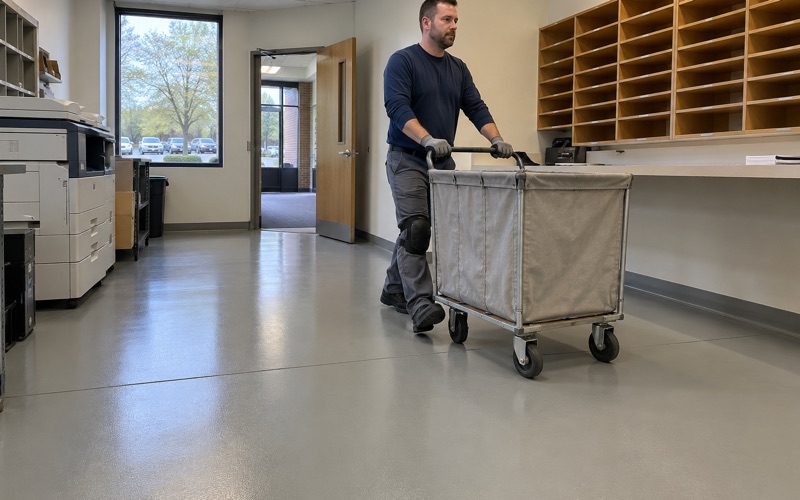
Grease travels farther than most owners expect, out of the cook line and into prep areas and back hallways. We extend the heat- and chemical-resistant system as far as the grease does, then step down to a lighter system in the dry rooms beyond.
Garage floors in the village
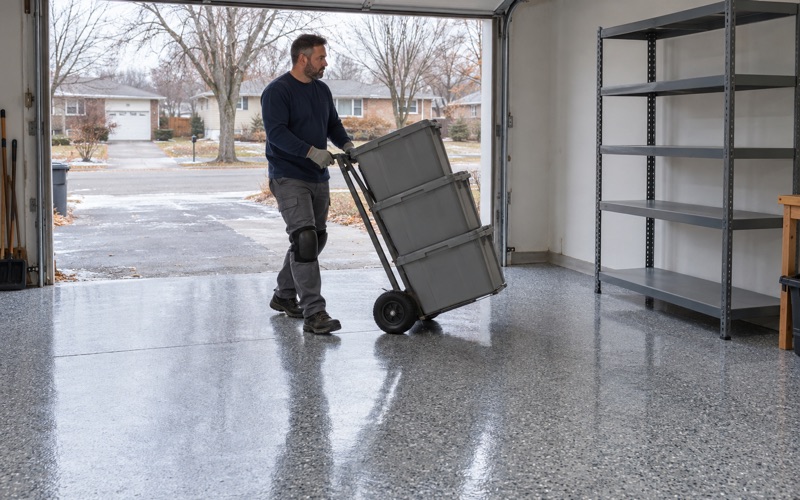
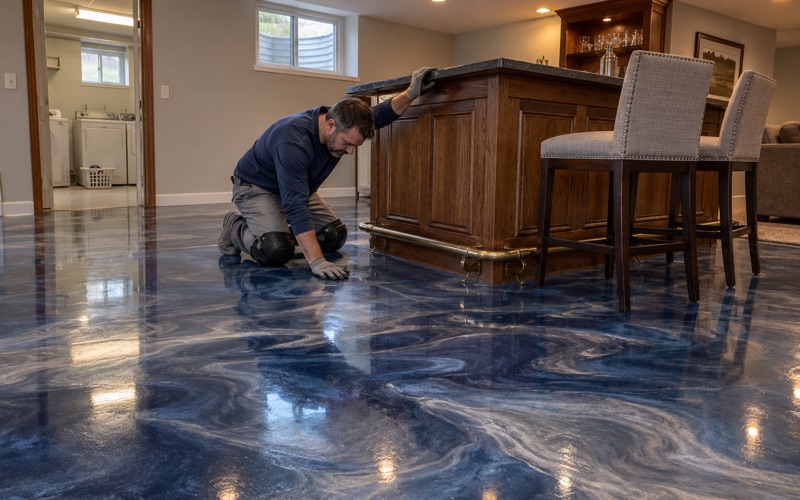
La Grange Park is a village in Cook County about 13 miles west-southwest of Chicago, and its home garages take the same winter that every Chicago-area driveway does. Brine and rock salt ride in on the tires from the first snow onward, so we choose garage systems that hold up to deicers and specify a broadcast and topcoat that resist hot tire pickup. In an unheated garage in deep winter, the honest advice is to wait for warmer slab temperatures.
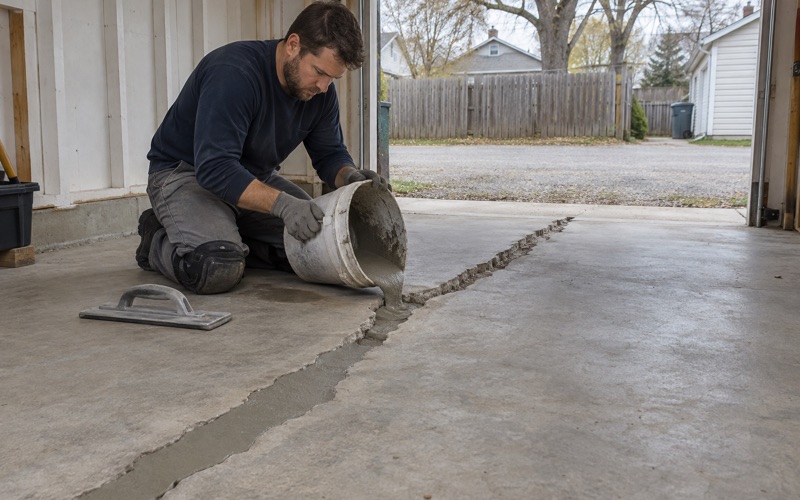
We also map every crack and spall before quoting, and we say plainly when a garage slab needs repair or replacement before it should be coated. A coating bonded to failing concrete only fails along with it.
Basements, paperwork and permits
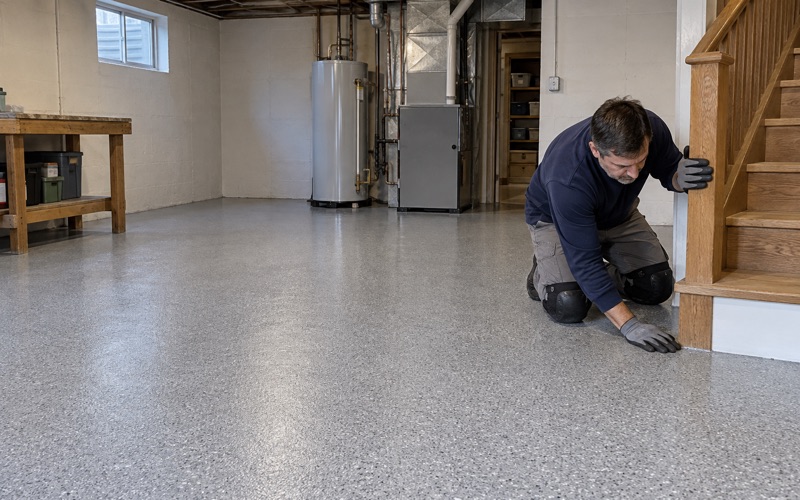
In a basement we read the slab for past water first, because a coating does not stop seepage or sewer backup, and moisture is the first exclusion we name when we explain a warranty. Testing can mean an ASTM F2170 relative humidity probe or an ASTM F1869 calcium chloride test, and the result decides whether a moisture-mitigation primer belongs in the system.
The village’s own permit guidance lists painting or surface coating among the work exempt from a permit, though we still ask the Building Department before quoting a larger scope. Home jobs over the state threshold get a written contract and the Illinois consumer-rights pamphlet before any grinding starts, and we never sell a floor coating as radon reduction.
- 20+ Years in Business
- Moisture Tested Before Pricing
- Free Written Estimates