Wheaton Epoxy Flooring has spent more than 20 years installing epoxy flooring in La Grange and the surrounding suburbs, and the floors we think hardest about are the ones where a lifted edge is more than a cosmetic problem. A tile that pops loose or a crack that opens across a hallway is a trip edge first and a repair ticket second. We build resin floors that remove those edges instead of patching them one at a time.
Every job starts the same way, whether it is a care-home corridor or a basement under a family house. We map cracks, spalls and failed coverings before anything is priced, and we tell you plainly when a slab needs repair before a coating belongs on it. A moisture test is written into the scope, so the number you sign reflects what the concrete actually showed us.
The proposal then names the product line, the coat count and the finished thickness. That gives a facilities manager or a homeowner something concrete to measure the finished floor against. The sections below cover how that works in a regulated building and in an ordinary basement.
A Skilled Nursing Building on Willow Springs Road and the Rule Behind It
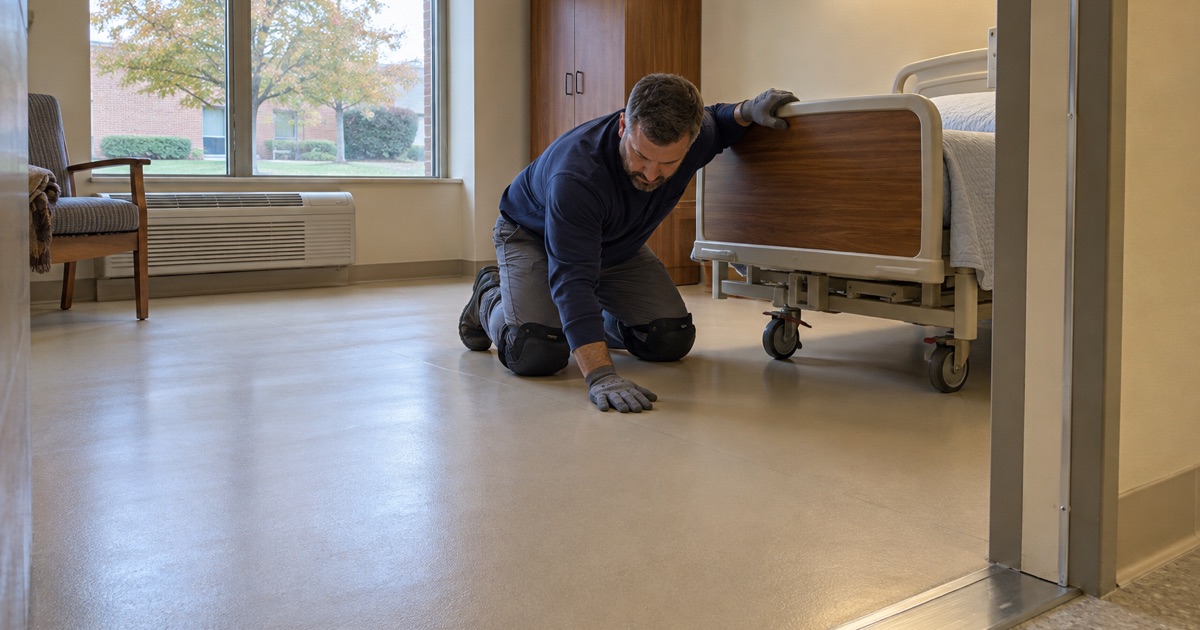
Lexington Health Care Center
Lexington Health Care Center sits at 4735 Willow Springs Road, inside the Village of La Grange in Lyons Township, Cook County. The village’s 2023 financial report ranks it sixth among principal employers, with 102 people. Directories now list Bella Terra La Grange at the same address and phone number, describing sub-acute rehab, wound care and long-term skilled nursing.
We have no connection to the building and have not seen its floors. We use it here because it shows the kind of property where flooring decisions are shaped by a state rule rather than taste. Any skilled nursing or sub-acute rehab building in the village works under the same text.
What 77 Ill. Adm. Code 300.2210 says about floors
Illinois sets maintenance duties for skilled nursing and intermediate care facilities in 77 Ill. Adm. Code 300.2210. Subsection (a) requires every facility to have an effective written plan for maintenance, including sufficient staff, appropriate equipment and adequate supplies.
Subsection (b)(1) requires the building to be kept in good repair, safe and free of cracks in floors, walls or ceilings and warped or loose boards. The same clause also lists warped, broken, loose, or cracked floor covering, such as tile or linoleum.
That wording names the exact failures a tile floor produces as it ages. A cracked slab telegraphs through the covering, a seam opens, and a corner lifts. In a care home that lifted corner is a trip edge for a resident and an item an inspector can write down, which is why the rule spells it out.
What the rule does not require
The rule asks for repair. It does not name a material, and it does not call for epoxy or any other resin. A building can meet it with well-kept tile, and no floor of any kind guarantees a clean survey.
What a seamless floor can change is how often the same item comes back. That is a maintenance-plan question, and it is where we focus when a facility asks us to look at a corridor.
Looking for epoxy-flooring closer to North Aurora? See Epoxy-Flooring in North Aurora.
Loose Tile, Cracked Floors and the Written Maintenance Plan
Why tile keeps returning to the list
Tile and sheet linoleum are assemblies of pieces held down by adhesive, with joints between them. Each joint is a place where cleaning water or slab movement can work in, and each piece is a separate thing that can let go. When the slab beneath has a crack, the covering over it tends to fail along that same line again after every replacement.
That pattern shows up in a written maintenance plan as recurring entries: the same hallway, the same doorway threshold, reset again. The labor and the closed-off area are the real cost, more than the tile itself.
How we survey a facility floor
Before we price anything, we walk the floor and map every crack, spall, hollow-sounding tile and failed seam. We pull samples where coverings come up to see what the adhesive and the slab look like underneath. Then we test moisture on the exposed concrete, using ASTM F2170 in-situ relative humidity probes or ASTM F1869 calcium chloride testing as conditions call for.
That survey becomes part of the written scope. It tells the facility which areas need slab repair first, which can go straight to coating, and where the readings call for a moisture-mitigation primer. If a slab should be repaired or replaced before it is coated, we put that in writing.
Working around the people who live there
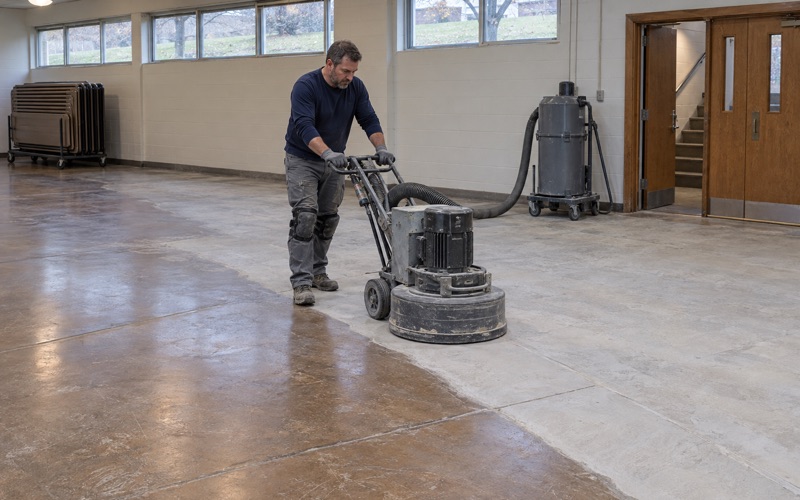
A skilled nursing building does not close, so the work is phased by wing or corridor, with overnight and weekend windows where staff can route around it. We plan each zone with the administrator so resident rooms, therapy space and exits stay reachable. Grinding dust is pulled into a vacuum at the machine instead of being rinsed toward a drain.
Cure time sets the order of zones more than anything else. We follow slab temperature and the dew point spread at the surface, not a calendar date, and hand a corridor back only when the system can take traffic.
Seamless Floors With Nothing to Lift, Over Cracks Repaired First
Repairing the slab before it is coated
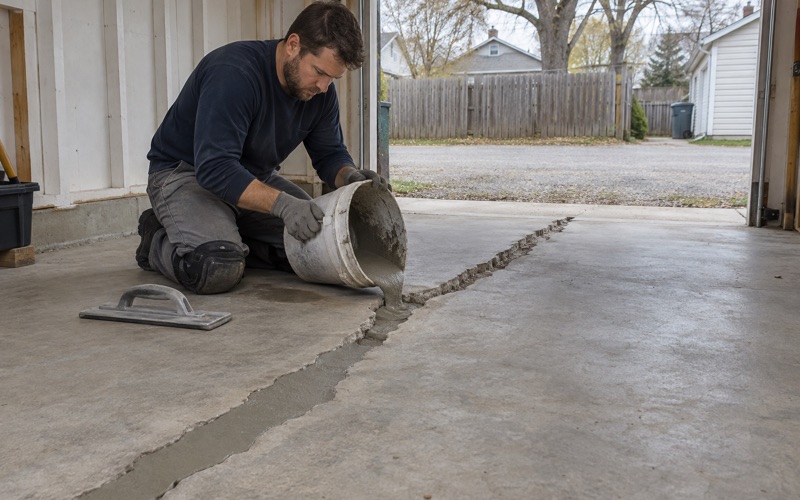
Removing old tile and adhesive exposes cracks that stayed hidden for years. We open the slab with a diamond grinder or shot blaster to a measured ICRI concrete surface profile, never an acid etch, then route and fill the cracks and patch spalls with materials compatible with the system going on top. A crack carried into a new coating without repair simply becomes the next entry on the list.
Moving cracks and control joints are treated as joints rather than buried, because a rigid resin will mirror any movement beneath it. We mark those locations on the floor plan so the maintenance staff know exactly where to look later.
What a seamless system takes away
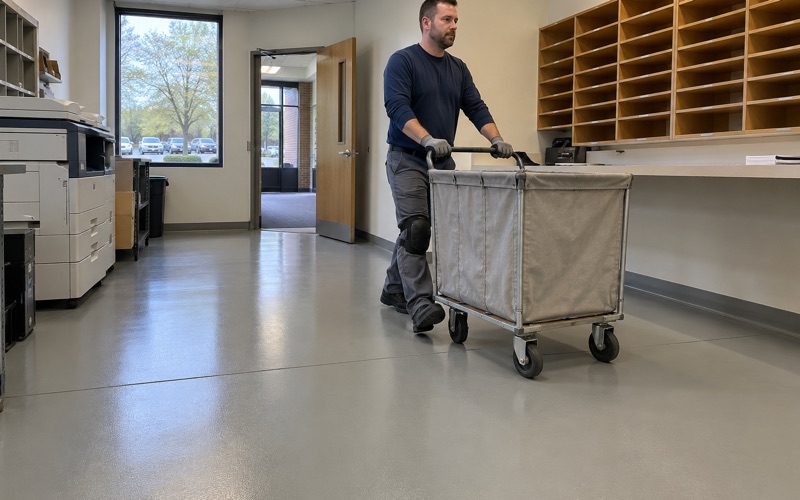
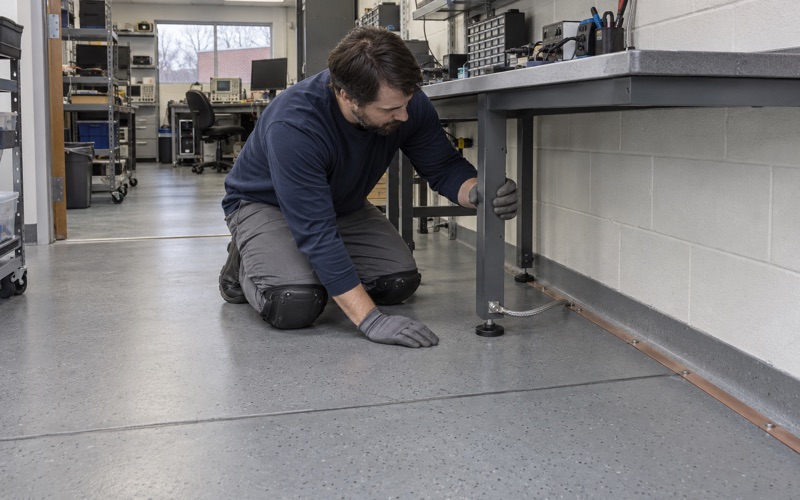
A 100% solids epoxy system placed as one continuous layer has no individual tiles to loosen and no seams to open. There is nothing to warp or curl at an edge, and nothing to reset after a cart catches it. The covering and the slab become a single bonded surface.
A quartz aggregate broadcast locked under a clear topcoat builds a hard wearing layer for wheelchairs, carts and beds rolling over it every day. Where a corridor has to return to service quickly, a polyaspartic topcoat can shorten the wait between coats.
Keeping the maintenance plan honest
A coated floor still belongs in the written maintenance plan. Topcoats wear in heavy traffic lanes and can be recoated without removing the base system, which is a scheduled task rather than an emergency. Before the job is sold, we explain what the coating warranty leaves out, and moisture vapor transmission is the first exclusion we name.
The aim is fewer recurring floor-covering entries, not a promise about any inspection. The facility still checks its floors, still repairs what it finds, and still documents the work.
Cracked and Loose Floor Tile in La Grange Basements
Old tile over a tired slab
The same failure shows up at home. Plenty of La Grange basements carry vinyl or ceramic tile laid by a previous owner, now lifting at the corners where the slab has cracked or water has crept underneath. About 81.5 percent of the village’s occupied homes are owner-occupied, so the person deciding on a basement floor is usually the household living above it.
We read a basement for past water first, because a coating does not stop sewer backup or seepage. Efflorescence, tide lines on the walls and a sump pump that cycles often all tell us what the slab has been through.
Testing, repair and the right system
After the old tile and mastic come up, we grind the slab, map the cracks and run a moisture test before the price is final. A plastic sheet test under ASTM D4263 can flag a problem quickly, and relative humidity probes give the reading that decides whether a moisture-mitigation primer goes down first. Cracks are repaired before any coating goes on, just as on a commercial job.
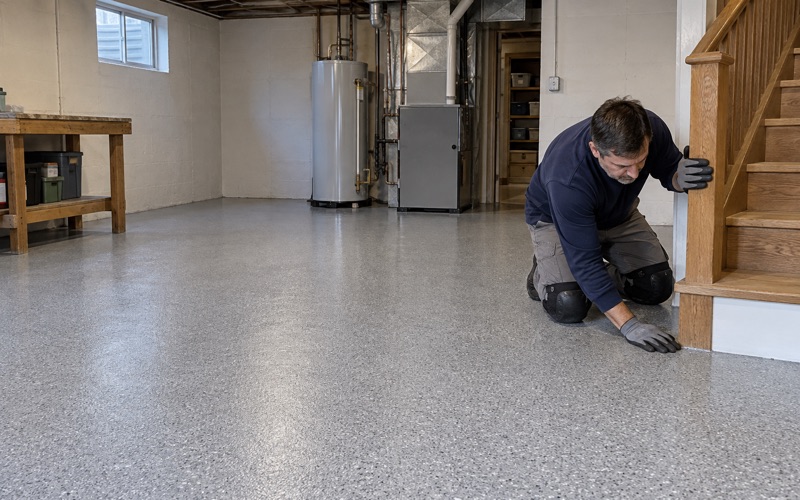
A vinyl flake broadcast over epoxy makes a practical basement floor that cleans with a mop and leaves no tile to lift. We never sell a floor coating as radon reduction, because in Illinois that is mitigation work regulated under IEMA’s radon program.
Permits and paperwork in the village
The Village of La Grange’s own permit guidance says replacing existing flooring does not need a permit, while finishing a room in a basement does. The page does not mention floor coatings, so we confirm with Community Development before scheduling when a coating is part of a larger basement project.
Home jobs above the Illinois threshold get a written contract and the Home Repair: Know Your Consumer Rights pamphlet before any grinding starts. Products are chosen inside the Illinois VOC limits for floor coatings, which apply to whoever puts them down.
- 20+ Years in Business
- Moisture Tested Before Pricing
- Free Written Estimates