Wheaton Epoxy Flooring has spent more than 20 years installing epoxy flooring in Justice and across the region on slabs that carry real work, and a truck repair bay is about as demanding as that work gets. Diesel, engine oil, wash water and road salt all land on the same concrete, and all of it is meant to leave the room through the drains. A coating there has to serve the drainage first and look good second.
That order of priorities shapes every bay we quote. We open the slab with a diamond grinder or a shot blaster rather than an acid etch, map the cracks, spalls and any old coating before a price is set, and write a moisture test into the scope. The proposal then names the product line, the number of coats and the finished thickness, so a shop owner can hold the finished floor up against the paper.
What a coating cannot do matters just as much in a repair garage. We do no plumbing, so we never install, move or cap a drain, and a coated floor does not make any drain meet code. The sections below explain where our work ends and the plumbing begins.
Repair Bays on South 86th Court and the Illinois Interceptor Rule
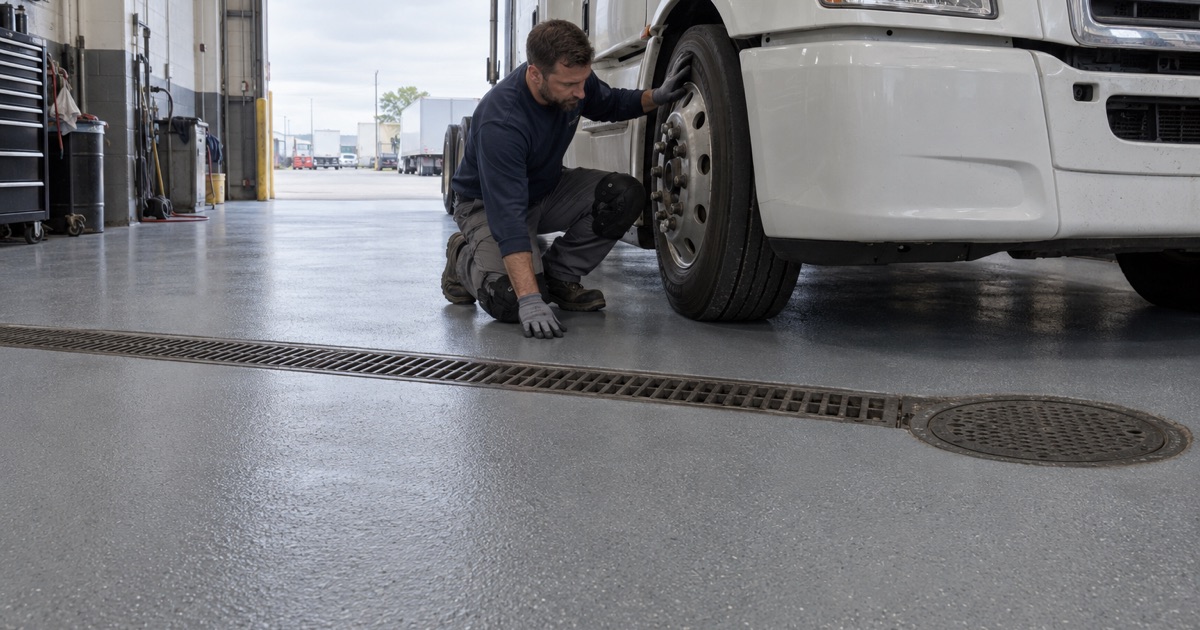
A repair-garage floor in Illinois is tied to the plumbing code in a way a showroom or a basement floor is not. Knowing that rule, and the street where it applies most visibly in Justice, is the starting point for any bay we coat here.
Six Truck Shops on One Block
The Village of Justice business list, marked Updated July 2025, groups its truck and trailer repair firms under one heading, and six of them share a single block of South 86th Court. CH Truck Center is listed at 8211, Andy’s Truck & Trailer at 8217, Paul’s Truck Repair at 8226, SSS Truck Repair at 8231, Wired Truck at 8237 and D.A.J. Truck Service at 8243.
That address run sits inside Justice village in Lyons Township, Cook County. The village describes its own industrial park as holding several truck repair shops and body shops rather than major industry, so floors on this street take fluids, jacks and creepers far more than forklift traffic. We have not seen the floors, drains or interceptors at any of these addresses, and nothing here describes their condition.
What the Illinois Plumbing Code Asks of a Repair Garage
The section on gasoline, oil and flammable liquids is 77 Ill. Adm. Code 890.520. It says commercial vehicle repair garages, gasoline stations with grease racks or pits, and oil change facilities shall be provided with floor drains or trench drains connected to a gas and oil interceptor.
Where a site is on a private sewage system, those drains go to a holding tank instead. We read the section as amended effective April 24, 2014, and we quote it rather than stretch it into rules it does not contain. For a coatings contractor its meaning is simple: on a repair-garage floor the drains belong to a required system, and the floor exists partly to feed them.
Where the Rule Stops: Garages Under Five Bays
The same section carries an exception: residential garages with fewer than five vehicle bays are exempted from this requirement. A homeowner’s two-car garage in Justice is not held to the truck-shop standard, and we do not price it as though it were.
The exemption does not make coating over a drain a good idea at home. If a residential slab has a floor drain, we still stop the coating cleanly at its body and keep the grate removable. The reasons are the same ones that apply in a shop, just at a smaller scale.
Looking for epoxy-flooring closer to Norridge? See Norridge Epoxy-Flooring.
Keeping the Falls to the Drains Under a Coating
A repair-bay slab is poured with a fall toward its drains, and that slope is what moves fluids and wash water to the interceptor. A coating is thin enough to follow that fall, which is the point: it should change the surface, not the geometry.
Reading the Slab Before Grinding
Before we grind, we walk the bay with a straightedge and water to see where the slab already drains well and where it ponds. Low spots, settled panels and spalled edges around drain bodies get mapped alongside cracks and old coatings. We say plainly when a section needs concrete repair or replacement before it should be coated at all.
Moisture is tested and written into the scope before the price is final, using methods such as an ASTM F1869 calcium chloride test or ASTM F2170 in-situ relative humidity probes. A slab that is wet from below will push a coating off no matter how well it drains on top. That is why moisture vapor transmission is the first exclusion we name whenever a warranty comes up.
Holding the Fall Through the Build
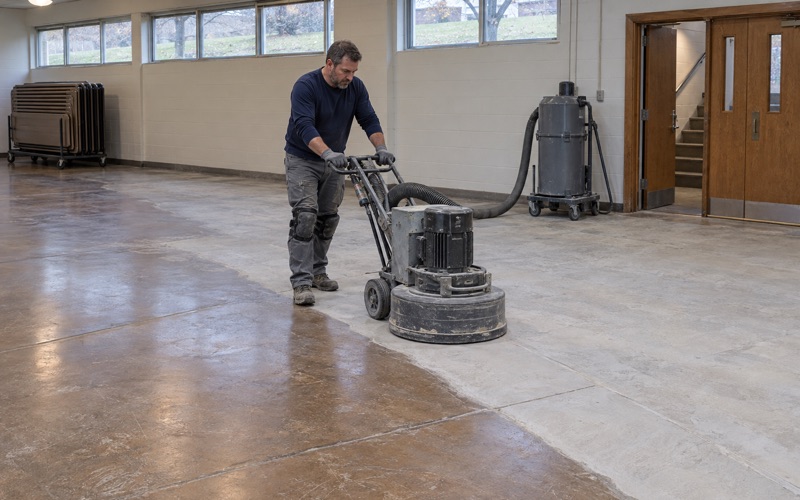
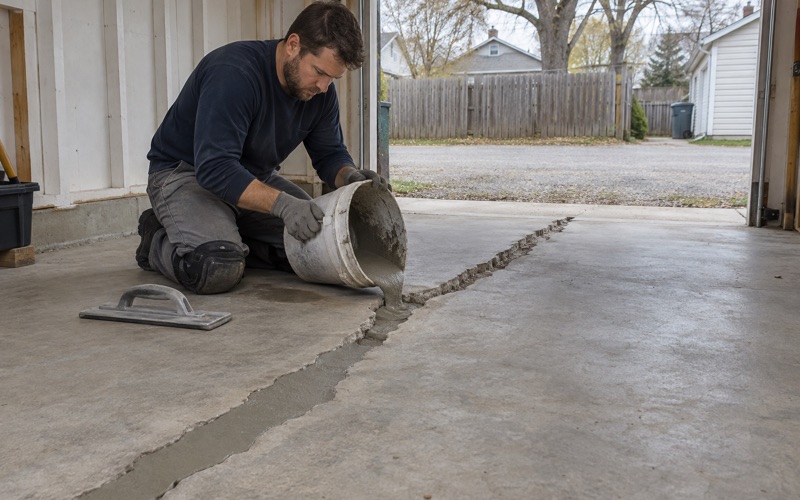
Diamond grinding or shot blasting opens the surface to an ICRI concrete surface profile the primer can grip, without cutting the slope away. Repairs to spalls and pits are filled flush with the surrounding plane, so a patch beside a drain does not become a dam that holds a puddle.
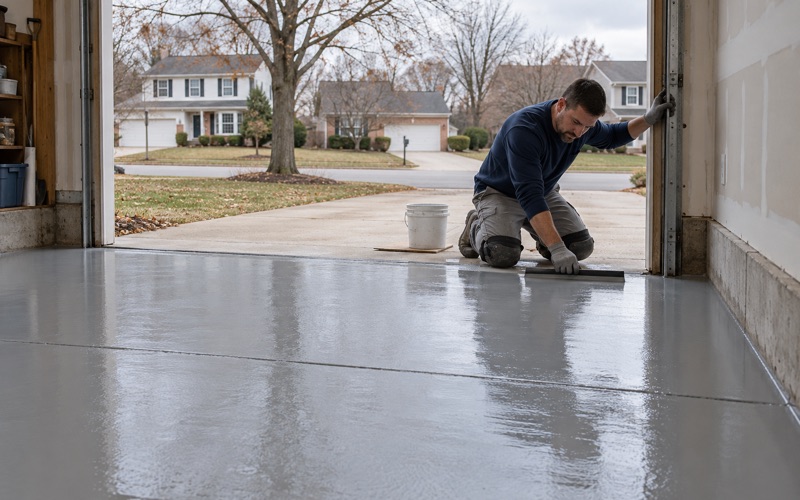
The coats themselves go down at the thickness the proposal states. We avoid a thick self-leveling pour on a sloped bay, because a material designed to find level works against the fall the slab was built with. A quartz aggregate broadcast in the build gives tires, creepers and boots grip on a wet floor, and that texture is specified by the broadcast and topcoat rather than promised as a slogan.
Keeping Prep Waste Out of the Interceptor
Grinding dust is captured at the machine with a vacuum rather than rinsed toward a floor drain. In a repair bay that matters twice over, because the drain leads to an interceptor with its own construction and effluent requirements under the code.
Stripped coating, slurry and any solvent used for cleanup are collected and bagged or drummed rather than washed down. We plan the prep sequence so the drains are protected while the floor is open. That protection comes off only once the surface is clean and the debris has left the building.
Drain Bodies, Grates and Interceptor Covers Stay Serviceable
Every fitting on a repair-garage floor has to keep working after the coating cures. Our edges stop where the plumbing starts, and nothing we apply makes a grate, a drain body or a cover harder to open.
Terminating at the Drain Body
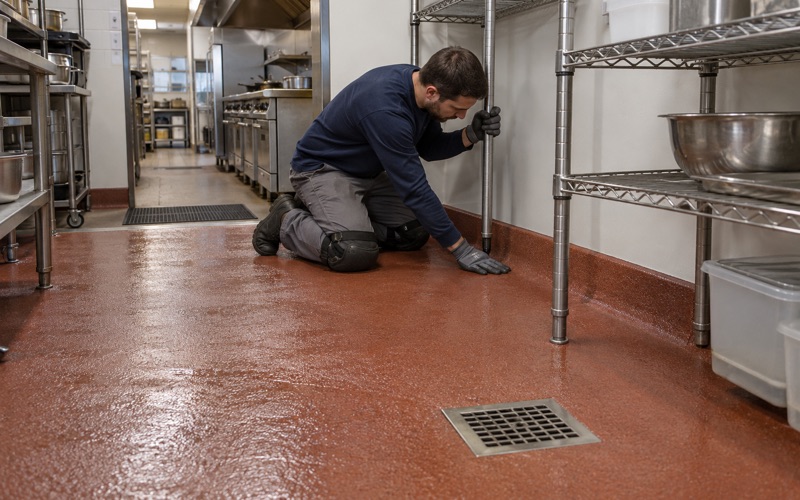
We stop the coating at the drain body’s rim with a clean, keyed edge rather than feathering resin down into the throat. Running a coating into the drain narrows the opening, can bond the grate in place and puts material where the drain’s maker never planned for it.
The edge is detailed so fluid sheds off the coating and into the drain instead of creeping under a lifted lip. A sawn termination line gives the system a straight shoulder to stop against. It is also far easier to inspect and maintain than a tapered smear of resin.
Grates That Still Lift
Trench drain grates and floor drain grates are pulled before prep and kept out of the work area until the floor has cured. A grate coated in place becomes part of the floor, and the next time a technician needs to clear debris, the coating cracks around it.
When the grates go back in, they should seat the way they did before, flush with the finished surface and free to lift. If the coating build would change how a grate sits in its frame, we flag that before the job rather than discover it afterward.
Interceptor Covers and Access
The code’s construction rules for gas and oil interceptors address covers, venting, traps and the water seal. We do not interpret or alter any of that, and our job is to leave the cover exactly as accessible as we found it.
Coating stops short of the cover frame, and the cover is never glued, sealed or buried under a broadcast layer. A shop that pumps or inspects its interceptor on a schedule should be able to open it the week after we leave, without a pry bar or a grinder.
A Coated Concrete Channel Is Not a Code Trench Drain
Some older bays have a channel formed in the slab itself, and the question comes up whether lining it with epoxy makes it acceptable. Under the Illinois section, that answer belongs to someone other than a coatings contractor.
The Poured-Concrete Prohibition
Among the interceptor construction rules, the section states that poured concrete trench drains are prohibited for gas and oil discharges. A resin lining over a formed concrete channel is still a concrete channel with a coating on it, and we never present it as a trench drain the code accepts.
If a bay has a channel like that, we coat the floor around it on the terms the owner and their plumbing contractor set, or we leave the channel alone. Whether it stays, gets replaced with a listed trench drain or is taken out of service is a plumbing decision, not a flooring one.
The Plumber’s Call and the Village’s Permit
Drain and interceptor work in Justice belongs to a plumbing contractor and to the Village of Justice Building Department on West 82nd Place. The village runs a Contractor’s Work Permit Program requiring every contractor to be insured, licensed and registered, and no building permit issues until each contractor under it is registered and bonded.
Permit bonds run $10,000 for most contractors and $20,000 for sewer contractors, over a licensing year from February 1 through January 31. Concrete work is a listed permit item that also calls for a plat of survey. Where a slab repair goes beyond surface patching, we check the village’s requirements before the job is scheduled.
Choosing a System for a Truck Bay
A truck bay takes hot tires, dropped tools, jack stands and the brine that rides in on every truck coming off a winter road. We generally look at 100% solids epoxy or urethane cement for the body of the system, with a polyaspartic or polyurea topcoat where hot tire pickup or a faster return to service is the concern. The proposal names the exact line rather than a generic category.
Cure follows slab temperature and the dew point spread at the surface, not the calendar, and an unheated bay in deep winter is told to wait. Products are chosen inside the Illinois VOC limits for floor and industrial coatings, which bind whoever applies them. The work is then phased so enough of the shop stays open to keep trucks moving while each section cures.
- 20+ Years in Business
- Moisture Tested Before Pricing
- Free Written Estimates