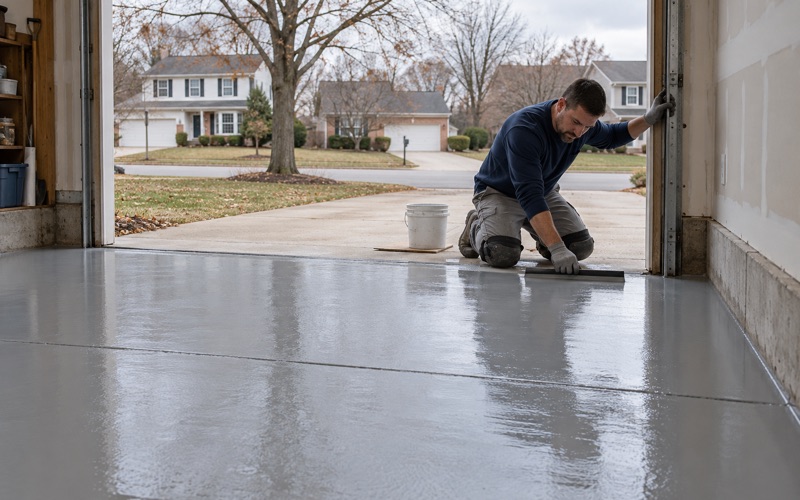
Wheaton Epoxy Flooring brings more than 20 years of coating work to epoxy flooring in Hickory Hills, and the work we care most about is the floor nobody sees once the equipment goes in. A coating that has to live under a cabinet, a cooler or a rack proofer gets one chance to be done right. After the unit is set, the only way back to that concrete is to empty the room and move the machine.
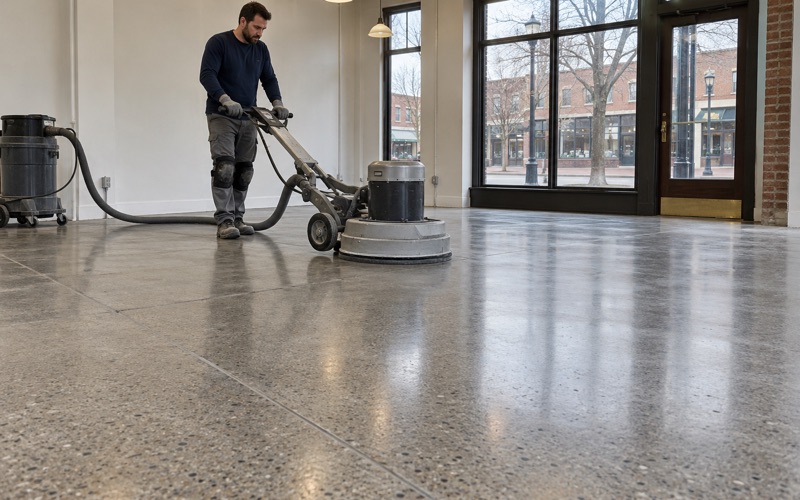
So our scope starts with the slab itself rather than the color chart. We open the surface with a diamond grinder or a shot blaster to a real ICRI concrete surface profile, never an acid etch, and a moisture test is written into the proposal before the price is final. That proposal names the product line, the coat count and the finished thickness, so an owner can hold the finished floor up against the paper.
Cracks, spalls and old coatings get mapped before anything is mixed. When a slab needs repair or replacement before it should carry a coating, we say so plainly, and we explain what a coating warranty leaves out before the job is sold, starting with moisture.
A Proof Box Sits on the Bakery’s Own Floor
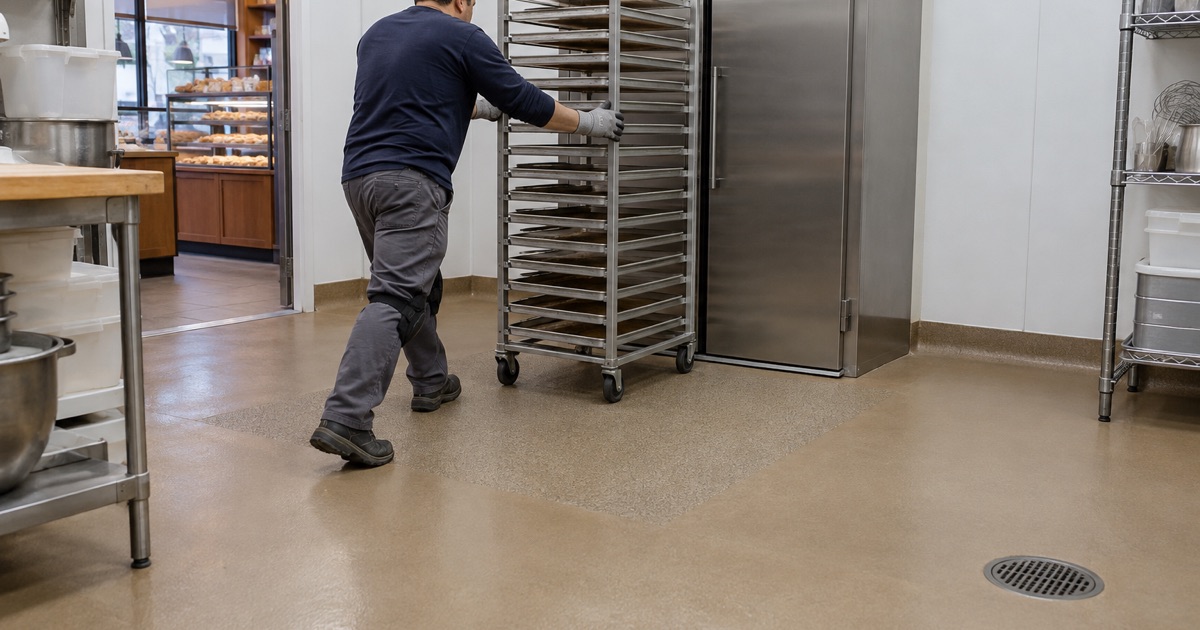
A roll-in rack proofer looks like a piece of furniture, but many of them have no floor of their own. The insulated walls and door are assembled around an open bottom, the rack rolls straight in, and the floor the dough rises over is the shop floor. That makes the slab inside the box part of the proofer, whether anyone planned it that way or not.
Olympia Bakery at 9220 S. Roberts Road, established in 1995, makes wedding cakes, pies, donuts, cupcakes and Polish baked goods. We have not seen its equipment or its floor, and we do not know whether it runs a roll-in proofer. A shop with that range of product is the kind of bakery where the order of work below matters, because a proofing floor gets wet every day it is in use.
A cabinet with no bottom
One maker’s installation manual for its roll-in rack proofers and retarder-proofers is unusually direct about this. It says the units are approved for installation on combustible floors with zero clearance, but it does not recommend setting them on a surface that is porous or cannot be easily cleaned and sanitized. It offers an optional stainless-steel floor kit for a secure surface, installed before the proofer is assembled.
That manual is one manufacturer’s guidance for its own equipment. It is not a code, and it does not name or endorse any coating. What it does do is describe the conditions a floor under a proofer has to survive, which is exactly the information we need to choose a system.
Condensation on the interior floor
Proofing runs warm and humid on purpose, and the same manual warns in capital letters that the humidity will naturally condense and accumulate water on the interior floor, making it slippery. Every proofing cycle leaves that floor warm and wet. Bare concrete under those conditions soaks up water, flour and sugar, and a porous surface becomes hard to clean in exactly the place the manual says should be easy to sanitize.
The manual also says each climatizer drain is to be routed out of the proofer to an air-gap drain. That is a plumbing detail rather than a floor one, but it tells us where water is expected to go. Our job is to make sure the condensate that does land on the floor stays on top of a sealed coating and does not find a path into the slab or under the cabinet walls.
The wet apron at the door
The warning does not stop at the cabinet. The same manual says the adjacent exterior floor may also become slippery, which describes the few feet of floor in front of the door where racks are pushed in and pulled out. Warm, moist air rolls out each time that door opens and settles on a cooler floor.
That apron is the busiest patch of floor in a proofing area. It takes the wet, the foot traffic of whoever is moving the rack and the turning wheels, all in one small strip. We treat it as its own zone in the plan rather than as an extension of the room.
Looking for epoxy-flooring closer to Campton Hills? See Epoxy-Flooring Services in Campton Hills.
Coat First, Then Set the Proofer
The order of work decides whether a bakery floor holds up. A coating stopped at the outside of a proofer’s walls leaves raw concrete inside the box and a seam right where the condensate runs. The only clean answer is to coat and fully cure the floor before the proofer is set down on it.
Why the sequence matters
Once a roll-in unit is assembled, the concrete beneath it is out of reach. Coating around the base later means trimming the system to the wall line, which leaves an edge for water to work under and a bare rectangle inside the cabinet that never gets touched. Moving the proofer later costs far more than planning the coating ahead of it.
That is why we ask about equipment early on any bakery or food-production job. If a new proofer, cooler or oven is on order, we want the delivery date before we schedule grinding. The coating needs to be complete and cured, not merely dry to the touch, before heavy equipment is rolled over it and set in place.
Testing the slab first
A floor that will be warm and wet on top cannot also be pushing moisture up from below. We run an ASTM D4263 plastic sheet test as a quick screen and use ASTM F1869 calcium chloride testing or ASTM F2170 in-situ relative humidity probes when the job calls for numbers. If the readings come back high, a moisture-mitigation primer goes into the written scope before the price is final.
We also read the slab for what is already wrong. Old coatings, oil and flour residue come off with the grinder, cracks are mapped, and spalls are filled before any primer goes down. A slab that is breaking up is told it needs repair first, because a proofer will not sit level on a bad patch.
Choosing the coating system
For a bakery floor that runs warm and wet, urethane cement is often the system we put forward, because it tolerates heat, moisture and cleaning far better than a thin decorative coat. Where the conditions allow it, a 100% solids epoxy base with a quartz aggregate broadcast and a sealed topcoat is another option. The proposal names which system, how many coats and the finished thickness, so there is no guessing later.
We also keep the product choice inside the Illinois VOC limits for floor and industrial coatings under 35 Illinois Administrative Code Part 223. Those limits bind the person applying the material, not just the manufacturer, so they shape the products we bring onto a job. Grinding dust is captured at the machine with a vacuum rather than washed toward a floor drain.
Seal All Edges, Texture the Apron
The proofer manual’s instruction is short: be sure to seal all edges when installing. On a coated floor, that is a detail we plan for, not one we leave to whoever sets the unit. Edges are where water gets under things, and a proofer has four of them sitting in condensate.
Running the coating under the walls
A continuous coating runs under the full footprint of the cabinet, not up to its outside face. The interior floor, the wall line and the area outside are one unbroken surface, with no seam trapped beneath the walls. If the bakery chooses a stainless floor kit instead, the coated floor around and beneath it still needs to be sound, clean and continuous.
Where the coating meets the room’s walls, we can carry it up into an integral cove base so there is no square corner for water and flour to collect in. Cook County Department of Public Health is the health authority for food businesses here, so we confirm its expectations for finishes in food areas before we fix the detail.
Sealing the base joint
Once the proofer is set on a cured floor, the joint where its base meets the coating gets sealed with a sealant suited to wash-down and warmth. That keeps condensate from running under the cabinet or lifting the coating edge from beneath. Without it, water works into the one line nobody can see.
We walk the bakery staff through what that seal needs over time. A sealant joint is a maintenance item, and it should be inspected when the floor is deep-cleaned. Catching a split bead early costs minutes rather than a section of floor.
A measured slip texture
The manual’s own word for the interior floor and the apron is slippery. A slip-resistant texture is specified by the aggregate broadcast and the topcoat we use, not promised as a slogan, and we state the grit and its size in the scope. Inside the box and across the door apron, the texture runs heavier than the rest of the room.
The tradeoff is cleanability, since a rougher surface holds more flour. We set the broadcast so it gives a wet floor real grip while still releasing to a squeegee and a scrub brush. A bakery should be able to clean that apron at the end of every shift without fighting it.
Hickory Hills Kitchens, Garages and Basements
Hickory Hills sits mostly in Palos Township in Cook County, with portions in Lyons Township, and its housing is mostly owner-occupied detached homes. Our residential work here follows the same rule as the bakery work: read the slab first, then coat it. The difference is what the slab has been through.
Slabs from the 1960s and 1970s
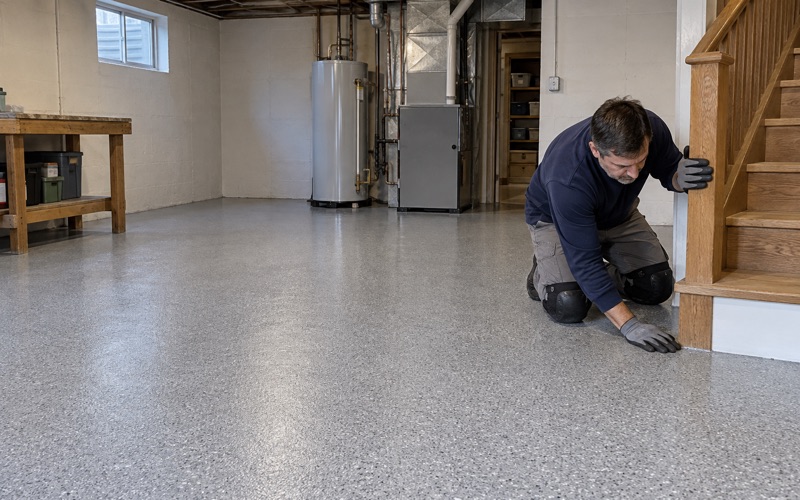
The Census count of housing by year built shows over half the homes in the city dating from 1960 to 1979. A basement or garage slab from that era predates routine under-slab vapor retarder practice, so we test for moisture vapor before we price a coating. On a block the city names as a repeat flooding location, the slab may already have been wet more than once.
The city has said that several miles of its storm sewers need replacement due to age, and it names the Blueridge subdivision and the 7700 blocks of 98th Street and 96th Place among its trouble spots. A coating does not stop sewer backup or seepage, and we will not sell one as if it does. If a basement has a water history, that conversation comes before any color choice.
Garage floors and winter salt
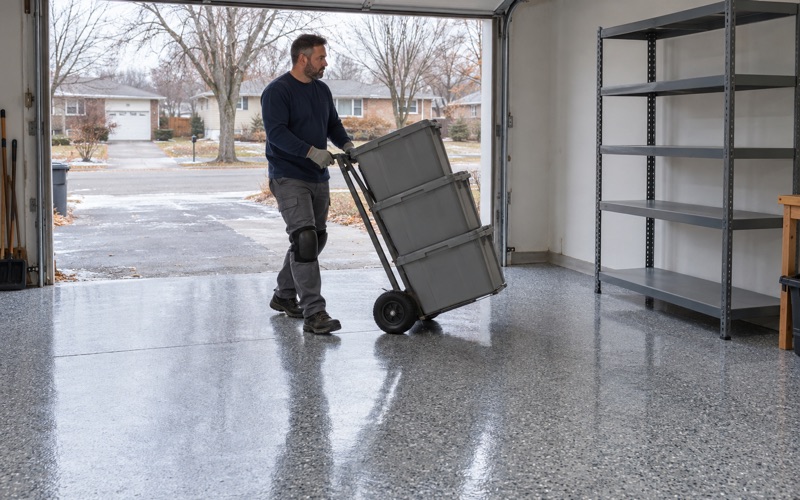
Garage systems here are chosen to hold up to the brine and rock salt that ride in on tires all winter. A 100% solids epoxy base with a vinyl flake broadcast and a polyaspartic topcoat handles that well when the slab is properly ground and dry. We also name the risks, including hot tire pickup on a poorly prepared floor.
A floor coating is never sold as radon reduction in our proposals, because in Illinois that is licensed mitigation work under IEMA. If a homeowner has a radon concern, they need a mitigation contractor first. The coating can follow once that work is done.
Contractor license and insurance
The City of Hickory Hills Building Department requires every contractor to hold a city license, renewed each calendar year. A certificate of insurance has to accompany the application with the city named as certificate holder, and a copy goes to the homeowner or business owner before work begins. We check those requirements before a job is scheduled, not after.
Illinois does not license flooring or coatings contractors, so the city license is the one that binds. Home jobs over the state threshold also get a written contract and the Home Repair: Know Your Consumer Rights pamphlet before any grinding starts. Contractors here haul their own debris, and we plan the grinding waste into the job from the start.
- 20+ Years in Business
- Moisture Tested Before Pricing
- Free Written Estimates