Wheaton Epoxy Flooring brings more than 20 years of slab preparation and coating to epoxy flooring in Franklin Park, and the jobs that need the most thought here are the floors that machines sit on. A floor that runs beneath conveyors and sorting equipment cannot simply be swept, ground and recoated over a quiet weekend. It has to be read first, cleaned with the right products and scheduled around the equipment that never really stops.
Every slab we take on is opened with a diamond grinder or a shot blaster rather than an acid etch, because a coating only holds as well as the profile it grips. Before anything is priced, we map cracks, spalls and failing old coatings, and we tell an owner plainly when a section needs repair before it should carry a new system.
Our written proposal names the product line, the number of coats and the finished thickness, so a facility manager can hold the finished floor up against the quote. A moisture test sits in that same scope, and we explain what a coating warranty excludes before the work is sold, with moisture vapor transmission named first.
A Cross-Belt Sorter in a River Road Sublease
What the listing describes
A sublease listing for 3710 River Road, Unit 300, offers about 30,121 square feet through May 2027, with roughly 2,609 square feet of office and 12 loading docks. The listing says the space comes with a Wayzim cross-belt parcel sorter installed in October 2022 and rated at over 7,000 packages per hour. Those figures come from search summaries of the broker listing, so we treat them as listed claims rather than anything we have measured.
We have no relationship with the sublessor, and we have not seen the sorter, the cleaning products in use or the floor beneath it. What the listing does show is the kind of space that is changing hands along River Road, inside Franklin Park village and Leyden Township. A building with a sorter already anchored in place is a different floor project from an empty bay.
What one sorter maker allows on its machine
The best public guide to sorter housekeeping we have read is a manual from a different maker, Interroll, for its horizontal cross-belt sorter. It tells installers to anchor the sorter torsion-free to the floor or adjacent components, and it says the machine may be cleaned only after the power is switched off and it cannot be started accidentally. Belts are to be cleaned dry only.
For the rest of the module, that manual permits only water-soluble cleaning agents that are free of phosphate, silicone and potassium and are non-acidic. Nothing in it speaks for the unit on River Road, which comes from another manufacturer. It does show how seriously at least one sorter maker takes silicone, and that caution matters to anyone who later has to coat the concrete underneath.
Why the cleaning rule reaches the floor
Around a parcel sorter, the floor and the machine end up sharing one housekeeping rule. A cleaner that is banned from the module tends to drift onto the slab anyway, through overspray, mopping and the routine wipe-downs crews do between shifts. Whatever lands on the floor stays there until the next floor job finds it.
That is why we ask about cleaning products before we ask about color or thickness. A facility that already keeps silicone away from its sorter has usually protected its next recoat without meaning to. A facility that does not may be carrying a contamination problem it cannot see.
Looking for epoxy-flooring closer to Brookfield? See Brookfield Epoxy-Flooring.
Silicone and Fish Eyes in a Floor Recoat
How a fish eye forms
Fish eyes are round separations in a fresh coating, small craters where the liquid pulls away from a spot it will not wet. One coating maker’s troubleshooting guide states it directly: contamination from silicone can cause fish eyes to appear. The coating looks fine when it goes down and then opens into rings across the floor as it levels.
The trouble is that silicone films are thin and nearly invisible on a worn, gray slab. A floor can look clean, pass a sweep and still refuse a 100% solids epoxy or a polyaspartic topcoat. Once the craters show up, the damage is done for that coat.
Where silicone hides on a working floor
On a warehouse or distribution floor, silicone usually arrives in small, ordinary ways. Spray lubricants, some general-purpose cleaners, mold-release products and tire shine carried in from a parking area can all leave a film. In a home garage the usual sources are tire shine and silicone protectant sprays used on cars and equipment.
We ask which products have been used near the area before we bid. Knowing that silicone sprays were in regular use changes how deep the preparation needs to go. It also tells us whether a light screen and recoat is realistic or whether the old system has to come off.
Grinding out a contaminated coat
The same troubleshooting guide says the repair for oil or grease contamination starts with removing the coating by grinding. Silicone is no different in practice, because no topcoat bridges a surface that will not wet. Wiping a contaminated floor with solvent mostly spreads the film around.
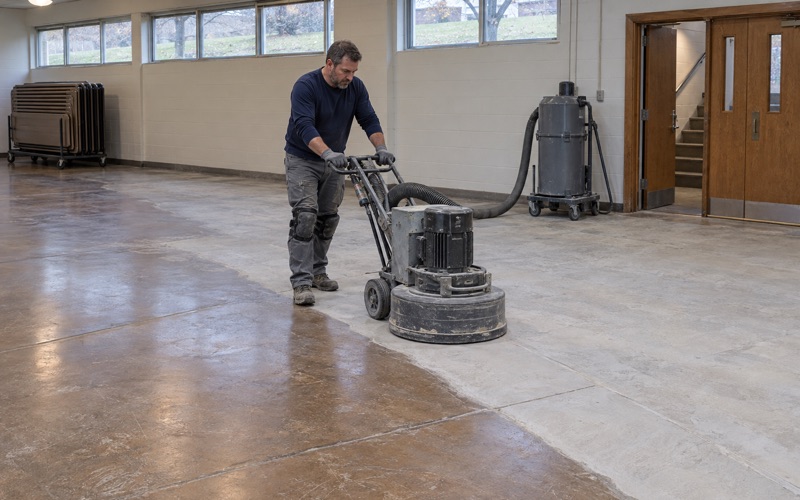
Our answer is mechanical. We open the surface with diamond grinding or shot blasting to a fresh concrete profile, capture the dust at the machine with a vacuum, and only then prime. That takes more time than a scuff and recoat, and we say so in the proposal rather than discovering it halfway through the job.
Cleaning Under an Anchored Loop, Only Under Lockout
Why residue collects beneath a sorter
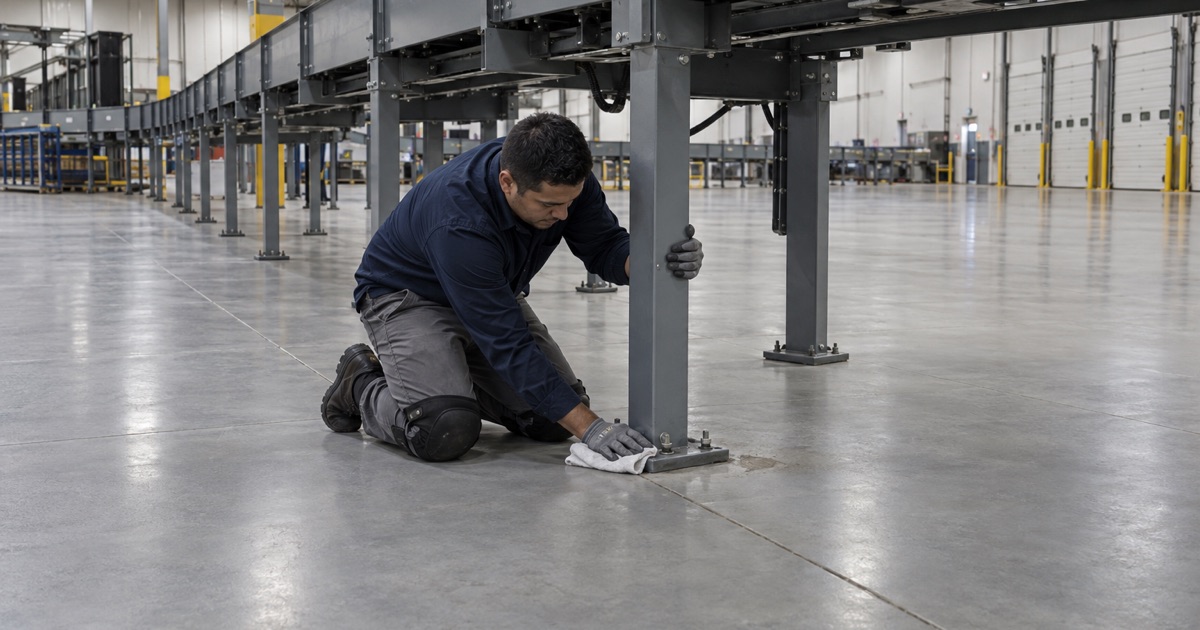
A sorter loop that is anchored to the slab leaves a band of floor that nobody reaches during a normal shift. If the machine can be cleaned only with the power off and secured, the floor beneath it gets the same treatment, so debris, dust and cleaner residue collect there between shutdowns. Over months, that strip can end up carrying more contamination than any open aisle.
This is the part of the floor that most often surprises an owner during a recoat. The aisles look ready, while the area under the loop holds packing dust, label backing and whatever has been sprayed nearby. We plan to clean and test that band separately from the rest of the floor.
Personnel passageways and transitions
The Interroll manual also asks installers to check the passageways for personnel once the sorter is set up and to install transitions where they are needed. Those walkways and crossings become the strips of floor that take the heaviest foot traffic around the machine. They are where a coating wears first and where a slip-resistant finish earns its keep.
We specify slip resistance by the broadcast and the topcoat, such as a quartz aggregate broadcast locked under a urethane or polyaspartic finish, rather than promising it in general terms. Walkways can carry more texture while the area under the loop stays smoother and easier to clean. Each zone is written into the scope separately.
Planning floor work around lockout windows
A floor job around a working sorter is scheduled to the facility’s shutdown windows, not to our calendar. Any work beneath the loop happens only while the machine is locked out under the site’s own procedures. Work in the open aisles can often run during other hours.
Cure times add another layer, because a coating has to reach traffic strength before the line restarts. We set cure schedules by slab temperature and the dew point spread at the surface rather than by the clock. When a window is too short for a full system, we tell the manager and split the job instead of rushing it.
Checking for Residue Before a Recoat in Franklin Park
Residue and moisture tests in the written scope
On any recoat of a working floor, our first step is a residue check, starting with a simple water-break test across the area and focusing on the strip under the loop. Where water beads instead of sheeting, we suspect a film and widen the grind. Moisture testing follows, using ASTM F2170 in-situ relative humidity probes or ASTM F1869 calcium chloride tests depending on the slab.
Both results go into the written scope before the price is final. If moisture readings call for a moisture-mitigation primer, the proposal says so and names it. An owner then knows exactly what is being bought and why.
Village license, bond and insurance
The Village of Franklin Park requires every contractor performing work in the village to be licensed, insured and bonded. The license year runs May 1 to April 30 at $100 for contractors and $250 for general contractors, with no half-year licenses, plus a $10,000 trade-specific license and permit bond and at least $1,000,000 in liability insurance. The Building Department at 9500 Belmont Avenue handles those requirements.
We work through those village requirements before a job is put on the schedule, not after the crew arrives. A facility manager should expect any coatings contractor to sort this out up front. It is one less thing to chase during a short shutdown.
Garages in a village of older homes
Franklin Park, a Cook County village named for real estate broker Lesser Franklin, also has a large stock of owner-occupied houses, most built from the 1940s through the 1960s. Older garage slabs often carry a previous coating, and the same silicone question applies when tire shine has been used inside for years. We grind, check for residue and test moisture on a garage just as we would under a sorter.
Garage systems are chosen to stand up to the brine and rock salt that ride in on tires every winter. In an unheated garage during deep cold, we recommend waiting for conditions that let the coating cure properly. A floor that goes down in the right weather lasts far longer than one rushed into January.
- 20+ Years in Business
- Moisture Tested Before Pricing
- Free Written Estimates