
Wheaton Epoxy Flooring installs ESD flooring in Wheaton, IL, serving surrounding cities including Winfield, Warrenville, Hinsdale, Wood Dale and Bensenville, drawing on more than 20 years of grinding and coating concrete for demanding commercial uses. An ESD floor is a coating with a job to do: carry static charge away from people and equipment to a safe ground before it can damage sensitive electronics.
Electrostatic discharge can damage circuit boards, components and instruments at charge levels far too small for anyone to feel. Facilities that assemble, repair or test electronics, run server rooms or handle sensitive lab equipment build ESD control programs to prevent it, and the floor is one of the largest surfaces in that system.
Because an ESD floor has to meet a measured specification rather than just look right, we start with your program’s requirements. The proposal names the system, the target resistance range, the grounding layout and the test method, alongside the usual product line, coat count and finished thickness.
How ESD Flooring Works
Conductive and Static-Dissipative Systems
ESD floors fall into two broad groups. Conductive floors have lower electrical resistance and drain charge quickly, while static-dissipative floors have a higher resistance that drains charge more slowly and in a controlled way. The right choice depends on what your facility handles and what its ESD program specifies, and we build to that range rather than picking one by habit.
The specified range is written into the proposal in the same terms your quality team uses. That way there is no translation step between what the program requires and what the installer is building toward.
Grounding the Floor
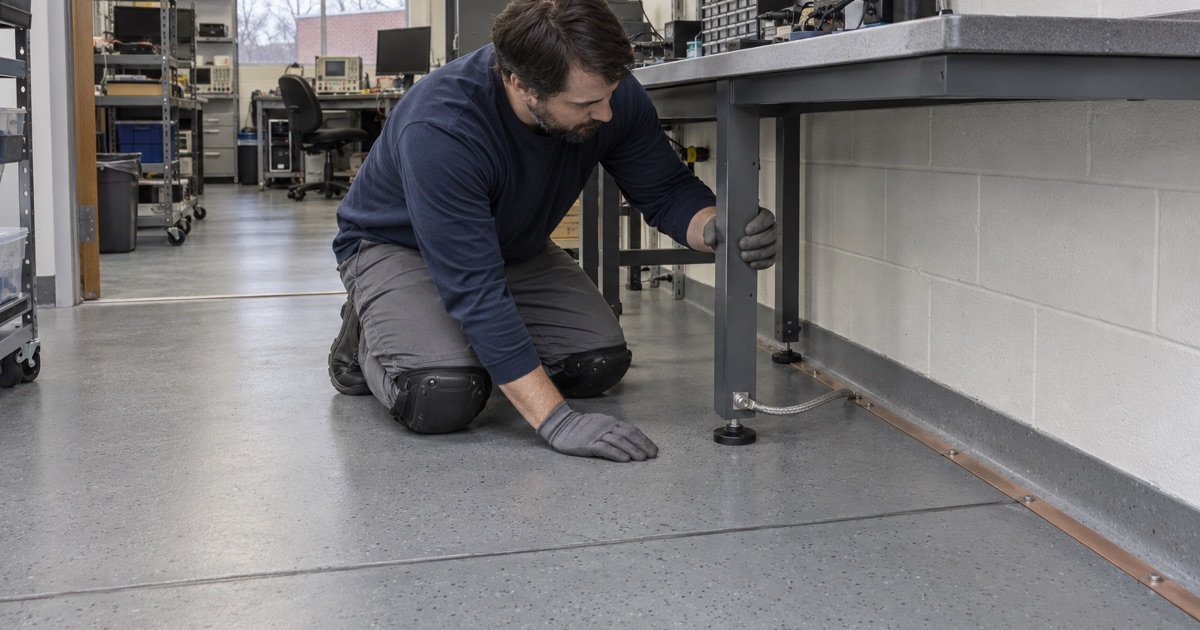
An ESD floor only works if the charge has somewhere to go. Copper grounding strips are laid on the prepared slab and connected to building ground at planned points, then covered by a conductive primer that spreads the path across the floor. The layout and the number of ground points depend on the size and shape of the area.
Ground connections are planned with the facility’s electrician or engineer. We do not alter building electrical systems ourselves, but we coordinate the connection points so the floor’s grounding ties into the facility as designed.
Conductive Primer and Topcoat
Over the grounding strips, a conductive primer creates a continuous layer that collects charge from the surface above. The ESD topcoat contains conductive material distributed through it, so charge passes through to the primer and then to ground. Each layer is applied at a controlled thickness, because too much or too little changes the resistance.
Preparing and Installing an ESD Floor
Surface Preparation
ESD systems need clean, sound concrete with old coatings, tile and adhesive fully removed. We diamond grind or shot blast to the profile the manufacturer calls for, capturing dust at the machine. Cracks and joints are repaired and ground flush so the grounding layer and coating stay continuous.
Oil and contamination are removed before the primer goes down, since they can interfere with both the bond and the conductive path. In older buildings, previous coatings sometimes hide damage, so grinding is also when the slab’s true condition comes to light.
Moisture Testing
As with any coating, moisture coming up through the slab can lift the system. A moisture test is part of the written scope before the price is final, using ASTM F1869 or ASTM F2170 methods where needed. A slab that tests high gets a mitigation primer that is compatible with the ESD system.
Controlled Application
Temperature, humidity and dew point at the slab surface affect how the conductive layers cure and perform. We check conditions before each coat and keep application thickness within the maker’s range. The work is phased to keep production areas running where possible, with nights and weekends used when a space cannot close.
Testing and Handover
Resistance Testing After Cure
Once the floor has cured, its resistance is measured with calibrated test equipment using the method your ESD program calls for. Readings are taken at locations spread across the floor, including near ground points and far from them, so the whole area is confirmed rather than a single spot.
The readings are recorded in a simple report that your quality or facilities team can file. It becomes the baseline against which future periodic checks are compared.
Footwear and Workstations
A floor cannot protect a part from someone wearing standard shoes. ESD footwear or heel grounders, grounded workstations and wrist straps complete the system. We explain how the floor fits with these elements so your team understands that the floor is one part of a larger program.
Care and Retesting
ESD floors should be cleaned with approved cleaners and never coated with ordinary floor finishes or waxes, which can insulate the surface. We provide care instructions at handover, and the periodic checks your program schedules will catch any change in performance early.
Where ESD Floors Are Used
Electronics Assembly and Repair
Assembly lines, repair benches and test stations that handle circuit boards and components are the classic setting for ESD flooring. These areas often see carts and chairs as well, so the system also needs good wear resistance.
Where only part of a room handles sensitive work, the ESD area can be laid out as a defined zone with a visible color or border, while the rest of the space gets a standard coating. That keeps cost under control and makes it obvious to staff where ESD footwear and procedures apply.
Server Rooms, Labs and Control Rooms
Server rooms, data closets, instrument labs and control rooms benefit from static control, a clean seamless surface and low dust. A coated ESD floor is easier to keep clean than bare concrete and helps protect equipment that is expensive to replace.
These rooms usually stay in service around the clock, so the installation is planned with the facility’s IT or lab staff. Equipment may need to be moved or protected in stages, and the schedule is built around the windows the operation can give us rather than the other way around.
- 20+ Years in Business
- Moisture Tested Before Pricing
- Free Written Estimates