
Wheaton Epoxy Flooring installs commercial kitchen flooring in Wheaton, IL, serving surrounding cities including Winfield, Warrenville, Hinsdale, Wood Dale and Bensenville, with more than 20 years spent preparing and coating concrete. A commercial kitchen floor faces heat, grease, standing water and daily washdown, and in DuPage County it also has to satisfy health department plan review.
Restaurants, bakeries, cafes, school kitchens, church kitchens and catering spaces all share the same problem: a floor that looks fine on opening day can soften, crack or trap grease within months if the wrong system is chosen. We start with how the kitchen is used and cleaned, then specify a floor built for those conditions.
The proposal names the product line, the number of coats and the finished thickness, the cove base detail and the slip-resistant texture. Surface preparation is mechanical, by shot blasting or diamond grinding, and moisture testing is part of the written scope before the price is final.
What DuPage County Plan Review Asks For
Floor Surface Requirements
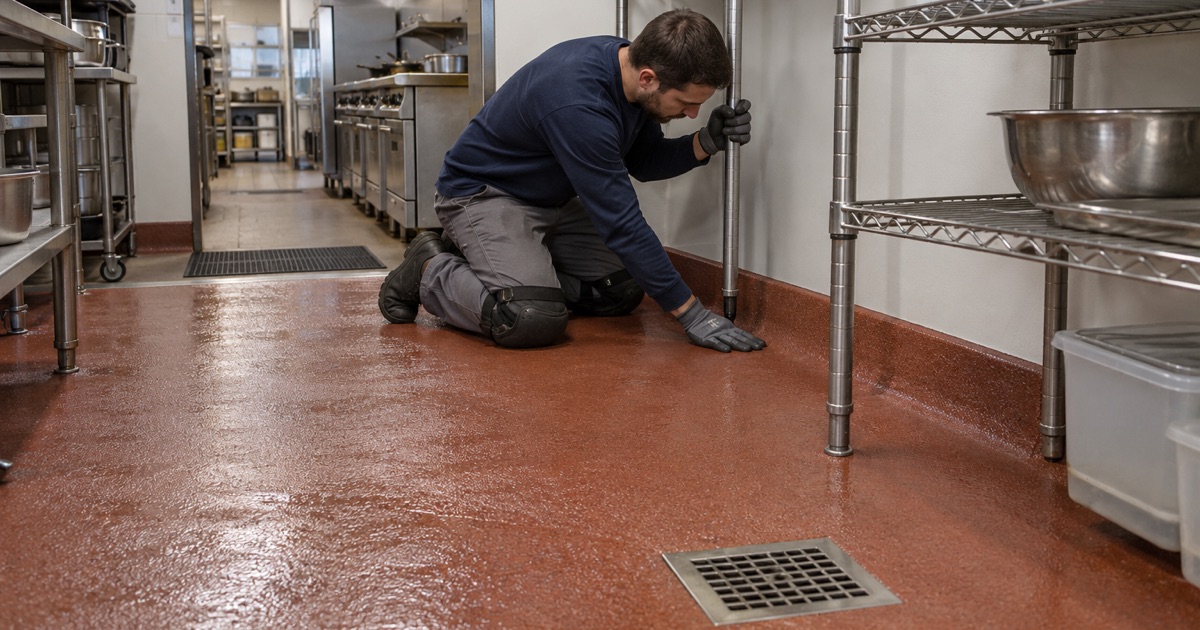
The DuPage County Health Department plan review manual calls for floors in food service areas that are commercial grade, smooth, non-slip, nonabsorbent, grease-resistant and easily cleanable. Restaurants, bars, groceries, schools and day-care kitchens all fall under that review, and plan approval comes before construction rather than after.
The manual also asks for approved flooring to extend 3 feet beyond wait stations, buffets and salad bars. That detail affects the layout of dining-area transitions, so we confirm it while the floor plan is still on paper.
Coved Bases and Sealed Wall Junctures
Plan review asks for a coved juncture between floor and wall with a radius of 3/8 inch or more, sealed at the wall. FDA Food Code section 6-201.13 points the same way. An integral cove formed from the flooring material curves up the wall without a seam, so water, grease and food debris cannot collect in the corner where a mop cannot reach.
No Sheet Vinyl
The DuPage County manual states that sheet vinyl is not approved for these floors. Seams and edges in sheet goods can lift and trap moisture, so a seamless resinous system is the common alternative. We build floors that meet the review requirements from the start, avoiding rework after an inspection.
Systems Built for Kitchens
Urethane Cement
Urethane cement is the workhorse of commercial kitchen flooring. It tolerates boiling water, steam cleaning, hot oil and thermal shock that would soften standard epoxy. It also handles more moisture vapor from the slab, which is important in kitchens that are hosed down daily and may sit over damp concrete.
Urethane cement is typically installed at a thicker build than a standard coating, and it can be troweled or self-leveled depending on the area. That thickness gives it impact resistance against dropped pans and rolling carts.
Slip-Resistant Texture
Kitchen floors are often wet and greasy, so texture is essential. Aggregate broadcast into the system and texture in the topcoat set the level of grip. FDA Food Code section 6-201.11 allows antislip floor coverings in areas where safety calls for them, and we balance grip against cleanability so the floor stays both safe and easy to mop.
Different zones can receive different textures. The cook line and dish area may get a coarser finish, while dry storage and walk-in coolers get a smoother one that is easier to clean.
Chemical-Resistant Topcoats
Degreasers, sanitizers and floor cleaners are used every day. The topcoat is selected for the specific products your kitchen uses, so the surface does not dull, stain or soften. We ask for the cleaning chemical list before finalizing the system.
Food acids matter too. Vinegar, citrus, tomato, dairy and blood from meat prep all attack floors differently, and some cause staining or etching on systems that handle hot water well. Knowing the menu and the prep areas helps us choose a topcoat that holds up to what actually lands on the floor.
Drains, Slope and Plumbing
Sloping to Floor Drains
Water has to move to drains rather than pond around equipment. Where the existing slab allows, the system is finished to carry water toward the drains, and low spots are built up before the final coats. Severe slope problems may need concrete work first.
Walk-in coolers and freezers need their own attention. Floors there stay cold, and the transition at the door sees carts and condensation every day, so the system and the threshold detail are planned to handle temperature changes without cracking or lifting at the seam.
Floor Drains and Grease Interceptors
Floor drains, trench drains and grease interceptor covers must stay accessible and sealed. The flooring terminates cleanly at drain bodies so water does not get under the system at the edges. Any plumbing changes, including new drains or interceptor work, should be completed before the floor goes in.
Installing Around a Working Kitchen
Scheduling and Phasing
Restaurants and food businesses lose money every hour they are closed. We schedule kitchen floors around slow days, holidays or planned closures, and phase work so parts of the space stay in use where possible. Fast-curing products shorten the time to return to service.
Equipment has to be moved and reconnected, so we coordinate with your team and contractors for the shutdown and restart. A clear plan prevents a short closure from stretching into a longer one.
Removing Old Flooring and Contamination
Old quarry tile, sheet vinyl, failed coatings and grease-soaked concrete all have to come off. Grease is removed and the slab is ground or blasted until clean concrete shows, because a new floor will not bond over contamination. Dust is captured at the machine and kept out of food areas.
Old tile beds and setting materials are removed completely rather than coated over. Leaving them in place would leave hidden voids and weak layers under the new floor, and those are exactly where a kitchen floor tends to fail first.
Handover and Cleaning Guidance
At handover, we provide cleaning guidance and product information so staff use compatible cleaners and methods. A properly maintained kitchen floor keeps its texture and cleanability, which helps both safety and inspections.
- 20+ Years in Business
- Moisture Tested Before Pricing
- Free Written Estimates