Wheaton Epoxy Flooring has spent more than 20 years on epoxy flooring in Burr Ridge and across the west suburbs, and the floors we think hardest about here are the ones people work on while sitting down. A coated office floor rarely fails under shoes. It wears where a chair rolls back and forth all day, and that wear is decided as much by the wheels as by the coating.
So our office and home-office jobs start with a question most contractors skip: what is going to roll on this floor? We open the slab with a diamond grinder or a shot blaster rather than an acid etch, test it for moisture before the price is final, and write the product line, coat count and finished thickness into the proposal. Then we talk about chairs, because the best topcoat we can install still loses to the wrong castor.
This page walks through how that plays out in Burr Ridge, from desks rented by the month to a basement corner turned into a workday office. It covers the two kinds of chair castor, how grit turns a hard wheel into an abrasive, and what we specify so a rolling chair and a coated floor can share a room for years.
Desks by the Month on Burr Ridge Parkway
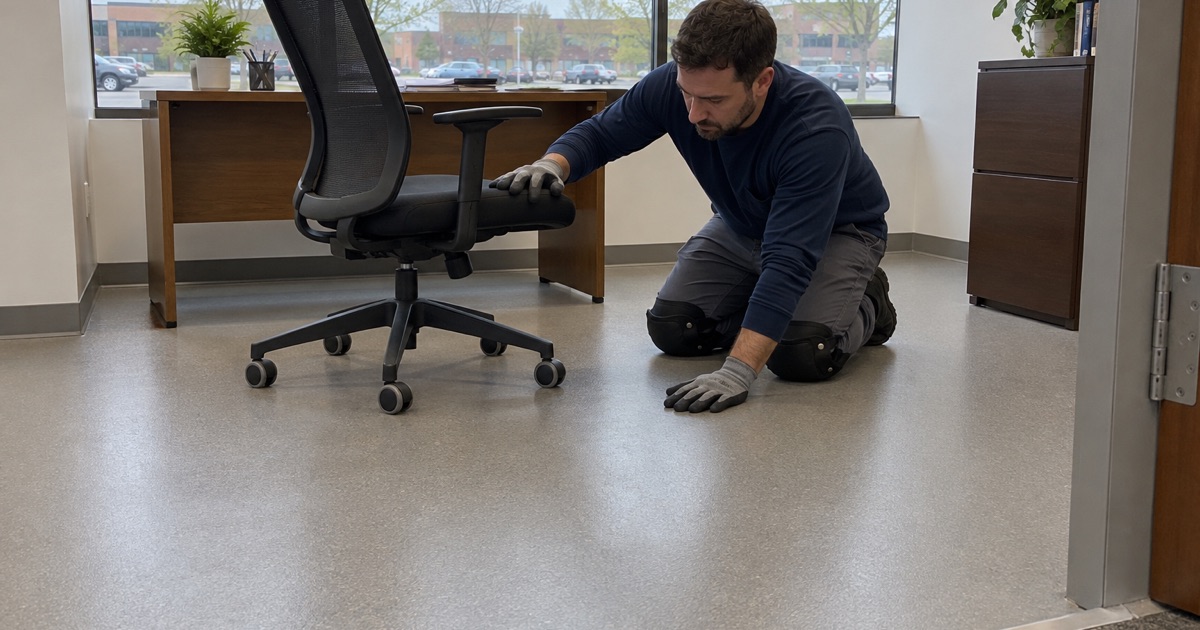
Burr Ridge is a village where a lot of people work at desks, and some of those desks are rented rather than owned. That changes how often a floor sees new furniture, new chairs and new habits, and it is a good place to start thinking about wheels.
Coworking memberships and private offices at 1333 Burr Ridge Parkway
The Regus center at 1333 Burr Ridge Parkway, Suite 200, sells coworking memberships, dedicated desks and furnished private offices sized from 1 to 15 desks, along with meeting rooms and day offices. Furniture and cleaning are included, and the center keeps weekday hours of 8:30 a.m. to 5:00 p.m. The address sits inside the village on the Lyons Township side, in Cook County, in a building described as having a park-like setting and secure underground parking.
We mention it as a place, not a client: we have not worked there, and its office floors are probably carpet. What it illustrates is the way Burr Ridge sells office space by the desk. Every one of those desks comes with a rolling chair, and a rolling chair is the most constant wheel load any office floor carries.
Why the chair outlasts the foot traffic
Foot traffic spreads across a room and moves on. A desk chair rolls over the same few square feet hundreds of times a day, carrying a seated person’s weight on five small wheels. Over a year that adds up to more concentrated wear than any doorway sees.
That is why a reception desk, a private office or a shared workroom with a hard floor should be planned around the chair. Whether the floor is a lobby, a front counter or a back office with a coated slab, the castor is a decision to make before the finish, not after the first dull patch appears.
Looking for epoxy-flooring closer to La Grange Park? See Epoxy-Flooring Services in La Grange Park.
Soft Tread, Hard Tread and the Grit Between Them
Office-chair castors are not all alike, and the difference matters far more on a coated floor than most people expect. A coating is a hard floor in castor terms, and it wants the wheel built for hard floors.
Two kinds of chair castor
The rule of thumb in office furniture is simple: soft castors for hard floors, hard castors for soft floors. A soft tread wheel has a rubbery outer layer meant for tile, laminate, floorboards and, by extension, a resin coating. A hard castor is the one-piece plastic wheel built to roll over carpet, where a soft tread would drag.
One European office-supply retailer notes that hard-floor castors are usually two-colored, with a visible softer tread, while carpet castors look like one solid piece. That gives an owner a quick way to check a room full of chairs. If the floor is coated and the wheels are one solid color, there is a good chance they are carpet castors working on the wrong surface.
Load-dependent braking under EN 12529
The same retailer states that office-chair castors must comply with EN 12529, a European standard that calls for load-dependent braking. The wheel is meant to hold the chair in place when no one is sitting in it, so an empty chair does not drift away across a hard floor. Furniture castors sold for carts and side tables are not built to that standard and should not be swapped onto a desk chair.
For a coated floor, braked chair castors are the right starting point. When a chair is replaced, we suggest checking that the new one carries proper office-chair castors with a hard-floor tread rather than whatever came in the box.
How a hard wheel and grit wear a track into a topcoat
A hard castor spinning on a hard surface is not much of a problem on its own. The trouble starts when grit gets under it. Sand, dried mud and fine dust caught between a hard plastic wheel and a topcoat act like a mild abrasive, and a chair rolling over the same path all day can grind a dull track into the finish.
This is our reading of how the wear happens rather than a lab result. We have found no castor-chair rating for resin floors, so we do not quote one and we do not call any coating scratch-proof. What we can say is that a soft tread wheel gives grit less to push against, and a clean floor gives it less to push in the first place.
Castor First, Clean Floor Second, a Mat Only Where Allowed
When a client asks how to protect a new coated floor from chairs, we give the same three steps in the same order. None of them is expensive, and together they do more than any single upgrade to the coating itself.
Start with the right castor
The first step is fitting every rolling chair with soft tread, hard-floor castors before the room goes back into use. In an office with a dozen desks, that may mean a box of replacement wheels, which costs far less than refinishing a worn lane under each desk. In a home office it may mean one chair and five new wheels.
We also look at what else rolls. Carts, filing pedestals and printer stands often ride on hard furniture castors, and they deserve the same check even if they move less often than a chair.
Keep the grit off the floor
The second step is housekeeping that keeps grit from collecting under desks. Regular dry dust mopping or vacuuming where chairs roll removes most of what does the damage. A walk-off mat at the entry catches a lot of the grit before it reaches the desk area at all.
On our side, the topcoat choice matters here too. For a desk area we usually look at a polyaspartic or urethane topcoat over a 100% solids epoxy base, and we name the system, coat count and finished thickness in writing so the client can compare the floor against the quote. Where a little texture is wanted near an entry, we specify it by the broadcast and topcoat used rather than promising slip resistance as a slogan.
Chair mats, and the topcoat maker’s say
The third step is the one people often reach for first: a chair mat. A mat can help where a chair rolls constantly, but some mats can trap grit or interact with a finish in ways a coating manufacturer does not want. We only recommend a chair mat where the topcoat maker approves one.
If an office already uses mats, we ask to see the product before we finish the floor. That keeps the protection plan consistent with the coating and avoids a mat quietly causing the wear it was meant to prevent.
Rolling Chairs in Burr Ridge Basement and Garage Home Offices
Not every desk in Burr Ridge is rented. The village is overwhelmingly owner-occupied, and most of its housing dates from 1980 to 2009, which means plenty of finished basements and attached garages that end up holding a desk. A home office on a coated slab follows the same castor logic, with a few extra concerns underneath it.
A basement home office starts with the slab
Before we coat a basement for a home office, we read the slab for any history of water, because a coating does not stop seepage or sewer backup. Moisture testing is part of our written scope, using a method such as an ASTM F2170 in-situ relative humidity probe or ASTM F1869 calcium chloride test. Whether a slab from that era was poured over a vapor retarder is not recorded anywhere at the neighborhood level, so we test rather than assume.
If the readings run high, we discuss a moisture-mitigation primer or advise against coating until the source is dealt with. Our warranty explanation starts with moisture as the first exclusion, and we say so before the job is sold. Once the floor is down, the desk chair gets soft tread castors like any office chair.
A garage corner turned into a workspace
Some owners carve a desk out of an attached garage, which puts a rolling chair on the same floor that takes car tires all winter. Those tires carry in brine and rock salt, so we choose a garage system built to hold up to deicers and plan the desk corner as part of it. A vinyl flake or quartz aggregate broadcast can hide some wear, but it does not change the castor advice.
Cure timing follows slab temperature and dew point rather than the calendar. An unheated garage in deep winter is told to wait, because a coating that cures too cold will not deliver the hardness the desk area needs.
Paperwork before the grinder starts
The Village of Burr Ridge permit page exempts finish work such as painting, hardwood refinishing, tile replacement and carpeting, while work that affects foundations, garages or patios needs a permit. We check permit questions with Community Development before a job is scheduled, not after. On home jobs over the state threshold, the homeowner receives a written contract and the Illinois consumer-rights pamphlet before any grinding begins.
Dust from the grinder is captured at the machine with a vacuum rather than rinsed toward a floor drain. That keeps a basement office clean during the work and keeps concrete fines out of the sewer, whichever side of County Line Road the house sits on.
- 20+ Years in Business
- Moisture Tested Before Pricing
- Free Written Estimates