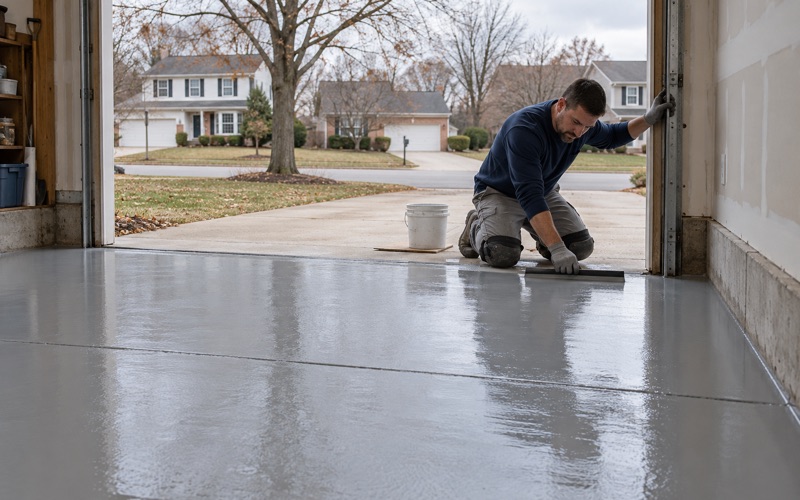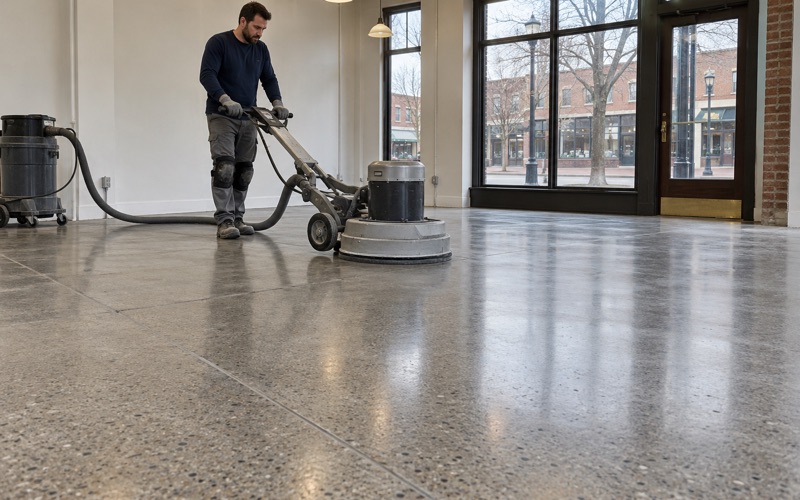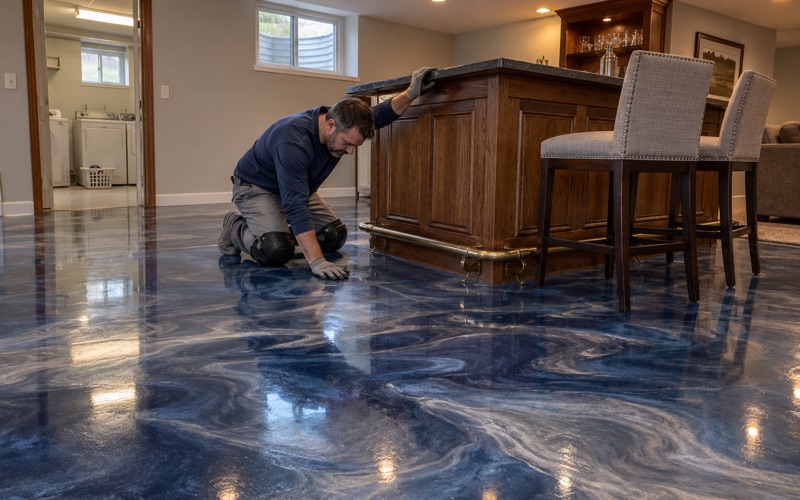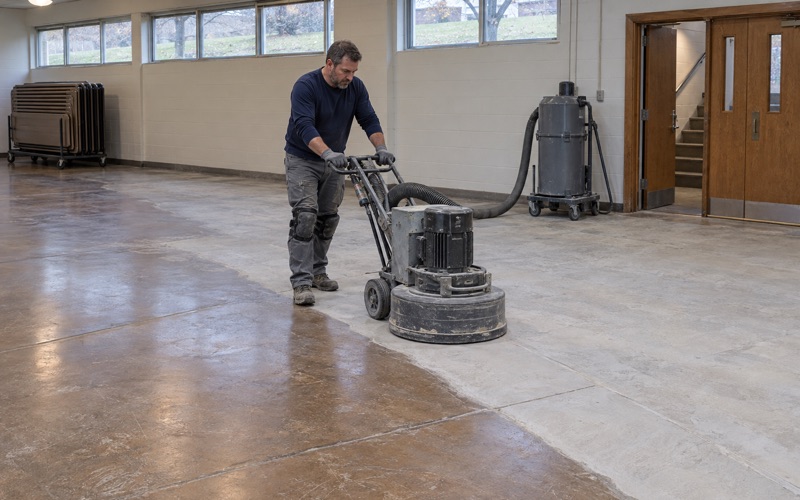
Wheaton Epoxy Flooring has spent more than 20 years putting epoxy flooring in Brookfield garages, basements and work rooms, and every slab we coat is opened with a diamond grinder or a shot blaster rather than an acid etch. That mechanical profile is what the first coat grips, and it is the difference between a floor that wears evenly and one that peels in sheets. Before a price is final, a moisture test goes into the written scope, because a slab that pushes vapor will undo the best product on the market.
Our proposals name the product line, the number of coats and the finished thickness, so you can hold the finished floor up against the quote. On the first visit we map cracks, spalls and any old coating, and if a slab needs repair or replacement before it should be coated, we say so instead of selling a coating over the problem.
This page is about one ordinary chore that meets a coated garage floor sooner or later: mixing a bag of concrete to set a post. It covers what wet concrete does to skin and to a finished surface, how the mess should be cleaned, and how we set up a garage so a weekend project and a new coating can share the same space.
A Fence Company on Cleveland Avenue, and Posts All Over the Village
Freeman Fence, ninth on the employer table
The Village of Brookfield’s 2023 annual financial report lists its ten principal employers, and ninth on that table is Freeman Fence, with 50 employees. Directory listings place Freeman Fence-Brookfield at 3515 Cleveland Avenue under fence contractor categories, and that address sits inside the village on the Proviso Township side.
We have no connection to the company and have not seen how it works, what its yard holds or what its floors are. We mention it because a fence contractor among the village’s largest employers is a fair signal of how many posts go into the ground around here, and posts are where its trade and ours happen to overlap.
The bag mixed in the driveway or the garage
Posts for chain-link and wood fences are commonly set in concrete, and homeowners do the same for a mailbox, a basketball hoop or a single replacement fence post. The usual setup is a bag of mix, a wheelbarrow or a tub, and a hose, parked in the open garage or on the apron just outside it because that is where the tools live.
Brookfield counts 6,008 single-family detached homes, so a great many garages double as the staging area for jobs like these. When that garage has a fresh flake or quartz floor, the mixing spot deserves a few minutes of planning, for reasons the concrete’s own safety sheet spells out.
A finished floor is not a work slab
A bare garage slab shrugs off a splash of mix because it is the same material, and nobody minds a gray stain on gray concrete. A coated floor is a finished surface with a topcoat and a texture, and it reacts to fresh concrete the way a kitchen counter would, not the way a sidewalk does.
That shift in thinking is most of the battle. Owners who treat the coated garage like a workshop floor tend to keep a drop cloth handy, and the ones who still treat it like a driveway are the ones who call about gray crusts stuck in the flake.
Looking for epoxy-flooring closer to Schiller Park? See Epoxy-Flooring in Schiller Park.
Wet Concrete Is Caustic: What Its Safety Sheet Says
Severe skin burns and eye damage
A ready-mix concrete safety data sheet from Peckham Industries, issued in March 2023, classifies freshly mixed concrete under skin corrosion category 1B and eye damage category 1, with the signal word Danger. Its hazard statement is blunt: “Causes severe skin burns and eye damage.” Cement mixed with water makes a strongly alkaline solution, which is why the burn needs no heat to happen.
Another manufacturer’s sheet warns that burns from wet concrete can develop without pain being felt, for instance when someone kneels in it. On a garage floor that means gloves, eye protection and long sleeves for whoever is mixing, and nobody kneeling in a splash while they hold a post plumb.
Scrape it up, never wash it toward a drain
The same sheet is specific about clean-up. Wet material is to be scraped up and placed in a container, then allowed to harden before disposal, and its environmental precaution reads “Do not attempt to wash wet concrete down sewers or storm drains.”
That rules out the reflex of hosing a splash out the garage door toward the street or across the slab toward a floor drain. It is the same discipline we hold ourselves to with grinding dust, which is captured at the machine with a vacuum rather than rinsed toward a drain or a storm inlet.
Rinsing the tools without rinsing the floor
The wheelbarrow, hoe and trowel carry the most cement at the end of the job, and that rinse water is where a lot of floor trouble starts. Rinse them on the lawn edge or into a bucket, never across the coated slab, so cement-laden water does not run into the texture and dry there.
Let the solids in that bucket settle and harden, then dispose of the hardened residue as the safety sheet describes. A bucket of gray water left open on the garage floor overnight is a spill waiting for a bumped knee, so it goes outside once the work is done.
Scrape It While It Is Plastic, Before It Locks Into the Texture
While it is still plastic
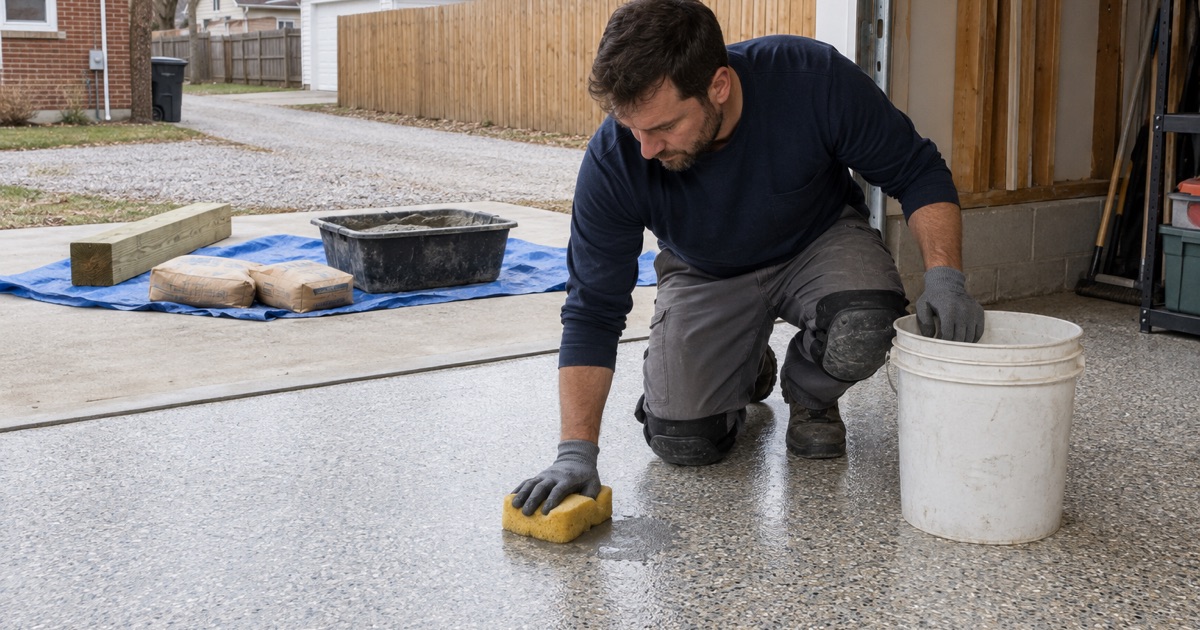
A splash of fresh concrete on a sealed epoxy or polyaspartic floor sits on top of the topcoat while it is still plastic. At that stage it can be lifted with a plastic or rubber-edged scraper and the remaining film wiped away with a damp rag and clean water, and the sooner that happens the better the result.
Work from the outside of the splash toward the middle so the paste is gathered rather than smeared into a wider ring. Wipe water goes into a bucket, not across the floor, and a rag loaded with cement goes into the trash rather than back into the clean water.
Once it sets into flake or quartz texture
Most garage floors we install carry a vinyl flake or quartz aggregate broadcast under the topcoat, partly for looks and partly because the texture gives tires and shoes something to bite. That same texture is what set concrete keys into, filling the low spots between chips the way it fills the gaps in gravel.
Once it has hardened, the only way off is scraping, and scraping hard enough to lift set paste out of a textured surface risks scoring or dulling the topcoat underneath. No floor coating is concrete-proof, and we will not tell you a set splash will pop off cleanly, because sometimes it does not.
Why we do not suggest acid
Homeowners sometimes ask whether an acid product will dissolve the set spots. We have not seen coating maker guidance that endorses that on a finished floor, so we do not recommend it, and the safer move for a stubborn spot is to call us and look at it together.
A small, deliberate topcoat repair over a damaged patch is a known quantity. An experiment with chemicals across a whole garage bay is not, and it can turn a few gray dots into a dull, stained section that costs more to fix.
Tarp, Scraper and a Bucket of Water: Mixing Near a Coated Brookfield Garage
Setting up the mixing spot
The working answer is simple: mix on a tarp or a sheet of plywood, never directly on the coated slab, and give the cover a wide margin past the wheelbarrow. Keep a bucket of clean water, a scraper and a few rags beside the spot before the first bag is opened, so a splash is handled while it is still plastic.
If the post is out in the yard, mixing out there and carrying nothing wet back across the garage avoids the problem entirely. Boots that stepped in the mix get wiped before they cross the floor, because a tread full of paste leaves a trail that sets in the texture overnight.
Choosing a system with projects like this in mind
A garage that sees post projects, workbench repairs and winter tires is a working floor, and we choose the system for that life. Our garage systems are picked to stand up to the brine and rock salt that ride in on tires all winter, and the slip resistance we specify comes from the broadcast and topcoat we name, not from a slogan.
A finer texture is easier to scrape clean, while a heavier broadcast gives more grip underfoot, and we talk through that trade-off with you rather than picking for you. Whatever you choose, the proposal names what goes down, so the decision is on paper and the finished floor can be checked against it.
Before the grinder starts
Brookfield requires every contractor working in the village to hold a Village of Brookfield Contractor License with a $10,000 License and Permit Bond, which is a condition of working here rather than a credential, and we sort that out before a job is scheduled. The village permit page lists replacing existing flooring among work that needs no permit, which suggests a coating on an existing slab sits on the permit-free side, though we confirm that with the village rather than assume it.
On home jobs above the state threshold you get a written contract and the Illinois consumer-rights pamphlet before any grinding begins. We also explain what the coating warranty leaves out before you sign, and moisture coming up through the slab is the first exclusion we name.
- 20+ Years in Business
- Moisture Tested Before Pricing
- Free Written Estimates