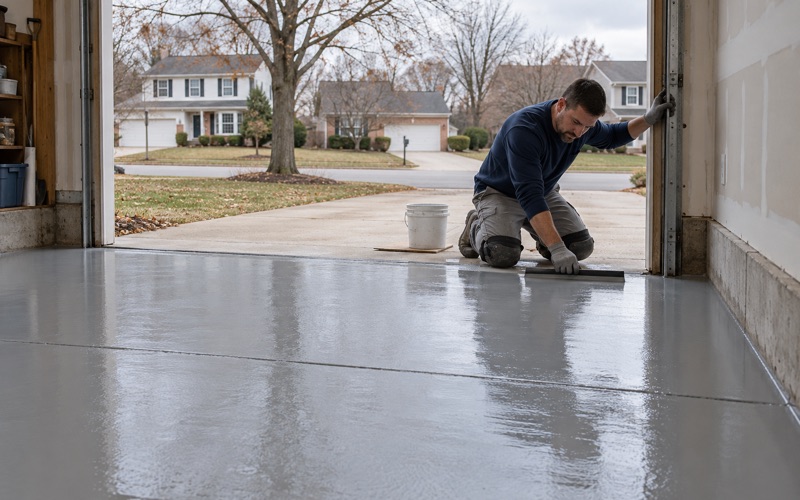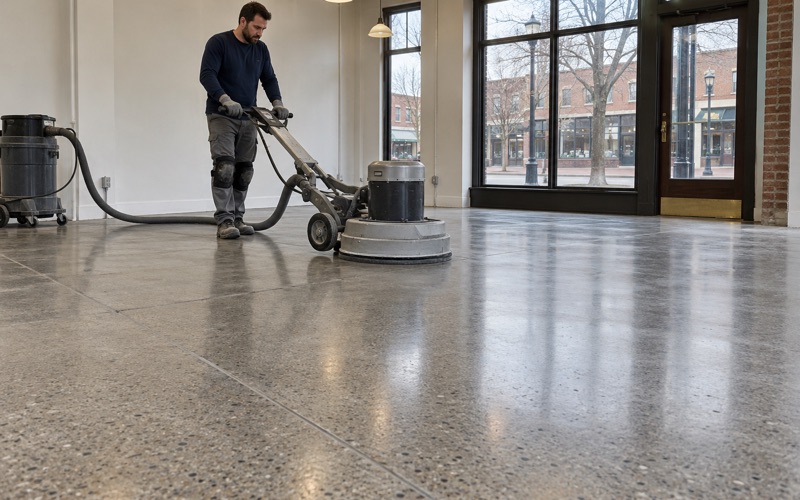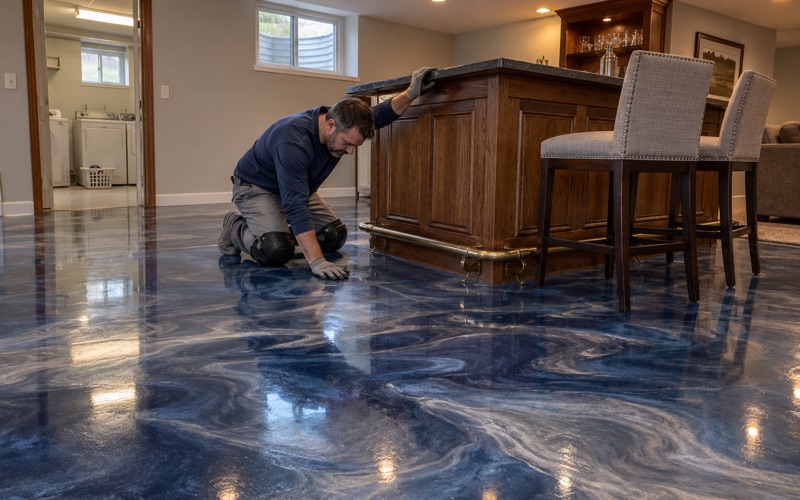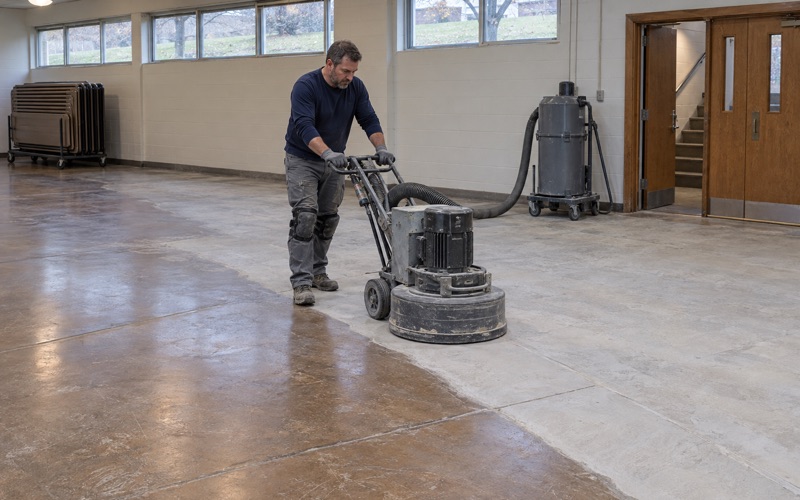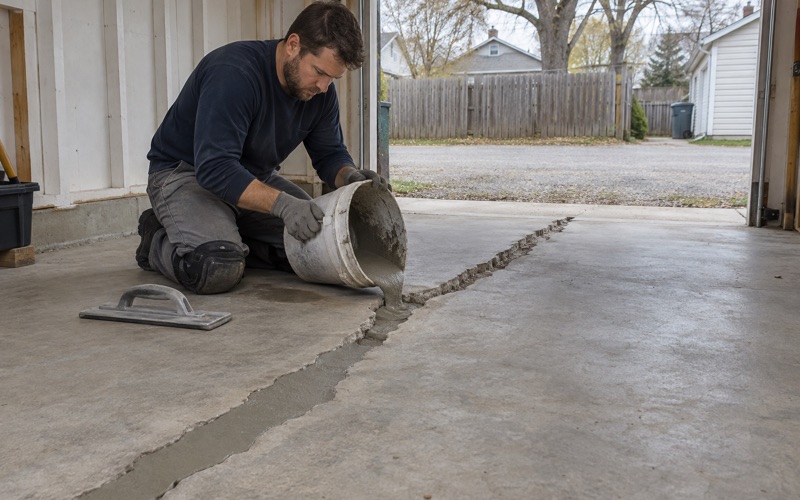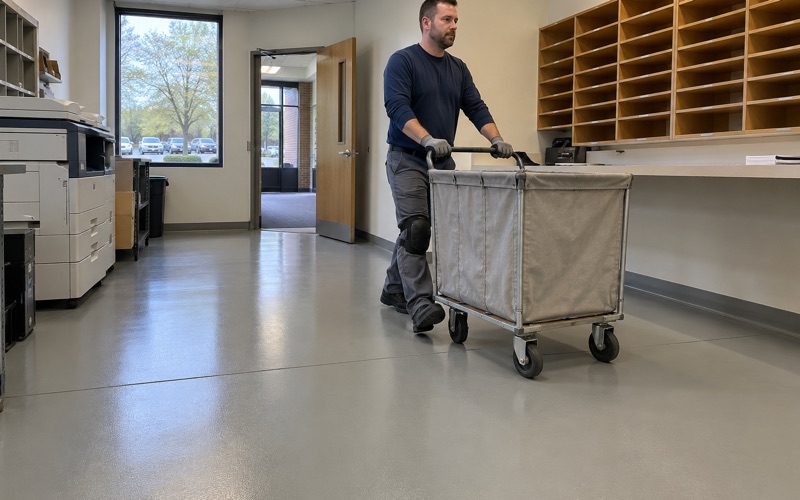
Wheaton Epoxy Flooring has spent more than 20 years on epoxy flooring in Bridgeview and the surrounding suburbs, and every job begins with a diamond grinder or a shot blaster rather than an acid etch. That mechanical profile is what a 100% solids epoxy or a polyaspartic topcoat actually grips. Before a price is final, a moisture test goes into the written scope, whether the slab sits under a garage door or at the bottom of a basement stair.
Our proposals name the product line, the number of coats and the finished thickness, so an owner can hold the finished floor up against the quote. We map cracks, spalls and failing old coatings before anything is sold, and we say plainly when a slab needs repair or replacement first. A coating cannot fix a broken slab, and pretending otherwise is how floors fail in their second year.
Commercial floors raise different questions than home floors, and one kind of plant changes how floor work has to be planned: a dry food plant. In a facility built around keeping product and surfaces dry, resurfacing is a hygiene event as much as a coating job. That idea runs through most of this page, and the garages and basements that make up much of our residential work come after it.
A Dry Pasta and Rice Plant on West 71st Street
What the Quaker Oats Plant Makes
Bridgeview is a village in Cook County, about 15 miles southwest of the Chicago Loop, with a population of 17,027 at the 2020 census. Its industrial corridor along West 71st Street includes the PepsiCo Quaker Oats plant, listed at 7700 West 71st Street in Lyons Township, which makes Rice-A-Roni, Pasta Roni and Near East products. In 2021 the plant added a pasta press, a dryer and a packaging line, nearly doubling its output of pasta and rice-based products.
The address has a longer history as a pasta site. A 1984 OSHA inspection record lists Golden Grain Macaroni at 7700 West 71st Street, and Quaker bought Golden Grain in 1986, which is why Golden Grain still appears as an industrial name on the village’s list of top ten taxpayers. We have no relationship with Quaker or PepsiCo and have not seen how the plant zones, cleans or floors its production areas, so what follows describes the category of plant rather than this building.
Why Water Is the Hazard in a Low-Moisture Plant
Pasta, rice mixes and cereal are low-moisture foods, and the industry has written guidance on how the plants that make them control Salmonella. The Grocery Manufacturers Association’s 2009 guidance, developed by a task force that included PepsiCo, Kellogg, General Mills and Cargill, says dry conditions must be maintained at all times in the primary control area except when controlled wet cleaning is deemed essential. It also says water must be removed immediately if it gets in, because limiting water is the primary means of control in that kind of plant.
That reverses the instinct most floor crews bring to a job. In a wet food plant a floor is judged partly by how well it sheds a hose stream to a drain, but in a low-moisture plant the goal is that water never arrives in the first place. The GMA document is industry guidance rather than an FDA regulation, and a floor coating does not control Salmonella, but a floor contractor still has to work inside the rules the plant’s food safety team runs by.
Looking for epoxy-flooring closer to Palos Hills? See Epoxy-Flooring in Palos Hills.
Resurfacing as Construction Inside a Hygiene Zone
Isolating the Work Site
The same guidance says hygienic design standards and sanitation performance specifications apply to construction and major maintenance. Its stated reason is that these activities can dislodge microbial growth niches and spread contamination through a facility. Grinding a production floor, cutting out a cracked joint or patching a spall is exactly that kind of activity.
The preventive measures it names are temporary isolation of the work site, rerouted traffic, controlled waste removal and negative pressure. In practice that means the floor area is closed off from production, foot and forklift routes move around it, and debris leaves along a path agreed in advance. We plan that sequence with the plant’s food safety team before a grinder is unloaded, not on the morning of the job.
Keeping Water Out of a Dry Production Zone
Several ordinary floor-prep habits put water on the slab. Wet grinding, rinsing dust toward a drain, mopping a fresh profile before primer and a long cure in humid air all bring moisture into an area that is run dry. In a dry plant each of those has to be replaced with a dry method or taken out of the plan.
Our standard approach already leans that way, since grinding dust is captured at the machine with a vacuum instead of being washed toward a floor drain. Cure schedules follow slab temperature and the dew point spread at the surface, which matters here because a coating that cures slowly or picks up amine blush can keep an area out of service longer than planned. A moisture test of the slab itself, using ASTM F2170 in-situ relative humidity probes or ASTM F1869 calcium chloride testing, belongs in the scope before a system is chosen.
Catching Grinding Dust at the Tool
Grinding dust is not only a housekeeping problem in this setting. Old cracks and failed joints are where residue settles, and opening them up releases whatever has collected there over years of operation. Dust captured at the grinder head and the shot blaster, and vacuumed rather than swept, stays inside the isolated area instead of drifting toward open product.
We map the cracks, spalls and failing coatings before grinding starts, so the plant knows which joints will be opened and in what order. That map becomes the sequence for the job, and it lets the food safety team decide which zones can be worked during which shutdowns.
Sealed Cracks and Joints for Dry Cleaning
Removing the Niches
The GMA guidance asks for equipment with no niches, which it describes as pits, cracks, corrosion and crevices. A floor is not equipment, but the same logic carries over to the slab: an open joint or a spalled edge is a place residue settles that a dry cleaning routine cannot reach. Routing out and filling cracks and joints before the coating goes down is the step that matters most on a floor in a low-moisture plant.
Our repair scope names which joints are filled, which cracks are routed and patched, and where the slab needs more than a coating can give it. When a section is too broken to hold a resin system, we say so and recommend repair or replacement before anything is coated. A crack bridged with a thin topcoat tends to reopen, and a reopened crack is the very niche the work was meant to remove.
A Surface Kept Clean by Vacuum, Not Hose
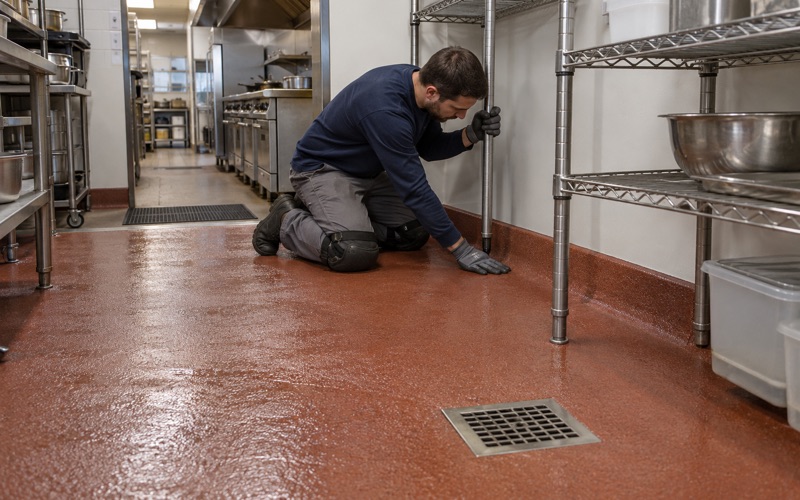
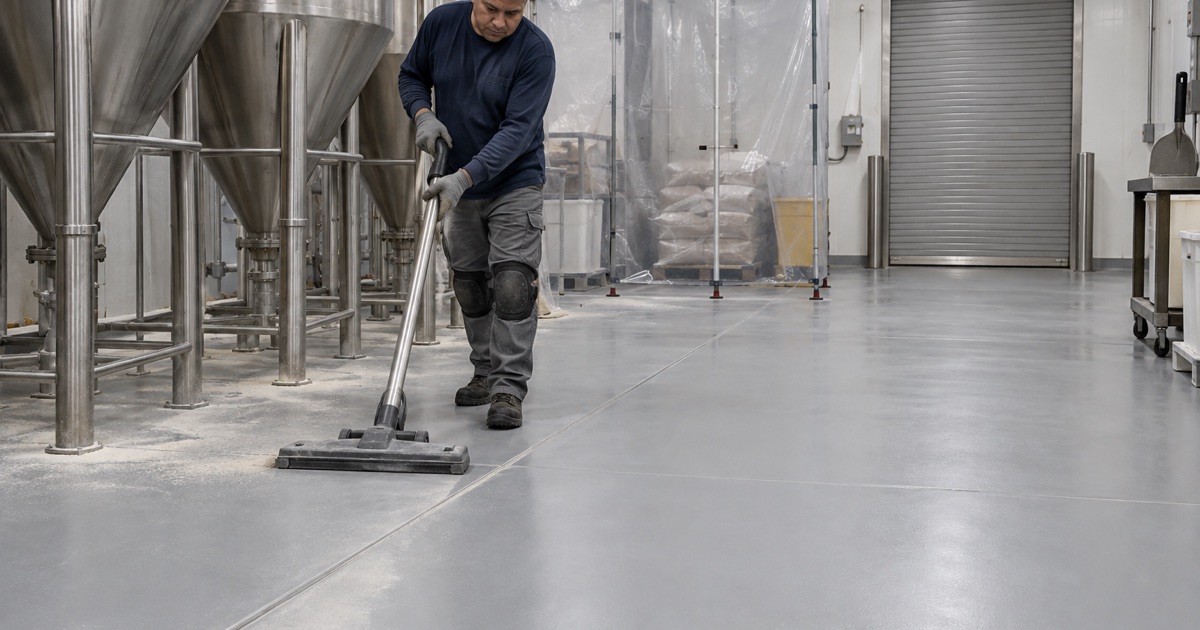
In a dry plant, dry cleaning means vacuuming, sweeping with dedicated tools and wiping, with water used only under controlled wet cleaning. The floor finish has to suit that routine. A dense, continuous surface with sealed joints and no loose broadcast edges lets a vacuum lift spilled flour, rice or seasoning instead of pushing it deeper into texture.
That does not mean the floor should be slick. A slip-resistant texture is specified by the broadcast and topcoat chosen, so a fine quartz aggregate broadcast under a sealing topcoat can give footing without deep valleys that trap powder. We write the texture into the proposal by product and broadcast size, so the plant can weigh how much grip it wants against how easily the surface vacuums.
Choosing the System for Each Area
Different parts of a food plant can call for different systems. An area that sees controlled wet cleaning or hot water at equipment may be better served by urethane cement, while packaging and dry storage may suit a 100% solids epoxy with a polyaspartic topcoat. Products are picked inside the Illinois VOC limits for floor and industrial coatings, which matters in an occupied building with a ventilation system serving production.
Whatever the mix, each zone’s system, coat count and finished thickness are written down, so the food safety team can check what went where. That record also helps at the next maintenance shutdown, because the crew can see what is already on the floor before choosing a repair material.
Bridgeview Garages, Basements and Workshops
Garage Floors and Winter Salt
Most of our Bridgeview calls do not come from food plants. The village has 6,534 housing units, and most of them were built between the 1950s and the 1980s, so many garage slabs carry decades of wear, old paint or an earlier coating. Those layers come off with the grinder before anything new goes down.
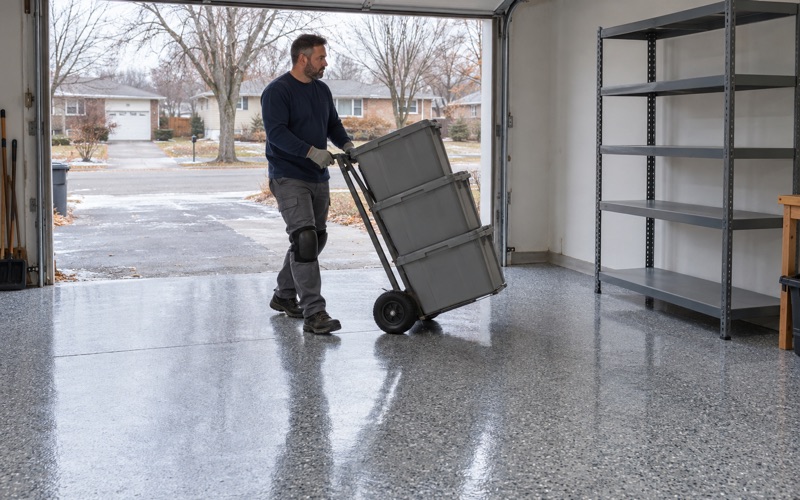
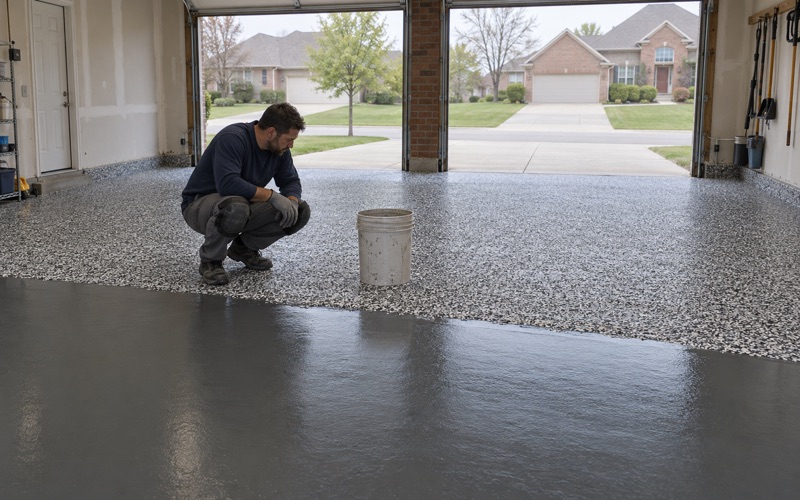
Garage systems are chosen to stand up to the brine and rock salt that ride in on tires all winter, and to resist hot tire pickup in summer. A 100% solids epoxy base with a vinyl flake broadcast and a polyaspartic topcoat is a common choice, and the flake also hides the small marks a workbench area collects. Cure schedules follow slab temperature rather than the calendar, so an unheated garage in deep winter is told to wait for warmer conditions.
Basements and Flood History
Bridgeview has a record of repeated flood losses, including residential structures along Roberts Road and 100th Place, and most of the village lies in a high urban flooding susceptibility zone. The village has said its flood maps do not adequately address that risk. A basement here is read for past water before we quote it, because a coating does not stop sewer backup or seepage.
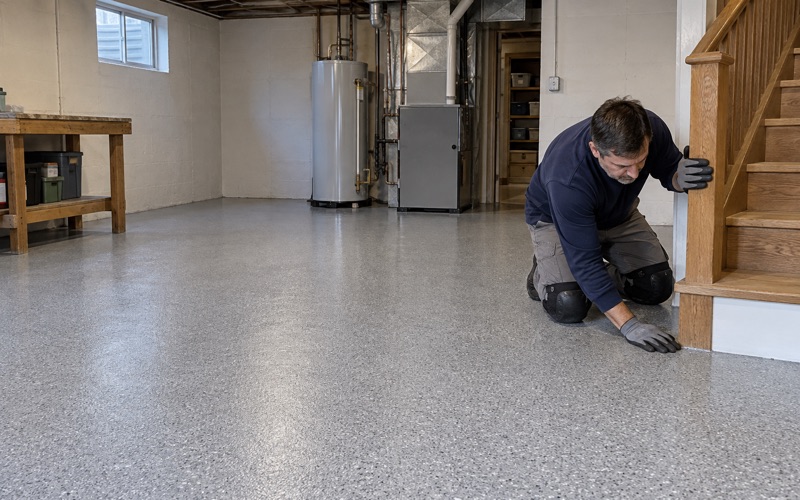
We look for efflorescence, staining at the wall line and the condition of the sump pit or floor drain, and the moisture test runs before the price is final. Where hydrostatic pressure or high vapor emission shows up, a moisture-mitigation primer may become part of the system, or the honest answer may be that the slab is not ready. Moisture is the first exclusion we name in the warranty, and we explain it before the job is sold.
Permits and Paperwork
When a floor job in Bridgeview needs a permit, the application goes to the Village of Bridgeview Building Department at 7500 South Oketo Avenue. Submittals include a contractor’s license, a $10,000 surety bond and a certificate of insurance, and no permit is issued without drawings. We check whether a permit applies and gather that paperwork before the job is scheduled.
On home jobs over the state threshold, the homeowner receives a written contract and the Home Repair: Know Your Consumer Rights pamphlet required under the Illinois Home Repair and Remodeling Act before any grinding starts. We also never sell a floor coating as radon reduction, because in Illinois that is licensed mitigation work regulated by IEMA.
- 20+ Years in Business
- Moisture Tested Before Pricing
- Free Written Estimates