Wheaton Epoxy Flooring brings more than 20 years of epoxy flooring in Bensenville and the surrounding suburbs to a question most coating sales pitches skip: what happens to a resin floor that is wet on purpose, all day, with a chemical meant to kill things. In a food plant, that is not a leak or a spill. It is the design.
We approach those floors as working equipment. The slab is opened with a diamond grinder or a shot blaster rather than an acid etch, the moisture reading goes into the written scope before the price is settled, and the proposal states the product line, the number of coats and the finished thickness so a plant manager can hold the installed floor against the quote.
That matters most at the doorways. A strip of floor a few feet wide, crossed by every boot and wheel that moves between rooms, can fail years ahead of the rest of the building if its coating was picked for a dry warehouse aisle. This page is about that strip.
A Seafood Headquarters on Thorndale Avenue
What the village’s food employers look like
Bensenville is a village near O’Hare International Airport, mostly in DuPage County with a portion in Cook County. Its list of principal employers at the end of 2024 included Fortune Fish & Gourmet with 350 workers, one of two food companies among the top three. Fortune describes its site on Thorndale Avenue as its 110,000-square-foot Bensenville headquarters.
That address, 1068 W. South Thorndale Avenue, sits inside the village in Addison Township, DuPage County. We mention it because it shows the kind of floor that exists here: not only dry freight space, but a seafood operation whose own paperwork describes a food-safety system with the floor inside it.
HACCP and an environmental monitoring program
Fortune’s January 2024 HACCP letter states that it maintains a HACCP plan in compliance with 21 CFR part 123, keeps written Standard Sanitary Operating Procedures, and holds a quality book that includes an Environmental Monitoring Program and a chemical program with control and training policies. We have no relationship with the company and have not seen its floors, so we use it only as a picture of the documents a seafood processor in Bensenville works under.
An environmental monitoring program swabs surfaces, and floors and drains are among the places a plant watches. A coating cannot sanitize anything and is not a Listeria control, but a cracked, peeling or porous floor gives moisture and soil somewhere to sit between cleanings. A sealed, intact surface is easier for a sanitation crew to clean completely, which is the part the floor can contribute.
Which health desk reviews the room
Because the village straddles two counties, the health authority for a food-handling floor depends on the parcel. The DuPage County Health Department covers the DuPage side, where most of the village sits, and the Cook County Department of Public Health covers the Cook portion. We check the address before we assume which plan-review rules, such as the cove radius at the wall, will apply.
Looking for epoxy-flooring closer to Northlake? See Northlake Epoxy-Flooring.
Foamers, Footbaths and a Strip of Floor That Never Dries
What the FDA guidance describes
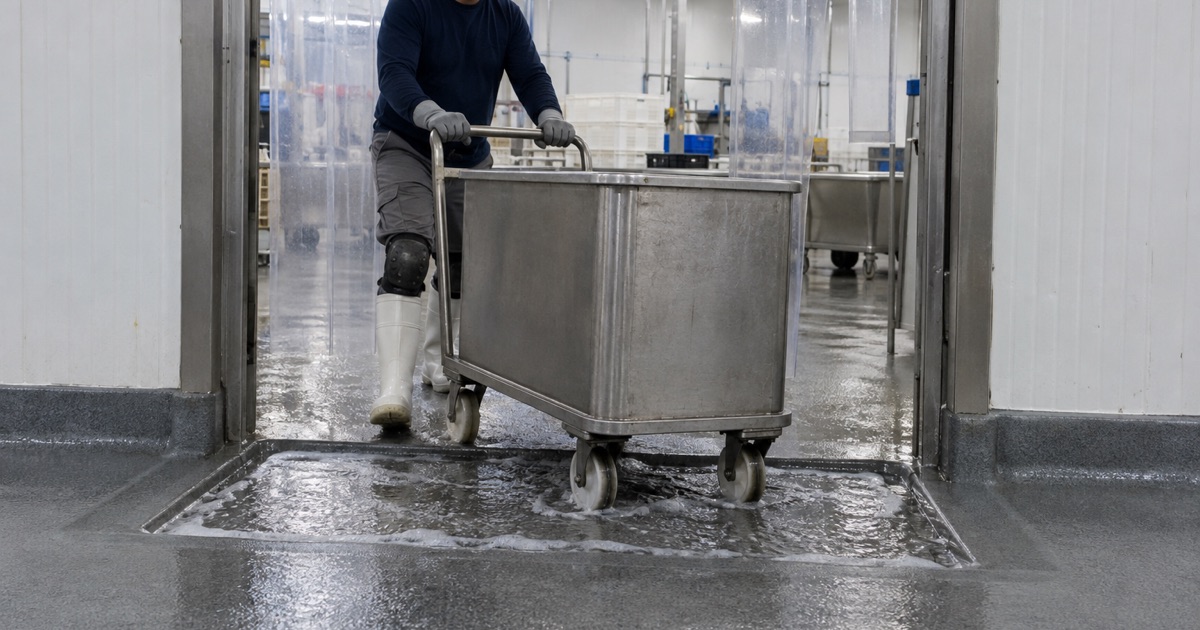
FDA’s 2017 draft guidance on controlling Listeria monocytogenes in ready-to-eat foods, which is nonbinding, suggests foamers, footbaths or dry powdered sanitizers at the entries to ready-to-eat areas. In its words, a foamer delivers an automatic spray of foam disinfectant on the floor where personnel, carts and forklifts enter. A footbath is usually a low flat container or a watertight recess in the floor with a non-slip surface, filled with a suitable sanitizer.
The guidance adds that foamers and footbaths generally suit a wet processing environment, and that people should not be able to avoid or jump over them. It is written for ready-to-eat foods under a different part of the federal rules, so how far it reaches into a seafood plant is a judgment for the plant’s own food-safety team, not for us.
Why the doorway takes the worst of it
Wherever a plant separates a raw cutting area from packed or ready-to-eat product, the doorway between them becomes the hardest-working floor in the building. A foamer or footbath keeps it wet with sanitizer through the shift, and every boot, cart and forklift wheel crosses it. The same guidance asks that cart and forklift wheels be cleaned and sanitized before they enter those areas.
So the doorway strip sees constant chemical contact, constant moisture and concentrated wheel traffic on the same few square feet. A floor that is fine thirty feet away can soften, lose gloss, or start lifting at its edge right where the sanitizer sits.
Where we start on an existing slab
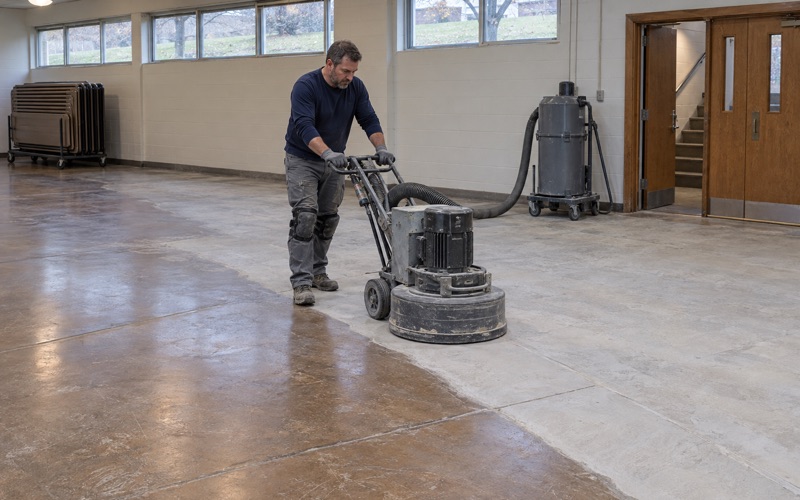
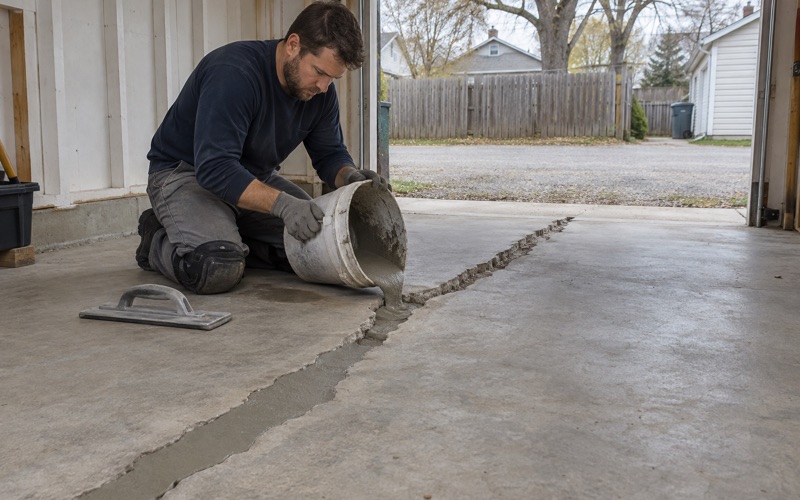
Before pricing that zone, we map cracks, spalls and old coatings and say plainly when the concrete needs repair or replacement first. A doorway strip that has been wet for years often has a coating failing from underneath, and putting new resin over a delaminating layer only moves the failure a few months down the road. Grinding or shot blasting to sound concrete, with the dust pulled into a vacuum at the machine, is how we find out what is really there.
Sanitizer, Chlorine, Caustic and Acid: What the Topcoat Has to Take
The chemical list in a fish plant
International guidance on fish processing names chlorine, lye and acids as the cleaning and disinfecting chemicals of process areas, and it notes that product waiting for the next step is kept cold with ice, slush ice or water-ice mixtures. Put together, a seafood floor sees caustic cleaners, acid descalers, chlorinated sanitizer and cold meltwater, often on one shift.
No single resin is equally good at all of that, and a coating that holds up to standing sanitizer can still dull or stain under a strong caustic left too long. We ask for the plant’s actual chemical list and concentrations, because the right answer depends on what is in the buckets, not on a brochure’s general claim of chemical resistance.
Building the system for chemical contact
For a doorway sanitizer zone we generally look at a 100% solids epoxy base or a urethane cement system, with a topcoat chosen for the chemicals on that list. Urethane cement tends to tolerate the thermal shock of hot washdown and cold slush better than a thin epoxy film, and a chemical-resistant topcoat over a broadcast layer protects the texture underneath. Whatever we specify, the proposal names it, with the coat count and finished thickness, so it can be checked after the job.
Products also have to sit inside the Illinois VOC limits for floor and industrial coatings, which bind the person applying them. We choose materials with those limits in mind rather than leaving the plant to find out about them later.
What a warranty will not cover
We explain warranty exclusions before the work is sold. Moisture vapor coming up through the slab is the first one we name, which is why moisture testing such as ASTM F2170 in-situ relative humidity probes is part of the written scope. A doorway that stays wet from above and is pushed by vapor from below is the classic case for a moisture-mitigation primer, and we say so before the price is final.
Wet Traction and a Watertight Footbath Recess
Texture a wet boot can trust
Fish-processing safety guidance lists falls on slippery floors and stairs among the industry’s accidents and recommends non-slip floor surfacing, along with clearly marked transport corridors. At a sanitizer doorway the worker is walking through foam or standing liquid in rubber boots, often pushing a cart. We specify slip resistance by the broadcast and topcoat, typically a quartz aggregate broadcast locked in with enough topcoat to hold the grit without burying it.
There is a trade-off. A coarser texture grips better but holds soil and takes more scrubbing, so we size the aggregate to the zone: heavier at the sanitizer strip and the footbath approach, finer where cleaning effort matters more than wet grip.
Building a footbath into the floor
When a plant wants a recessed footbath rather than a portable tray, the recess becomes part of the floor system. It has to be watertight so sanitizer cannot work into the slab, and its floor has to be non-slip like the rest of the entry. We coat the recess walls and floor continuously with the surrounding slab, carry the system around the lip without a seam, and cove inside corners so there is no joint for liquid to collect in.
The floor around the recess should drain freely rather than pond, so we check the existing pitch to the drains before we commit to a layout. The recess depth, its location and any change to the doorway are the plant’s call, made with its own food-safety staff.
Scheduling around a running plant
A food plant rarely closes for a week, so doorway zones are usually done in phases over weekends or overnight windows, one entry at a time while traffic is rerouted. Cure follows slab temperature and dew point rather than the clock, and a slab chilled by ice melt has to be brought up to the product’s minimum before we coat it.
We also leave the time between the final coat and the first sanitizer contact that the product line requires. Opening a doorway early to foam and forklift wheels is the quickest way to undo the work, so the return-to-service date is written down with everything else.
- 20+ Years in Business
- Moisture Tested Before Pricing
- Free Written Estimates