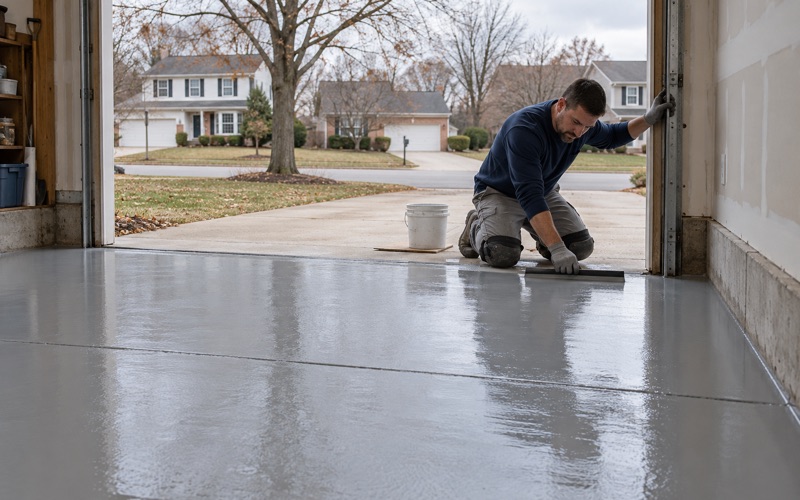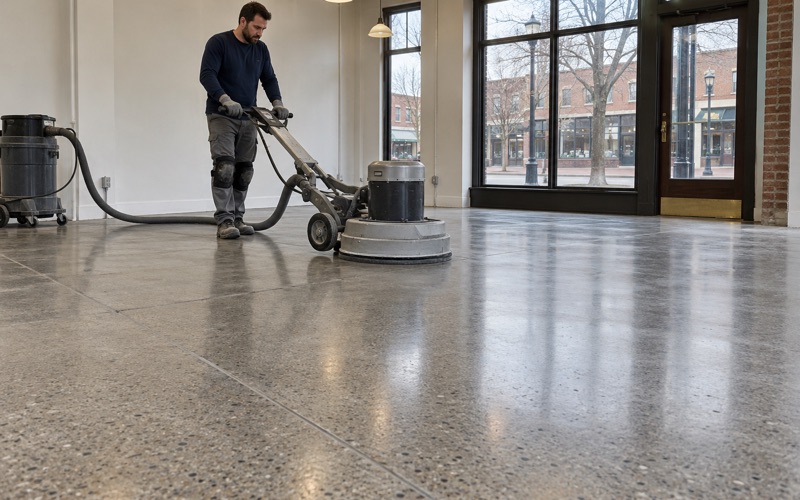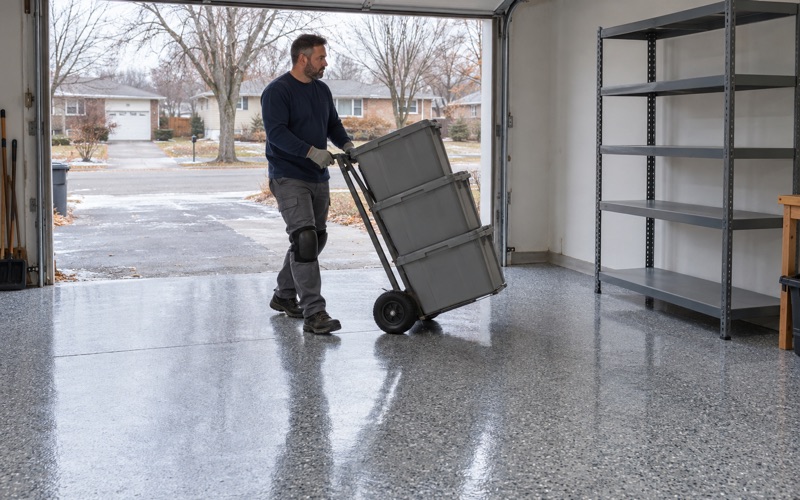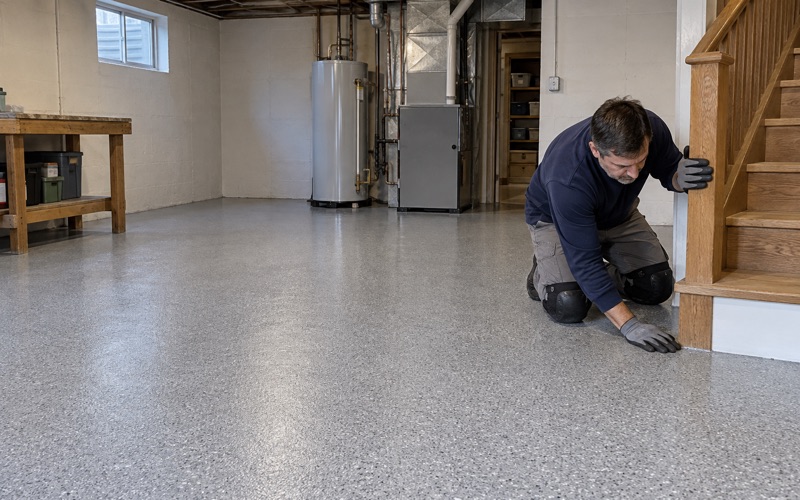
Wheaton Epoxy Flooring brings more than 20 years of epoxy-flooring work to Barrington, and every job we take starts with the slab rather than the color chart. We open the concrete with a diamond grinder or a shot blaster, never an acid etch, so the coating has a real profile to bond to. A moisture test is written into the scope before the price is final.
Our proposals name the product line, the coat count and the finished thickness, so the floor you get can be held against the paper you signed. We map cracks, spalls and old coatings before anything else, and we say plainly when a slab needs repair or replacement before it should be coated.
This page covers one narrow question that matters in older rooms where small children spend their days: how floor work fits around the federal lead renovation rule. We are not a lead renovation firm and hold no lead certification. What we do is plan our part of a project so it never undoes the cleanup that came before it.
New Floors at a 1969 Elementary School
What Barrington 220 has said about Lines
Arnett C. Lines Elementary sits at 217 Eastern Avenue, on the Cook County side of a village that spans Cook and Lake counties. Barrington 220 says the school opened in 1969 and serves kindergarten through fifth grade. The district’s Windows, Doors and Flooring page reports that Lines was due for new flooring and that crews spent summer 2025 removing old materials before new flooring went in.
The district has not said what came up or what went down, and we had no part in that project. The same page says more work is slated to be bid in winter 2026 and finished in summer 2026, without naming the schools. What makes Lines worth discussing here is its opening date and its youngest students, not anything about its floor.
When a school counts as a child-occupied facility
The federal lead renovation rule, 40 CFR 745 Subpart E, defines a child-occupied facility as a building, or part of one, built before 1978 and visited regularly by the same child under 6 years of age. The visits have to happen on at least two days a week, adding up to 3 hours a day, 6 hours a week and 60 hours a year. The definition says such a facility may include kindergarten classrooms.
A K-5 building that opened in 1969 meets the date test on its face, and its kindergarten rooms are the kind of space the rule names. The rule reaches renovation that disturbs painted surfaces, so the real question on any project is whether the work touches paint. Whether the 2025 work at Lines disturbed paint is not something the district has published.
Where floor work meets painted surfaces
Floor jobs in older rooms rarely stay on the floor. Pulling a cove base, removing a threshold or grinding tight to a painted wall can disturb paint a coating crew never meant to touch. That is why we ask who is handling the lead-safe side of a project before our equipment arrives.
On a pre-1978 job where painted surfaces will be disturbed, that work belongs to a firm qualified for it under the rule. Our role is the slab itself: preparing it, testing it for moisture and coating it once the room has been cleaned and released to us.
Looking for epoxy-flooring closer to Winfield? See Epoxy-Flooring in Winfield.
Plastic 6 Feet Past the Work, HEPA Vacuums and Two Buckets
Containment on the floor
For interior work, the rule requires the floor of the work area to be covered with taped-down plastic sheeting or another impermeable material reaching 6 feet beyond the perimeter of the surfaces being renovated. That sheeting is what keeps dust off the floor while paint is being disturbed. It also means the floor belongs to the containment until the containment comes down.
For a coating crew, that fixes the order of work. We cannot grind, prime or broadcast flake on a floor that sits under someone else’s plastic, so our schedule begins after containment and cleanup are finished. Planning it that way keeps a crew from arriving at a taped-off room with nothing it can do.
Cleanup with a HEPA vacuum and separate wash and rinse water
After the work, the rule calls for cleanup with a HEPA vacuum and for mopping uncarpeted floors with a method that keeps the wash water separate from the rinse water. A two-bucket system is the plain version of that requirement. The point is that dirty water is never wrung back onto the floor it just came off.
We treat our own grinding dust with the same instinct, even though it is concrete dust rather than paint. It is captured at the machine with a vacuum instead of being rinsed toward a floor drain or a storm inlet. A room that was cleaned to a standard should not be reloaded with dust by the next trade through the door.
Handing the room from one trade to the next
The cleanest sequence has one clear handoff. The renovation firm finishes its work, cleans, verifies and releases the room, and only then do we start grinding. On a school calendar, that usually means agreeing on the release date before the summer begins rather than discovering it in August.
We also ask what else will happen in the room after our coating cures. A floor that passed its wipe and then received a fresh coat of resin is a better floor, but a crew that drills overhead the following week can put dust right back on it.
The Cleaning Verification Wipe, 40 Square Feet at a Time
How the wipe works
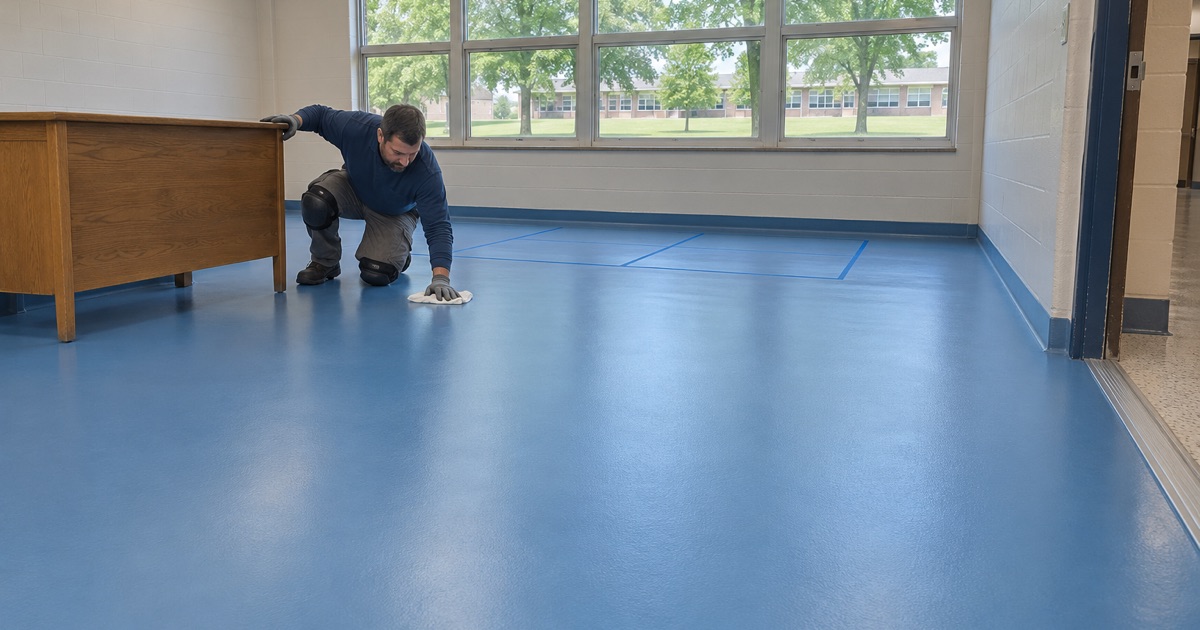
Once cleanup is done, the rule requires cleaning verification. Uncarpeted floors are wiped with a wet disposable cleaning cloth on a long-handled tool, and any floor larger than 40 square feet is divided into sections that are each smaller than 40 square feet. Every cloth is then compared to the cleaning verification card.
That turns verification into a section-by-section test rather than one glance across the room. A kindergarten classroom ends up gridded into a run of small patches, each judged by its own cloth against the card. A floor that wipes cleanly in one corner and badly in another shows it.
Why surface texture matters to the cloth
A wet cloth reads a smooth surface cleanly and a rough one poorly. Open pores, spalls, cracks and worn joints hold fine dust where a mop cannot reach it, and a cloth drawn across them collects whatever the last pass left behind. A smooth, sealed floor is the one that can pass that wipe.
That is where a coating fits into the picture, and only there. A finished resin floor is easier to clean and easier to verify. A coating is not abatement and it is not encapsulation, and it does nothing about the paint on the walls, doors or trim.
Texture as a specification
The grip on a finished floor is a choice made in the proposal, not a slogan. Slip resistance comes from the broadcast and the topcoat, so on a floor that will be mopped and wiped often we weigh a finer quartz aggregate or a lighter vinyl flake load against how much traction the room needs.
The topcoat matters as much as the broadcast. A polyaspartic or urethane topcoat over 100% solids epoxy gives a tighter, more even surface than a heavy, open texture, and that surface is easier to mop and wipe.
Pre-1978 Barrington Homes With Young Children
The same work practices at home
The child-occupied facility definition is written for schools and similar settings, but the same federal rule also governs renovation in pre-1978 housing. A family with a toddler in a Barrington house built before that year faces the same work practices when painted surfaces are disturbed. That means plastic past the work, HEPA cleanup and the verification wipe on the floors.
If a basement or garage project includes pulling painted trim, cutting into a painted wall or tearing out old flooring next to painted surfaces, that part of the job needs a firm qualified under the rule. We will say so when we walk the space. Our grinding and coating are then scheduled after that work and its cleanup are complete.
Reading the slab before quoting
Our own part of a home job in Barrington starts with moisture. We run a calcium chloride test under ASTM F1869 or in-situ relative humidity probes under ASTM F2170 as part of the written scope. Basements are read for past water first, because a coating does not stop seepage or a sewer backup.
Moisture is also the first exclusion we explain in any coating warranty, before the job is sold. Cure schedules follow the slab temperature and the dew point rather than a date on the calendar. In an unheated garage in deep winter, that sometimes means telling a homeowner to wait.
Contracts, products and village questions
Home jobs above the state threshold get a written contract and the Home Repair: Know Your Consumer Rights pamphlet before any grinding starts, as the Illinois Home Repair and Remodeling Act requires. Barrington is a home-rule village, and building questions go to its Development Services department. We check permit questions there before a job goes on the calendar, not after.
For garages, we choose systems that stand up to the brine and rock salt that ride in on tires all winter. Every product we use falls inside the Illinois VOC limits for floor and industrial coatings. Those limits bind the person applying the coating, which makes them our responsibility as much as the manufacturer’s.
- 20+ Years in Business
- Moisture Tested Before Pricing
- Free Written Estimates